
You're probably looking at a few foggy panes, a draft that shows up every afternoon, or a window that rattles whenever the wind kicks up. In Houston, that's not a minor annoyance. Window replacement Houston TX is a climate decision, a code decision, and a durability decision, because this city asks more from a window than most markets ever will.
The mistake homeowners make is treating every replacement the same. A house inland doesn't face the same wind exposure as a near-coastal property, and a window that looks fine in a showroom can still be the wrong choice once it sits in Houston heat, humidity, and storm risk. If you want the right result, you have to match the product to the neighborhood, then verify the installation after the crew leaves.
Table of Contents
- Why Houston Window Replacement Demands a Local Approach
- Choosing the Right Window Type for Your Houston Home
- Houston Energy Codes and Wind Performance Requirements
- Permits, Timeline, and What to Expect During Your Project
- How to Choose a Window Replacement Contractor in Houston
- Verifying Installation Quality After the Crew Leaves
- Frequently Asked Questions About Houston Window Replacement
Why Houston Window Replacement Demands a Local Approach
A homeowner on a humid Houston afternoon usually notices the same pattern. The glass looks hazy, the frame feels warm to the touch, and the AC seems to run forever after lunch. That's not just age, it's the local environment exposing weak windows fast.
Houston averages 101 days per year in the 90s°F, has an annual average wind speed of 7.6 mph, and Harris County carries about a 3% annual probability of a hurricane landfall and a 1% probability of a Category 3 to 5 hurricane landfall according to National Weather Service Houston climate data. Those numbers explain why replacement windows here are judged on more than looks. They have to help with heat control, humidity resistance, and wind-borne-debris resilience in a Gulf Coast market.
Climate beats catalog copy
You can buy a window with a sleek frame and a polished sales pitch, but Houston will reveal the truth fast. Hot sun beats on west-facing elevations, humidity works on seals, and wind pressure exposes bad fastening. A replacement that would be “good enough” in a milder region can be the weak point in a Houston home.
Practical rule: if a window choice doesn't make sense for heat, moisture, and storm exposure, it isn't a real Houston solution.
That's why local lead work matters too. If you're trying to find a contractor who understands this market, local lead generation strategies that work is a useful reminder that homeowners usually respond to clear local proof, not broad marketing language.
Houston homes are built under different pressures
Houston also runs through a centralized permitting system for most building-related permits and inspections, and that system supports code enforcement through the city's permit portal, according to the City of Houston permitting center. That matters because replacement windows can trigger code questions around egress, safety glazing, and storm-hardening upgrades in older homes and remodels.
The point is simple. In Houston, window replacement isn't a cosmetic upgrade with a new frame color. It's part of how you manage comfort, code compliance, and storm readiness in one move. If you treat it like a generic purchase, you'll probably buy the wrong product.
Choosing the Right Window Type for Your Houston Home
The right window for a Houston bungalow near the loop is not always the right window for a home farther south or closer to the coast. That's where a lot of homeowners waste money, they buy for style first and risk profile second. Start with location, then choose the product.
Match the window to the submarket
For inland neighborhoods, a solid ENERGY STAR-rated vinyl window with low-solar-gain glass is often the practical move. It handles Houston heat well, keeps the budget under control, and makes sense when hurricane exposure is lower and the main battle is cooling load. For near-coastal homes, the conversation changes fast, because wind performance and opening protection move to the front of the line.
| Window Type | Best For | Key Performance Feature | Typical Consideration |
|---|---|---|---|
| Standard ENERGY STAR vinyl | Inland homes, budget-conscious replacements | Efficient cooling support with lower maintenance | Good value, but check the glass package and installation quality |
| Laminated impact-resistant windows | Near-coastal homes, higher wind exposure, storm-prone properties | Added debris resistance and stronger opening protection | Higher upfront commitment and more careful product matching |
| Low-E insulated glass packages | West- and south-facing rooms, heat-heavy elevations | Lower solar heat gain and better cooling control | Works best when the NFRC numbers line up with Houston code targets |
Pick the product for the problem, not the brochure
Impact-rated windows make sense when wind exposure and debris risk justify them. They can be overkill for an inland neighborhood where the main issue is solar heat and aging builder-grade units. Low-E insulated packages are the smarter answer when your biggest complaint is afternoon heat pouring through the glass.
A homeowner should ask one direct question before signing anything, “What problem am I actually solving, heat, wind, or both?”
That question cuts through a lot of sales fluff. A window can be efficient without being impact-rated, and it can be impact-rated without being the best comfort choice for a shaded inland lot. The right call depends on your address, your exposure, and how long you plan to stay.
For a deeper look at a common efficiency-focused option, the overview at energy efficient double pane window installation fits homeowners who want a better cooling profile without jumping straight into storm-hardened products.
Houston Energy Codes and Wind Performance Requirements
A homeowner replacing windows in Houston has two jobs. First, hit the energy code. Second, make sure the product and install match the wind exposure at the house.
Houston falls in IECC Climate Zone 2, the hot-humid zone, so window choice here is mostly about keeping cooling loads under control. The prescriptive fenestration limits are a maximum U-factor of 0.35 and a maximum SHGC of 0.25, according to the Houston energy code table. Those are the numbers that matter when a contractor says a window is “efficient.”
Read the label, not the sales script
The NFRC label is what tells you whether the product meets the performance target. Marketing can talk about comfort, efficiency, and savings all day, but the label shows the U-factor and SHGC. In Houston, that matters most on west- and south-facing elevations, where a compliant SHGC can cut the afternoon heat load on the house.
Bottom line: if the label doesn't support the claim, the claim doesn't matter.
Ask for the NFRC label before the order is placed, not after the windows are installed. That is the cleanest way to separate a code-ready product from a glossy brochure. It also keeps comparisons honest when you are looking at different glass packages. If you want a practical example of a heat-focused upgrade path, see hurricane resistant home exterior remodeling for the kind of exterior work that pairs with Houston's weather realities.
Wind performance is part of the decision
Texas Gulf Coast projects also have a structural side. Design wind-speed requirements can range from about 110 mph inland to 130 mph seaward in catastrophe areas, and Houston-area guidance commonly cites 130 to 150 mph depending on location and exposure, according to Texas wind load requirements guidance. That means frame strength, anchorage, and opening protection deserve real attention.
Impact-rated windows address debris and wind pressure, while Low-E insulated packages handle solar heat gain. The right choice depends on your address, your exposure, and how long you plan to stay.
What Houston homeowners should demand
A solid proposal should clearly state the product's U-factor, SHGC, and wind rating details. If it doesn't, the contractor is asking you to trust a label-free promise, and that is a bad deal in this city. Houston rewards precision, not assumptions.

Permits, Timeline, and What to Expect During Your Project
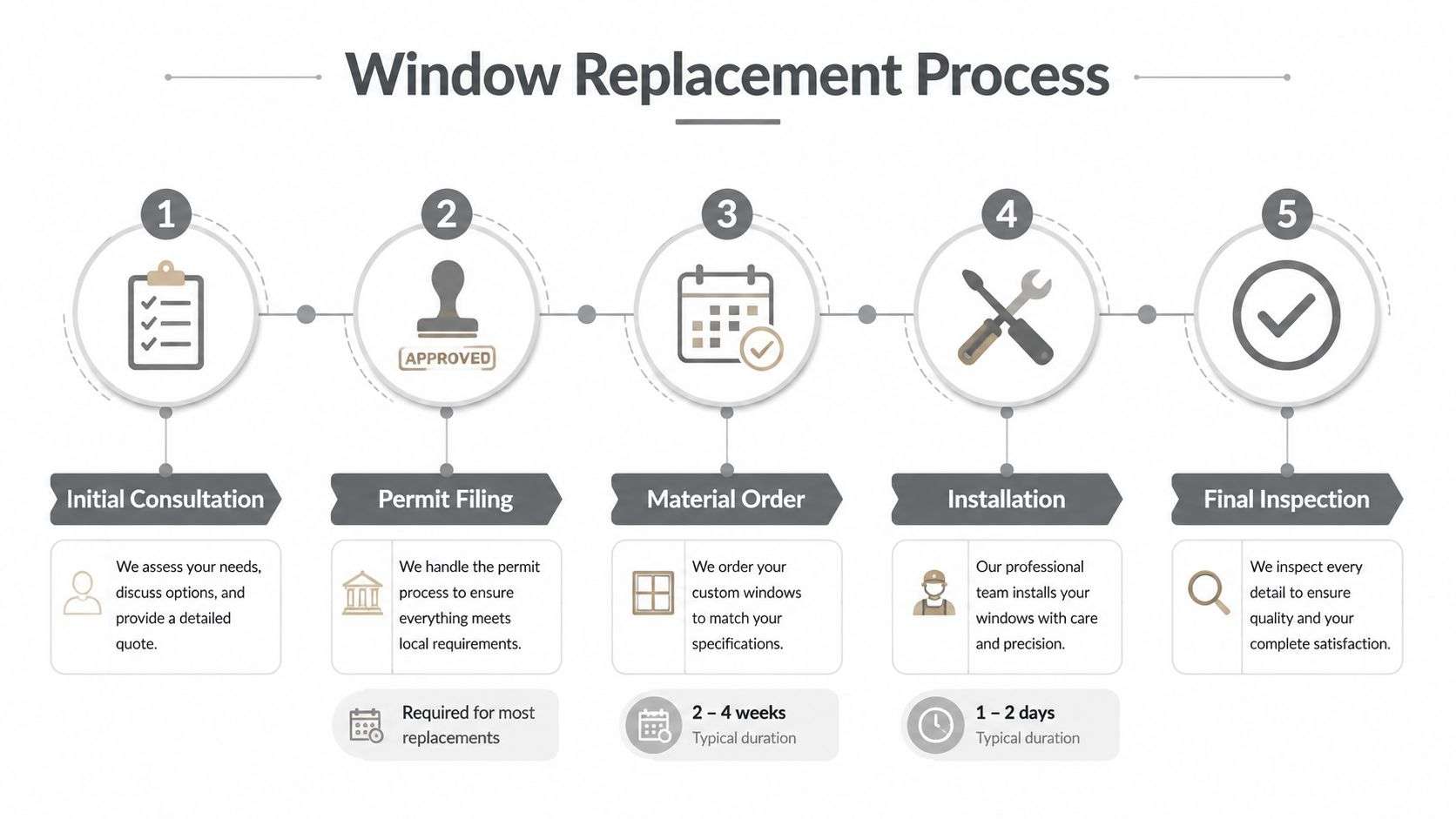
A good window project should feel orderly, not chaotic. The process starts with a measurement visit, moves through product selection, then into permits, ordering, installation, and final sign-off. If you're doing a full-home replacement, the contractor should stage the work so your house doesn't turn into a construction zone for days on end.
Permits come first when the scope crosses a line
Houston permits are commonly required when a kitchen or bathroom remodel changes structure, plumbing, gas, or electrical systems, according to Houston construction permit guidance and Houston remodeling permit guidance. For windows, the trigger is usually tied to egress, safety glazing, or storm-hardening work in older homes and remodels. The city's centralized system runs through the Houston Permitting Center and starts with an iPermits account, a building permit application, payment of plan-review fees, and plan uploads after an email invitation, as described by the Houston Permitting Center Residential Remodel Permit process.
A practical project flow
- Consultation and measurement. The contractor checks existing openings, frame condition, and any obvious rot or water damage.
- Product selection and order. You approve the window type, glass package, and finish details that fit the home.
- Permit filing. The paperwork goes in before the work that needs approval starts.
- Installation. Crews remove the old units, set the new ones, flash and seal them, then finish trim work.
- Final inspection. The project closes out after the relevant city review or sign-off.
What to expect on a real job
For standard replacements, ordering and installation usually move faster than custom or impact-rated work because special units take longer to source and coordinate. Whole-home jobs are often phased by elevation or room so the homeowner can keep living in the house without constant disruption. That's the kind of planning that keeps a project from dragging.
A contractor like H-Towne & Around Remodelers, Inc. handles window replacement as part of larger remodeling work, and that matters because permit coordination, trim repairs, and code-sensitive details often overlap with kitchen or bath projects. The smoother jobs are the ones where the paperwork, ordering, and site work are all managed together.
How to Choose a Window Replacement Contractor in Houston
The lowest bid is usually the worst filter in this market. A Houston window contractor should be judged on code knowledge, installation method, warranty clarity, and whether the crew understands how Gulf Coast weather punishes sloppy work. If the salesperson can't explain those things clearly, keep moving.
Ask the questions that expose shortcuts
Start with the basics. Is the company licensed and insured? Who handles permits? What installation method are they proposing, full-frame or pocket-fit, and why does that method suit your house? If the answers stay vague, the proposal probably is too.
The most useful checklist is the one that forces details into writing.
- Verify license and insurance: Don't let anybody into your home without both.
- Ask for local references: You want recent Houston-area work, not a vague promise.
- Request a detailed written proposal: Product model, installation scope, and finish work should all be spelled out.
- Confirm warranty terms: Frame, glass, and labor should each be clear.
- Check reviews and standing: Look for consistency, not just a handful of polished comments.
Pay attention to installation methods
In Houston, the installation method matters almost as much as the window. A full-frame replacement removes the old assembly and lets the crew inspect for hidden damage, which is why it's often the right call in older homes. Pocket-fit can be faster, but it only makes sense when the existing frame is sound.
If a contractor won't explain how the window gets sealed to the rough opening, that contractor isn't ready for Houston.
The same standard applies to weatherproofing. Ask what flashing materials they use, how they handle trim repair, and what they do when they uncover rot. A qualified team won't treat those questions as annoying. They'll treat them as normal.
Don't ignore company behavior
Look at how the company communicates before the sale. Do they answer directly, show up on time, and explain the permit process without hand-waving? That's usually the same behavior you'll get during the project. The companies that do the little things cleanly are usually the ones that do the big things right.
Verifying Installation Quality After the Crew Leaves
The truck leaving does not mean the work is finished. A new window can look clean and still leak air, carry a poor seal, or sit wrong in the opening. Check performance, not just appearance.
Walk each window in daylight
Open and close every sash. It should move smoothly, latch properly, and hold position without binding. Inspect the perimeter inside and out for clean caulk lines, tight contact, and no visible gaps between the frame and the rough opening.
Check the proof, not just the finish
Make sure the NFRC label is on the installed unit documentation or still available with the paperwork, and confirm the permit sign-off if your project required one. In Houston's hot, humid climate, a bad seal invites water intrusion, air leakage, and later warranty claims.
Practical rule: if you can see sloppy sealant, uneven trim, or a sash that drags, assume the hidden details are sloppy too.
If the job involved energy-efficiency verification, a utility-linked inspection may follow after installation. Coastal-area work should also reflect windstorm-certified installation standards. The product only performs as well as the crew that installs it. A good window with a bad install is still a bad result.
Take photos of the finished work, save the paperwork, and do not sign off until the hardware works cleanly and the finish details match the proposal. That protects the warranty and cuts off arguments later.
Frequently Asked Questions About Houston Window Replacement
Do replacement windows qualify for rebates or insurance savings? Sometimes homeowners see utility or insurance benefits tied to performance and storm-hardening, but those programs depend on the specific product, the policy, and the address. Don't assume savings, ask for written confirmation before you buy.
Should I replace all the windows at once? Not always. Phasing makes sense when the budget is tight or when one side of the house takes the worst sun and weather exposure first. A smart sequence starts with the windows that are failing fastest or causing the most discomfort.
What if the old frames are rotted or water-damaged? Then the job needs more than a simple swap. Hidden damage has to be repaired before the new unit goes in, which is one reason full-frame replacement matters in older Houston homes.
Are impact windows necessary for every home? No. Inland homes often don't need laminated impact glass if the main goal is heat control and efficiency. Near-coastal or higher-exposure properties are a different story, because wind and debris risk matter more.
How do I know the work is compliant? Check the permit paperwork, the NFRC labels, and the installation finish. If the contractor can't show you those basics, the job isn't finished in a meaningful way.
If you're ready to compare window options for your home, H-Towne & Around Remodelers, Inc. can help with replacement windows, permit handling, and the kind of Houston-specific planning that keeps a project on track. Visit H-Towne & Around Remodelers, Inc. to request a complimentary estimate and talk through the window replacement details that matter for your house.