
A lot of Houston homeowners start thinking about storm protection the same way. The forecast turns ugly, the patio furniture gets dragged into the garage, someone checks the flashlight batteries, and then the bigger question lands hard: if this storm tracks our way, is the house ready?
That's where hurricane-resistant home exterior remodeling stops being a cosmetic project and becomes a building-performance project. On the Gulf Coast, wind is only part of the problem. Houston homes also deal with wind-driven rain, heavy humidity, drainage failures, swollen trim, garage-door blow-in risk, and soil movement from clay that can stress openings and exterior joints over time.
The practical question isn't whether every upgrade sounds nice. It's what should you do first so the money goes into the parts that matter most. That means looking at the house as a system, not as a shopping list of shutters, windows, siding colors, and roofing brochures.
Beyond Shutters A Systems Approach to Hurricane Remodeling
When a storm enters the Gulf, homeowners often focus on the most visible protective item first. Usually that's shutters. Shutters can help, but they don't solve a weak roof connection, a poorly braced garage opening, failed sealants, or siding details that let water drive behind the wall assembly.
Professionals look at two things first: the building envelope and the continuous load path. The envelope is the shell of the home, roof, walls, windows, doors, and the transitions between them. The load path is how wind forces move from the roof down through the framing and into the foundation.
Why isolated upgrades disappoint
A new impact-rated window installed into a weak wall assembly can give a false sense of security. Strong glass doesn't fix poor anchorage. New siding doesn't compensate for a roof edge that can lift. A reinforced front door doesn't help much if the garage door folds and the house pressurizes from the inside.
Practical rule: Fix the parts that hold the house together before you spend heavily on the parts that make it look upgraded.
This systems mindset isn't just contractor talk. In hurricane-prone Florida, new homes in 120+ mph wind zones must have exterior impact protection, which reflects how modern codes have moved toward a continuous, code-compliant exterior protection system where the envelope acts as the first line of defense, as described in hurricane protection guidance.
That same logic applies in Houston, even though the local conditions differ. Here, homes also fight moisture for months after the storm passes. If humid air and water get into wall cavities, attic spaces, or trim transitions, the damage keeps going long after the wind stops.
What a system looks like on a real house
A proper exterior hardening plan usually works through these layers:
- Structure first. Roof connections, roof deck attachment, framing continuity, garage opening reinforcement.
- Water control second. Flashing, drainage plane, siding details, roof edge, soffit integrity, drainage away from the slab.
- Openings third. Windows, exterior doors, garage doors, and their anchoring details.
For homeowners planning a broader renovation, storm-hardening can be folded into a larger exterior or whole-home scope instead of treated as a separate emergency purchase. That's often the smarter route if you're already evaluating remodeling services for a Houston home.
If you remember one thing, remember this: the house survives as an assembly. Shutters are one part of that assembly. They are not the assembly.
Prioritizing Your Remodel Where to Invest First for Max Impact
If your budget won't cover everything at once, don't split money evenly across flashy upgrades. Put it where failure starts. On most homes, that means fixing the bones before the skin.
Many homeowners need a risk-based retrofit sequence that prioritizes the roof-to-wall load path, openings, and water management before cosmetic upgrades. A common mistake is replacing siding or windows while ignoring weaker roof connections or garage doors, which can still lead to failure, as noted in this hurricane retrofit guidance.
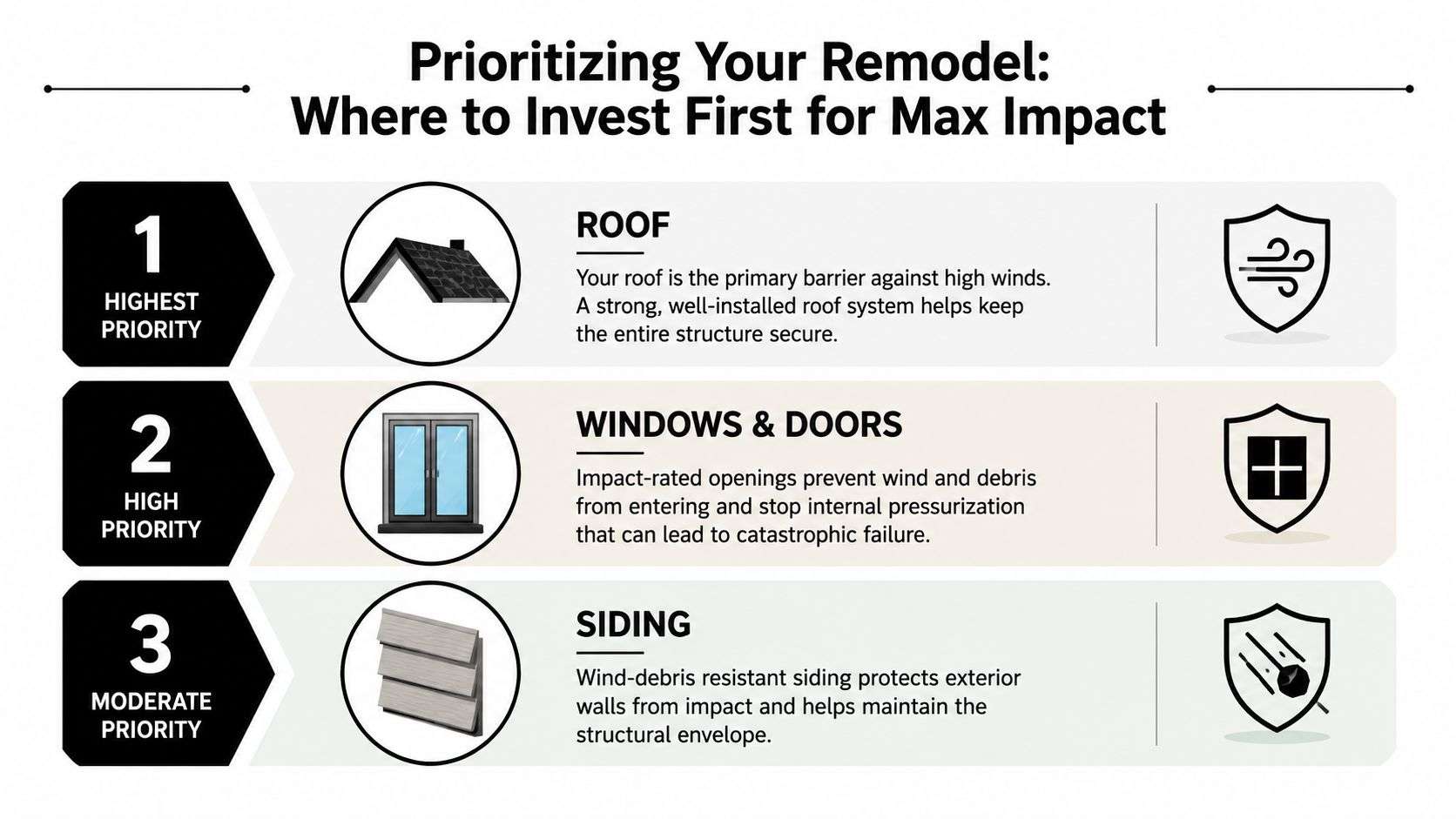
Start with what keeps the roof attached
If the roof assembly loses its grip, the rest of the remodel won't matter much. This is why the first dollars should often go into items that homeowners rarely see once the project is done.
Roof-to-wall connections
Hurricane straps, clips, and connector upgrades matter because they tie the top of the house into the wall system. On older homes, these details may be inconsistent, undersized, or hidden behind repairs from previous reroof work.
Roof deck fastening
The decking has to stay attached under suction and repeated pressure changes. This is not just a materials question. It is an installation question involving fastening pattern, edge conditions, and whether the assembly is being upgraded as part of a reroof.
Garage door reinforcement
In Houston neighborhoods with wide suburban garage openings, this is one of the most overlooked weak points. A failed garage door can change the pressure inside the house fast, and then everything above it is under more stress.
Then deal with water, not just wind
Houston storms punish houses in two ways at once. Wind tries to pull assemblies apart, while rain tries to find every shortcut into the wall and attic.
That's why the second tier of spending should go toward moisture management:
- Roof drainage details that move water off cleanly
- Flashing corrections at roof-to-wall intersections, windows, and penetrations
- Siding transitions that don't trap water behind trim
- Grading and runoff control around the slab, especially on expansive clay soil
If your siding looks tired but your drainage is wrong, fix the drainage first. Wet walls and slab-edge moisture create damage you often don't see until trim rots, paint fails, or floors begin to react.
Openings come after the shell is credible
Windows and doors matter, but they should be installed into a house that is already structurally and moisture-wise ready for them. Otherwise, you pay premium-window prices and still leave major failure points untouched.
A simple way to think about priorities is this short checklist:
| Priority | What to evaluate first | Why it comes first |
|---|---|---|
| 1 | Roof attachment and framing continuity | It protects the whole structure |
| 2 | Garage door and roof drainage details | These are common real-world failure points |
| 3 | Wall water management and siding assembly | Houston rain exploits weak transitions |
| 4 | Windows and exterior doors | Best value after the shell is sound |
That isn't glamorous advice. It is usually the right advice.
Fortifying the Building Envelope Roofs and Siding
Your roof and siding cover most of the house, so they do most of the work. If either one is treated as a finish-only decision, the remodel underperforms.
According to NOAA findings cited in industry guidance, roof failures account for about 40% of total hurricane damage in coastal areas, and homes built or upgraded to FORTIFIED standards can reduce storm-related damage by up to 70%, according to this hurricane-resistant home resource. Those numbers are why roof work belongs near the top of the list, not near the end.
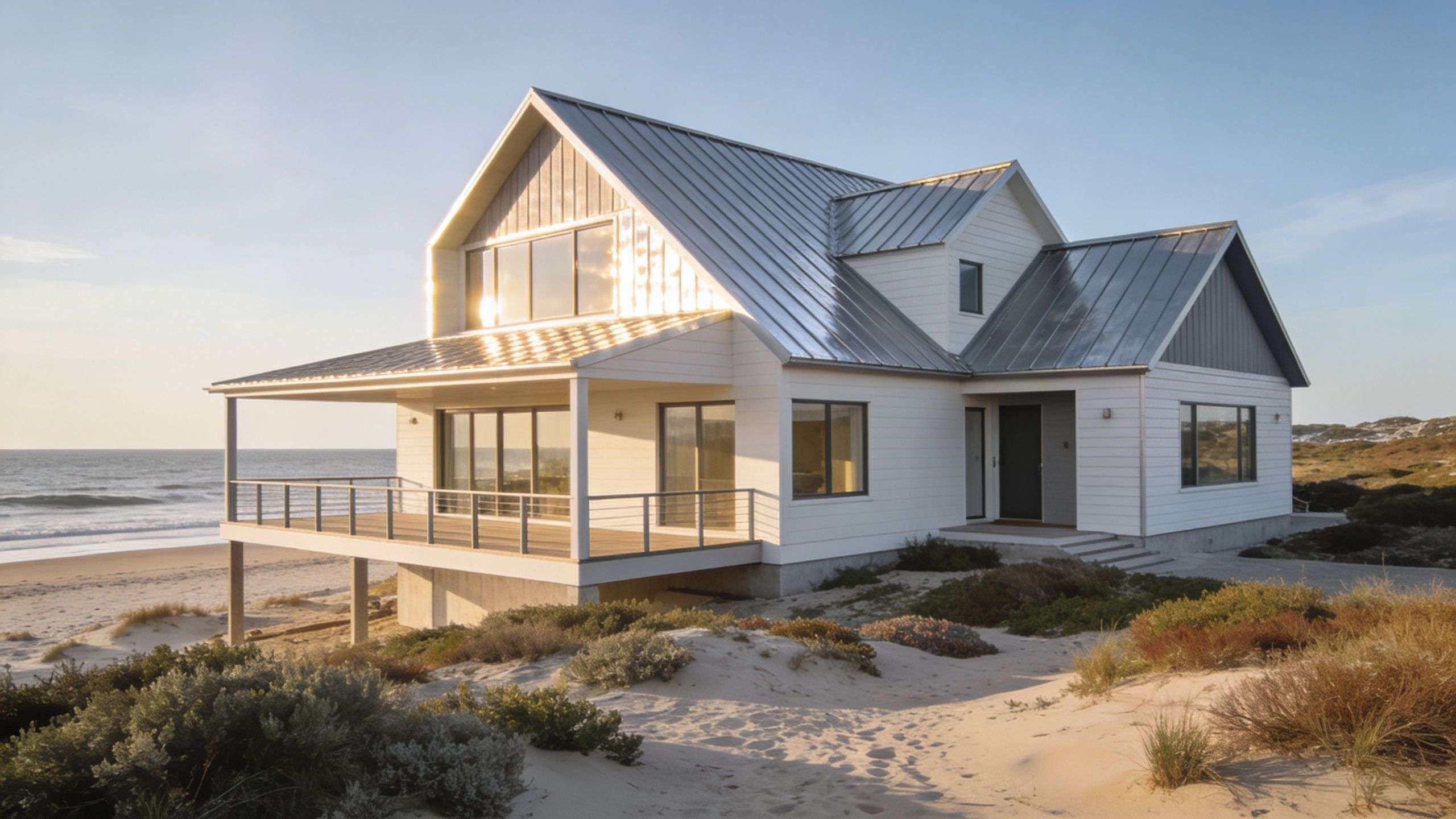
Roofing choices that make sense on the Gulf Coast
Not every roof that looks good in Houston performs well in a hurricane. Shape, fastening, edge detailing, underlayment, and penetrations matter as much as the top-layer material.
A few practical observations:
- Hip roofs generally perform better than gable-heavy layouts because they present fewer vulnerable vertical ends to direct wind pressure.
- Standing-seam metal roofs can be a strong choice when the whole assembly is engineered and installed correctly. They shed water well and can perform well under coastal conditions.
- Asphalt reroofs can still be part of a strong system if the deck attachment, underlayment, edge metal, and vulnerable transitions are upgraded rather than reused carelessly.
For low-slope areas, additions, porch covers, and certain tie-in conditions, homeowners sometimes look at spray polyurethane foam roofing because it can create a continuous sealed surface on the right assembly. It isn't a universal answer, but on specific roof geometries it can be a useful part of a moisture-control strategy.
A hurricane-resistant roof isn't one product. It's decking, fasteners, underlayment, edge securement, penetration flashing, and the way each part is tied to the next.
Siding has to resist water as much as impact
Houston's humidity changes the siding conversation. Wind resistance matters, but so does drying potential. A siding product that traps water behind it or depends on perfect caulk forever is asking for trouble.
Here's a practical comparison:
| Siding option | What it does well | Where contractors have to be careful |
|---|---|---|
| Fiber cement | Durable finish, solid appearance, useful in wet climates when detailed well | Clearance, flashing, cut-edge treatment, fastening |
| Engineered structural sheathing with cladding system | Better whole-wall performance when part of a full rebuild | Design coordination and installation sequencing |
| Vinyl systems | Lower maintenance appearance for some homes | Wind performance varies, and poor installation can rack or detach |
| Masonry or reinforced wall systems | Strong durability and impact resistance | Weight, structural implications, and cost |
Houston-specific trouble spots
On a lot of local homes, failure doesn't start in the field of the siding. It starts where one trade handed off to another. Roof-to-wall kickout flashing. Belly bands. Window head flashing. Penetrations for hose bibs, lights, vents, and outdoor kitchens. Those details decide whether the wall stays dry.
Clay soil adds another issue. Seasonal movement can stress caulk joints and window perimeters. That means remodelers can't rely on sealant alone. The wall needs proper lapping, drainage, and a path for incidental water to get out.
Securing Your Home's Weakest Points Windows Doors and Garage
Once the roof and wall system are being handled correctly, openings become the next decision. Many homeowners often spend first on these, as the upgrades are visible. The better move is to spend here after the structural and water-management work is credible.
A high-impact remodel should be sequenced to upgrade the load path first, then the envelope, then the openings. If the roof deck or wall-to-roof connection remains weak, internal pressurization from a broken window can still drive structural failure, which makes a window-only upgrade less effective, according to this insurance industry report on storm-resistant construction.
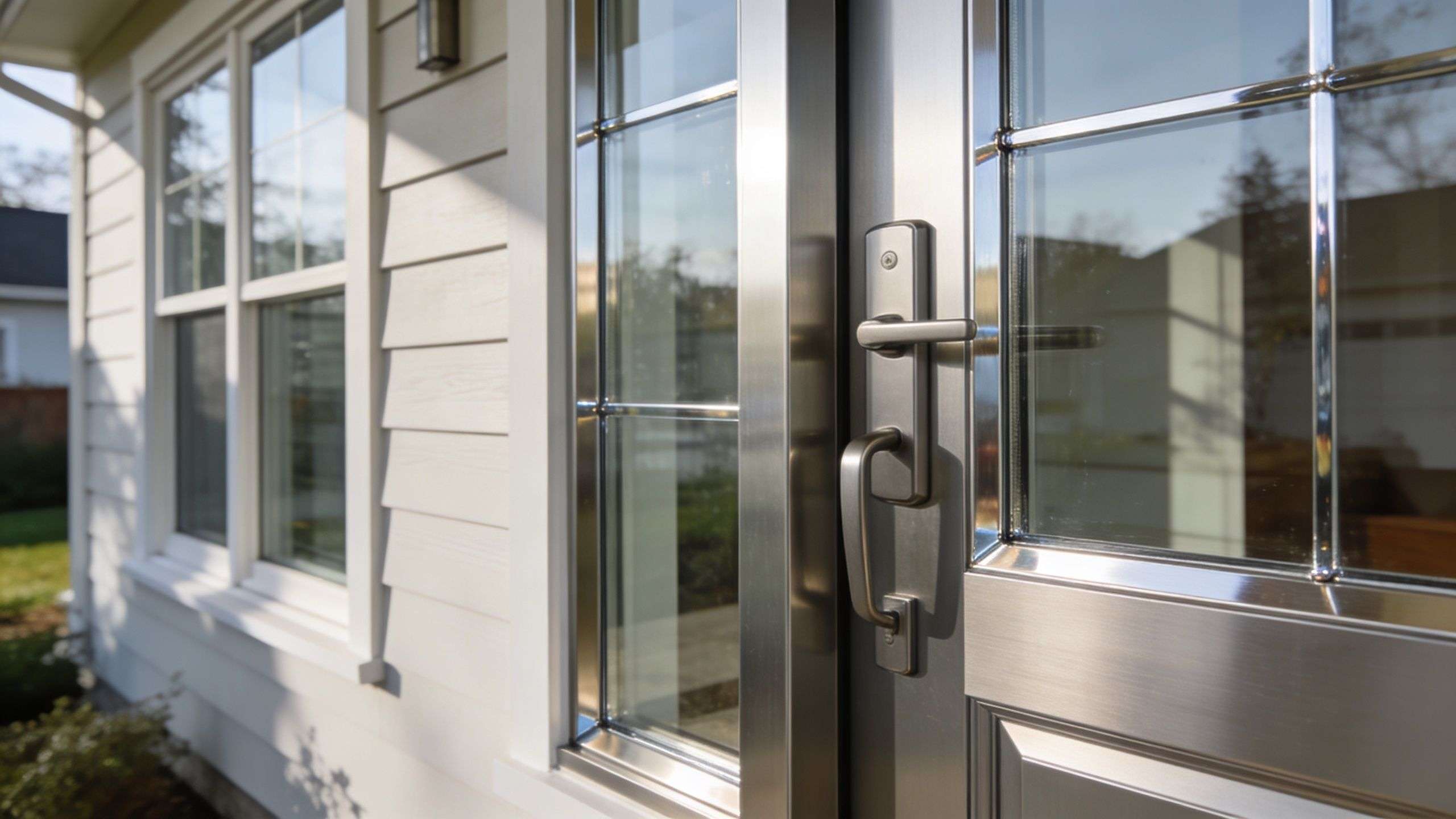
Impact windows versus shutters
Homeowners usually ask which is better. The honest answer is that each solves a different problem in a different way.
| Option | Main advantage | Main trade-off |
|---|---|---|
| Impact-rated windows | Always on duty, no setup before a storm, cleaner appearance | Higher upfront cost, installation quality is critical |
| Shutters or storm panels | Lower entry cost in many cases, useful for targeted protection | You have to deploy them, store them, and maintain hardware |
| Mixed strategy | Spend on key windows, protect others with shutters | Requires planning so protection is consistent |
Impact windows make sense when you're already replacing old units, correcting rotten framing, or doing a larger exterior renovation. Shutters make sense when the windows are in decent condition and the budget has to be staged carefully. The mistake is assuming either one can make up for weak anchorage or poor wall conditions around the opening.
Exterior doors need more than heavy glass
A front door unit has to be evaluated as a full assembly. That includes the slab, frame, hinges, anchoring, threshold, and the condition of the surrounding framing. A thick decorative door with weak fastening is still a weak point.
Back patio doors deserve extra scrutiny in Houston because they often open to exposed yards, pool decks, or wind corridors between houses. If they leak, rack, or flex now, they're already telling you something.
Don't ignore the garage door
The garage door is one of the biggest single openings in many Gulf Coast homes, and it often gets the least respect during remodeling. Standard doors can bow, rack, or fail under pressure if they weren't selected or reinforced for storm conditions.
For homeowners comparing options, Danny's Garage Door Repair hurricane guide is a useful overview of what to look for in a hurricane-rated garage door assembly. It helps frame the right questions before you buy on appearance alone.
A good garage-door conversation should include:
- Track and hardware strength so the door stays guided under load
- Panel reinforcement if the existing system is being upgraded
- Opener and locking behavior during severe weather preparation
- Attachment to the surrounding framing, not just the door itself
If you want to see how different exterior upgrade types come together on real remodels, a local project portfolio of Houston-area renovations can be useful for comparing practical design choices, not just finish selections.
Navigating Houston Codes Costs and Finding the Right Contractor
After a storm, a lot of Houston homeowners make the same mistake. They replace the damaged surface and leave the weak assembly underneath. The new shingles look fine, the new door looks stronger, and the house is still vulnerable at the attachment points, flashing, and framing.
That is why code, scope, and contractor selection matter as much as the products you buy. In Houston, exterior remodeling often overlaps with reroof work, structural repair, drainage correction, and sometimes flood recovery. Clay soil movement can throw openings out of square. Year-round humidity punishes bad flashing details. A contractor who only talks about product brands is missing the job.
Installation quality decides whether the upgrade works
Analysts cited in MIT News coverage of hurricane-resistant construction research found that stronger construction methods are often undervalued because performance depends on the full assembly, not just the rated product.
That matches what we see on real remodels. A high-rated window can still leak if the opening is out of square or the flashing sequence is wrong. New siding installed over wet or damaged sheathing can trap moisture and shorten the life of the wall. A reinforced roof covering does not fix weak decking attachment.
The label sets the ceiling. The installer sets the floor.
Houston code and permit issues are part of the risk calculation
Permits are not just paperwork. They are one of the few checks that force the scope to be defined, reviewed, and inspected. That matters when a project includes roof replacement, garage opening reinforcement, reframing around windows and doors, or repairs tied to prior storm damage.
Houston-area homes also bring conditions that change the scope after demo starts. Settlement cracks may be cosmetic, or they may point to movement that affects door alignment, window performance, and water entry. Older homes can hide rot at roof edges, failed flashing at wall transitions, or framing damage around openings. If storm exposure has already caused interior or structural problems, a contractor with experience in storm and flood damage restoration in Houston homes can connect the exterior work to the repairs behind it instead of treating them as separate jobs.
Questions to ask before you sign
Ask direct questions. Good contractors should answer them without dodging.
- Who pulls the permits, and what inspections will this scope require?
- How will you verify roof-to-wall, opening, and garage framing attachment before covering it up?
- What is your flashing and water-management plan at windows, doors, trim, roof edges, and material transitions?
- How do you handle Houston clay movement when openings are out of square or sealant joints have failed?
- What hidden-condition allowances are included if sheathing, framing, or substrate repairs show up after demolition?
- What gets documented with photos, manufacturer instructions, and inspection records?
- What work is self-performed, and what work is subcontracted?
If the conversation stays on finishes, color samples, and brochure claims, keep shopping.
Cost planning should follow failure points
Homeowners usually ask for one number. That is not how these projects behave in the field. The actual budget is driven by what has to be corrected so the house performs as a system.
Start with the work that keeps the shell intact:
- Structural correction, roof attachment, and framing repair
- Water management, flashing, and substrate repair
- Window, door, and garage opening upgrades
- Finish restoration and appearance work
That order matters on a real-world budget. Spending heavily on appearance before fixing attachment, drainage, or framing is how money gets wasted.
H-Towne & Around Remodelers, Inc. is one Houston company that handles broader renovation scopes, permit coordination, and storm-related repair work. That kind of range matters when a hurricane-hardening project overlaps with interior repairs, additions, or flood restoration.
Maintaining Your Fortress A Plan for Before and After the Storm
A hardened exterior still needs upkeep. Houston heat, UV exposure, humidity, and slab movement work on the house every season, not just during named storms. The best remodel in the neighborhood can lose performance if seals fail, drainage paths clog, or hardware corrodes.
Before storm season
Keep the checklist simple and repeatable.
- Inspect sealants and joints around windows, doors, trim, and penetrations. Look for shrinkage, separation, and cracking.
- Clear drainage paths at gutters, downspouts, splash blocks, drains, and swales so water leaves the house quickly.
- Check roof edges and visible flashing for displacement, loose sections, or signs of repeated leakage.
- Test shutters or panel hardware if you use them. Missing fasteners on installation day create avoidable problems.
- Review the garage door for smooth travel, bracket condition, and any visible looseness in tracks or framing.
After a storm
Don't limit the inspection to obvious damage. A house can take water without showing dramatic exterior failure.
Walk the property carefully and look for:
- Lifted roofing or edge movement
- Wet soffits, staining, or drips in the attic
- Cracked caulk joints at openings
- Binding doors or windows that suddenly operate differently
- Water marks at baseboards or around garage walls
- Erosion or standing water near the slab after drainage overload
Small post-storm clues matter. A stiff back door, a damp garage corner, or a lifted shingle edge can point to a larger assembly problem.
If the house took on water or wind damage, move quickly on documentation and repairs. A contractor that handles storm and flood damage restoration in the Houston area can help assess hidden damage before minor issues turn into mold, framing deterioration, or repeated leaks.
The goal isn't to make the house invincible. The goal is to make it harder to damage, easier to dry, and less likely to fail at the weakest point.
If you're planning exterior upgrades with storm performance in mind, H-Towne & Around Remodelers, Inc. can help you evaluate the house in the right order, from structural weak points and moisture control to window, door, and restoration scopes. That's especially useful when your exterior project overlaps with a kitchen remodel, bathroom remodel, whole-home renovation, or post-storm rebuilding work in the Greater Houston area.