
So you’re ready to finally tackle that remodel. Whether it’s dreaming up a chef’s kitchen, a spa-like master bath, or a full-home transformation, the excitement is real. But that energy can come to a screeching halt the moment someone mentions Houston construction permits. Suddenly, the project feels overwhelming.
Don't let it. I've seen homeowners get tangled in red tape, and I've also seen how a little bit of knowledge can make the whole process feel straightforward.
Your Guide to Houston Construction Permits
Let's get one thing straight: a construction permit isn't just a piece of paper or a bureaucratic headache. Think of it as your project's insurance policy. It's the official confirmation from the city that your plans are safe, structurally sound, and won’t cause problems for you down the road.
Skipping this step is one of the costliest mistakes you can make. It can lead to city-issued stop-work orders, hefty fines, and major roadblocks when it’s time to sell your house.
This guide is designed to be your roadmap. We're going to break down the entire system, turning confusing regulations into simple, clear steps.
Why Permits Matter for Your Remodel
Getting the right permit is about so much more than just following the rules; it’s about protecting your biggest asset—your home. For any significant upgrade, a permit ensures the work meets Houston's building codes for everything from electrical safety and plumbing function to structural integrity.
A study of construction projects found that 46% of delays were caused by permitting issues alone. Proper planning isn't just helpful—it’s essential for keeping your project on time and on budget.
Without that official approval, you risk the nightmare scenario: being forced to tear out beautifully finished work just for an inspection. A properly permitted remodel, on the other hand, solidifies your home’s value and gives you genuine peace of mind.
What This Guide Will Cover
We've spent years helping Houston homeowners bring their visions to life without the stress of navigating the permit office alone. You can learn more about our approach to remodeling in the Houston area and see how we handle these details for every client.
Here’s what we’ll walk through in the sections below:
- When a Permit is Required: We’ll give you clear guidelines for kitchens, bathrooms, and whole home remodels.
- Navigating Jurisdictions: You’ll learn the crucial differences between the City of Houston, Harris County, and other local municipalities.
- The Application Process: A step-by-step look at how to submit plans and what the city expects from you.
- Common Pitfalls: We'll share the most common mistakes that derail timelines and blow up budgets, and how you can avoid them.
By the time you're done reading, you’ll have the confidence and know-how to tackle your project the right way, from the ground up.
When Do You Need a Permit for Your Houston Remodel?
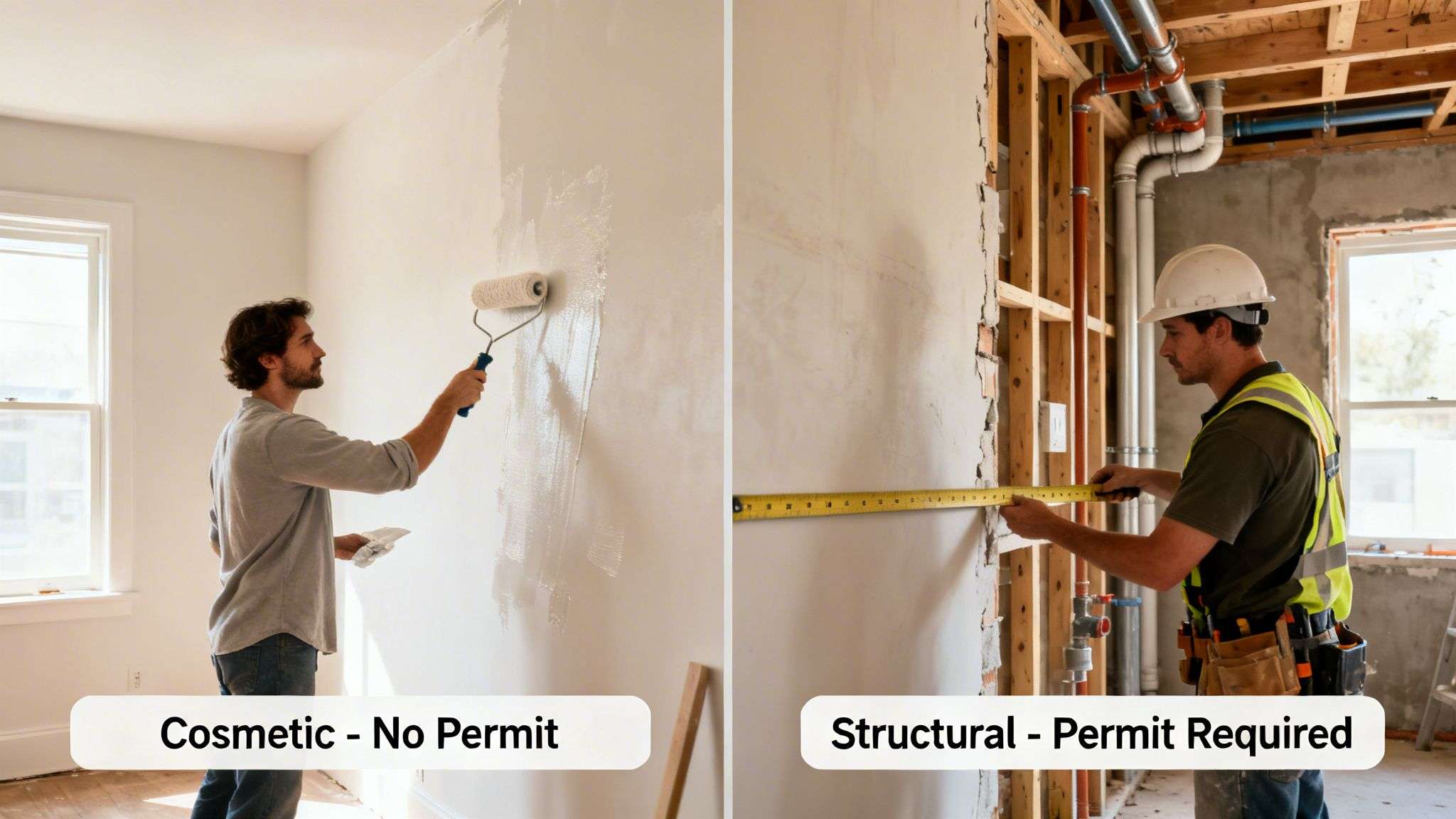
This is the first question every single Houston homeowner asks before starting a project, and the answer can feel a little murky. But after 20 years in this business, I’ve found a simple rule that clears things up almost every time.
Think of it this way: are you changing your home’s bones or just its outfit? Anything that touches the structure, electrical, or plumbing systems—the bones—is going to need a Houston construction permit. If you're just updating the outfit with cosmetic changes, you're usually in the clear.
A permit is basically a third-party safety check. It ensures that any changes to your home's critical systems are done correctly and to code, protecting both your family and the long-term value of your property.
Getting this right from the start is crucial for your budget and timeline. Let’s break down what this means for the primary remodeling projects we focus on in Houston: kitchen remodeling, bathroom remodeling, and whole home remodeling.
Kitchen Remodeling Permit Guidelines
Everyone wants a new kitchen, but whether you need a permit depends entirely on how deep you're going. If you're just giving the space a facelift, you can likely skip the trip to the permitting office.
No Permit Typically Needed For:
- Painting cabinets or walls: A fresh coat of paint is purely cosmetic.
- Replacing countertops: As long as you aren't moving the sink, this is a simple surface swap.
- Installing new flooring: New tile, wood, or vinyl doesn't alter your home’s core structure.
- Swapping out a faucet: A direct, one-for-one replacement using the existing plumbing is considered basic maintenance.
But the moment your plans involve moving, adding, or re-routing those core systems, you’ll need a permit. This is where most full-scale kitchen renovations land.
Permit Almost Always Required For:
- Relocating a sink or dishwasher: This involves cutting into walls to change plumbing supply and drain lines, which absolutely must be inspected.
- Adding or moving electrical outlets: Running new wires for an island or under-cabinet lighting requires an electrical permit to ensure it’s done safely.
- Removing or moving walls: Taking down a wall to create an open-concept living area is a major structural change that demands a building permit.
- Installing new lighting: If you're adding recessed cans or pendant lights where none existed before, you're running new electrical circuits and will need a permit.
Bathroom And Whole Home Remodeling Permits
The exact same logic applies to bathroom projects and larger whole home renovations. Cosmetic updates are one thing; touching the guts of the house is another.
In a bathroom, for example, replacing a toilet or a vanity in the same spot is fine. But the second you decide to rip out a tub to create a beautiful walk-in shower or move the toilet to a different wall, you’re altering plumbing drains and water lines. That means it’s permit time.
For whole-home remodels, permits are pretty much a guarantee. These projects almost always involve a combination of structural work, significant electrical rewiring, and major plumbing adjustments. Adding new square footage is also a major trigger. If you're looking to expand, it's smart to get familiar with the requirements for Houston room additions, as those have their own specific permitting needs.
Houston Remodeling Permit Cheat Sheet
To make it even clearer, I’ve put together this quick cheat sheet. It covers some of the most common tasks we handle for kitchen, bathroom, and whole home remodels and whether a permit is typically required by the City of Houston.
| Remodeling Task | Permit Typically Required? | Why It's Required |
|---|---|---|
| Moving an interior wall | Yes | Changes the structural load and floor plan of the home. |
| Replacing a light fixture | No | A simple fixture swap using existing, approved wiring. |
| Adding a new bathroom | Yes | Involves all three: new plumbing, electrical, and framing. |
| Painting interior walls | No | Purely cosmetic and doesn't impact any of the home's systems. |
| Installing a new HVAC system | Yes | Involves mechanical and electrical systems that must meet code. |
| Refinishing wood floors | No | A surface-level cosmetic job. |
This table should give you a solid starting point, but remember that every project is unique. The best first step is always to have a conversation with a professional who knows the local codes inside and out.
Navigating Jurisdictions: City of Houston vs. Harris County
One of the first, and biggest, stumbling blocks for homeowners planning a remodel isn't the work itself—it's figuring out who on earth actually issues your Houston construction permits. The greater Houston area is a classic Texas patchwork of different governing bodies, and getting this step wrong is like trying to navigate I-610 during rush hour with a blindfold on. It’s a surefire way to get lost and cause major delays.
Think of it this way: your property address determines which rulebook you play by. A kitchen remodel inside the official City of Houston limits is handled by the Houston Permitting Center. But if your home is in an unincorporated area like Cypress or parts of Katy, your project falls under Harris County's completely separate set of rules.
This distinction is absolutely critical. The documents you need, the inspection schedule, and even the specific building codes can change dramatically from one jurisdiction to the next.
How to Pinpoint Your Correct Jurisdiction
Before you can even dream of swinging a hammer, you have to know for certain which government entity has authority over your property. Submitting your plans to the wrong office is a rookie mistake we see all the time, and it costs homeowners wasted time and non-refundable application fees.
The single most reliable way to find this information is by using the Harris County Appraisal District (HCAD) website. Every single property in the county has a detailed record that lists all its taxing jurisdictions.
Here’s how we do it:
- Head over to the HCAD website and search for your property by address.
- Once you’ve pulled up your property’s profile, look for a section called "Jurisdictions" or "Taxing Units."
- If you see "City of Houston" listed, your permits will go through the Houston Permitting Center.
- If you don't see the City of Houston but do see "Harris County," you’re in an unincorporated area and will work with the county's engineering department.
- If you see a different city name, like "Bellaire" or "West University Place," that city's own permitting office is your starting point.
City vs. County: A Tale of Two Remodels
To make this crystal clear, let's imagine two identical whole-home remodels. One is a classic 1940s bungalow in Montrose, and the other is a spacious home out in Cypress.
The Montrose Bungalow (City of Houston):
- Permitting Authority: Houston Permitting Center on Washington Ave.
- Process: The homeowner's contractor submits detailed architectural and structural plans electronically through the city's online portal.
- Key Considerations: The plans will be heavily scrutinized for compliance with City of Houston amendments to the building code. If the home is in a historic district, another layer of review kicks in. All inspections for plumbing, electrical, and framing are scheduled directly through the city's system.
The Cypress Home (Unincorporated Harris County):
- Permitting Authority: Harris County Engineering Department.
- Process: The application process here might have different documentation needs. We often see a bigger focus on things like lot drainage, floodplain compliance, and septic systems.
- Key Considerations: While the core building codes are similar, Harris County has its own rules about property line setbacks and utility easements. Their inspection scheduling and procedures are handled through the county’s separate system, which operates differently from the city's.
While the core safety standards are based on the same international codes, the administrative journey—the paperwork, the people you talk to, and the specific local rules—is a completely different ballgame.
Key Takeaway: Never assume the rules are the same, even for neighborhoods that feel like they're right next to each other. Always verify your jurisdiction through HCAD before you do anything else.
Doing this homework up front saves you the massive frustration of being told weeks into the process that you've applied to the wrong place and have to start all over from scratch. And with the amount of construction happening, these offices are busier than ever.
The dollar volume of Houston's construction contracts tells the story of massive investment pouring into our region. In 2026, Dodge Data & Analytics clocked a staggering $43.8 billion in contracts awarded across the Houston area—a 31% jump from $33.3 billion in 2025. With Harris, Fort Bend, and Montgomery Counties making up 90% of this activity, knowing your specific jurisdiction is more important than ever. You can learn more about the scale of this growth by reviewing recent Houston building permit data.
The Permit Application Process Step by Step
Alright, let's break down the journey of getting your Houston construction permits approved. It might seem like a maze of red tape, but if you approach it as a series of clear, logical steps, it becomes much less intimidating. This is your practical roadmap, showing you exactly what to expect from start to finish.
Your trip begins long before you talk to a city official. It starts with gathering all your essential documents—this is the foundation for a successful application. This isn’t just about filling out a form; it’s about painting a complete, professional picture of your project for the plan reviewer.
Step 1: Assemble Your Permit Application Package
Before you can submit anything, you need a complete set of documents. Think of this package as the instruction manual for your renovation. It needs to tell the city reviewer everything they need to know about what you're changing and how you plan to do it safely and up to code.
For most residential projects like a kitchen or bathroom remodel, your application will need a few core components:
- Detailed Construction Plans: These are the heart and soul of your application. You'll need professional drawings that show every proposed structural, electrical, and plumbing change. For a kitchen remodel, this means detailing the new locations for outlets, light fixtures, sinks, and any walls you plan to move.
- Site Plan: This is an overhead, bird's-eye view of your entire property. It shows your home's footprint, property lines, and any other structures on the lot. It's absolutely crucial for additions or any work that might affect setbacks or how much of your lot is covered.
- Engineering Reports: If your whole home remodel involves serious structural changes—like removing a load-bearing wall to create that dreamy open-concept living area—you'll almost certainly need a report from a licensed structural engineer to prove the house will remain stable.
Submitting vague or incomplete plans is the number one reason we see permits get delayed. A professional remodeler knows exactly what details the city is looking for, which prevents that frustrating back-and-forth.
Step 2: Navigate the Houston Permitting Center Portal
Once all your documents are in order, it's time for the official submission. The vast majority of Houston construction permits are now handled electronically through the Houston Permitting Center's online portal. This system is the central hub where your application will live from submission to approval.
Here's the typical workflow you can expect:
- Account Creation and Submission: You or your contractor will create an account and upload all the plans and documents you've prepared.
- Fee Payment: Application fees are usually based on your project's total value. For example, a $20,000 bathroom remodel might have a permit fee of around $200. These fees have to be paid before any review will start.
- Plan Review: Now comes the waiting game. A city plan reviewer will meticulously check your submission against all current building codes. Simple projects might sail through in a few days, but more complex remodels can easily take several weeks.
- Revisions and Resubmission: It's very common for reviewers to come back with questions or request clarifications. An experienced contractor anticipates these potential issues and can respond quickly to keep the process moving forward.
- Permit Issuance: Once the reviewer is satisfied and gives their approval, the permit is officially issued. Only then can construction work legally begin.
This digital process is where having a seasoned pro in your corner becomes invaluable. At H-Towne Remodelers, we manage all the paperwork, track the application's status, and handle every piece of communication with the permitting office. It’s a key part of how we deliver a seamless experience, which you can learn more about in our remodeling services.
Visualizing the First Steps
This simple flowchart lays out the very first decision you need to make: figuring out which office to even talk to. As we covered before, getting the jurisdiction right is step zero.
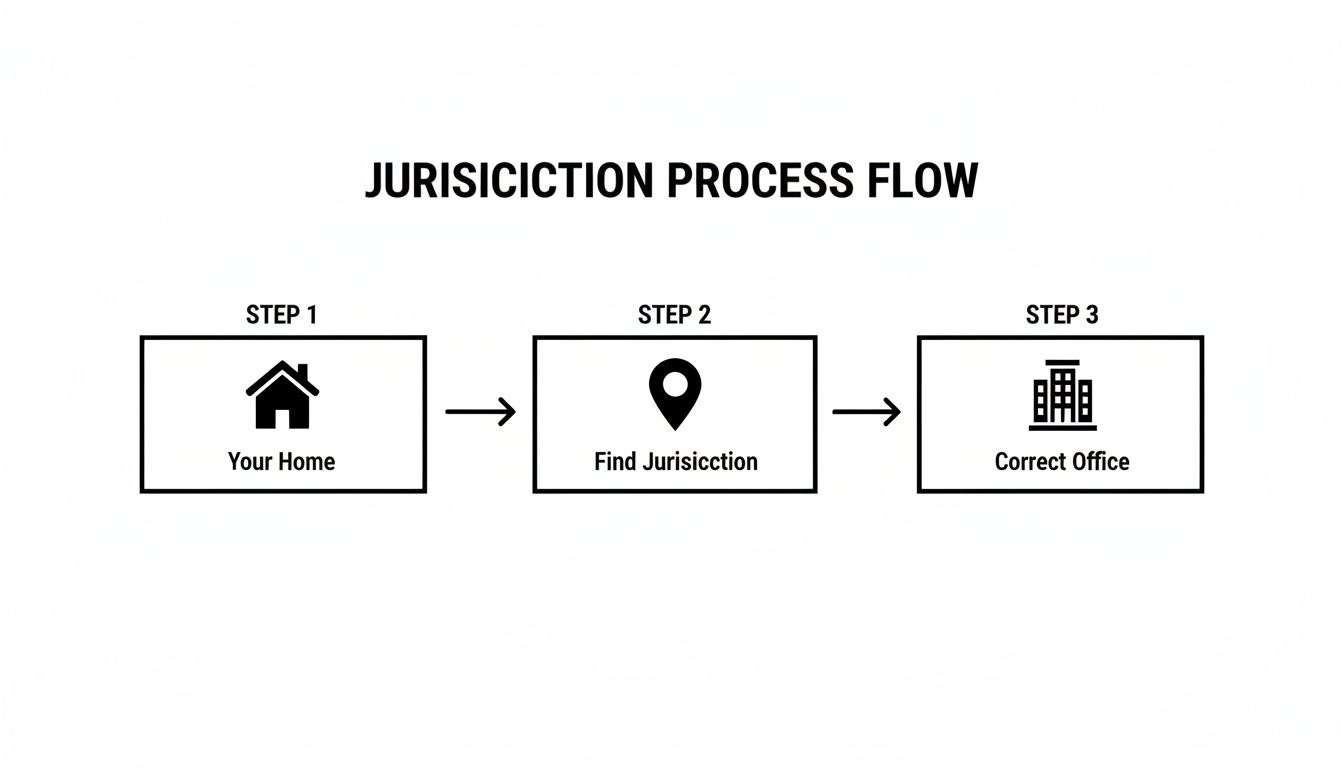
This visual really drives home why you need to identify your jurisdiction before you even think about putting your application documents together.
Understanding the Bigger Picture
The meticulous nature of this process makes a lot more sense when you see the sheer volume of construction happening across our region. Texas and Houston consistently lead the nation in building permit statistics. Nationwide in 2026, single-family permits rose 6.7%, but Texas was the undisputed leader with 158,121 permits issued—a 5.5% increase year-over-year.
The Houston metro area cemented its spot at the top with 75,786 total permitted units in 2025. For homeowners, these numbers translate directly into real opportunities. Every permitted project is a chance to build significant, lasting value in your property. You can discover insights on building permits by state and see just how active our market is.
Common Permit Pitfalls and How to Avoid Them
Trying to navigate the world of Houston construction permits can feel like you’re walking a tightrope. Make one wrong move, and your whole project can get hit with delays that drain your wallet and your patience. I've seen it happen dozens of times over the years.
The best defense is knowing the common traps before you fall into them. Think of it this way: you wouldn't head out on I-10 for a road trip without checking your gas and tires first. The same logic applies here—a little preparation goes a long way in keeping your remodel on track.
The #1 Permit Killer: Incomplete Plans
If there’s one mistake I see more than any other, it’s submitting vague or incomplete drawings to the city. The folks at the plan review office have one job: to make sure every single part of your project is up to code and safe. If your plans are fuzzy, they can’t sign off. Period.
A "good enough" sketch might show the general idea of a new kitchen layout. A professional plan, the kind that gets approved, details everything:
- The exact location of every new outlet, switch, and light fixture.
- The precise path of the new plumbing lines for that island sink you want.
- The specific materials, lumber sizes, and engineering for any wall you’re removing.
The Pitfall: Handing the city a set of napkin sketches and hoping for the best.
The Solution: Invest in professional plans from an architect, a designer, or a remodeler like us. These drawings are the language the city understands. They prevent the frustrating back-and-forth that grinds a project’s momentum to a halt.
This is non-negotiable for bigger jobs like a whole home remodel, where the electrical, plumbing, and structural blueprints have to line up perfectly.
Forgetting You Live in Houston
Houston isn’t Dallas or Austin. Our local environment throws some unique curveballs, and our building codes are written to handle them. Two of the biggest are our windstorm and floodplain regulations. Ignoring them is a surefire way to get your permit application stamped "REJECTED."
For example, if your home is in a designated windstorm area, you can’t just use standard materials. The code will demand things like enhanced roof decking and impact-resistant windows. If you’re in a floodplain, there are strict rules about how high your foundation must be to protect against future flooding.
This is a massive deal in a city that’s growing as fast as ours. Just look at the numbers: in 2025, the Houston metro area led the entire nation by issuing permits for 75,786 new housing units. With that much construction happening, you can bet the permit offices are laser-focused on enforcing these critical local codes. You can explore more about Houston's housing permit trends to see just how busy things are.
Confusing HOA Rules with City Law
This is a huge one that trips up so many homeowners. You have to understand that your Homeowners Association (HOA) and the City of Houston are two separate entities with two totally different jobs. You need a green light from both.
- HOA Approval: They’re the "style police." They care about things that affect the neighborhood's look—your exterior paint color, the type of fence you want to build, or whether your addition’s roofline matches everyone else’s.
- City Permit: They’re the safety inspectors. The city is concerned with legal building codes—proper wiring, sound plumbing, and structural integrity.
One cannot be substituted for the other. In fact, most city and county permit offices won't even start their review until you show them a letter proving your HOA has already signed off on the project. Always, always start with your HOA.
Starting the Demo Before the Permit Is in Your Hand
I get it. You’re excited. The permit is submitted, and it feels like a waste of time to just sit and wait. It can be incredibly tempting to grab a sledgehammer and get a head start on demolition.
This is one of the costliest mistakes you can possibly make.
If a city inspector drives by and sees work has started without a permit physically posted on-site, they will slap a "stop-work order" on your project immediately. That bright red sticker freezes everything. You'll likely face hefty fines, often double what the original permit would have cost. Worse, you could be ordered to tear out what you’ve already done so it can be properly inspected from the beginning. It's a devastating and completely avoidable setback.
Remember, the permit isn’t approved when you submit it. It’s approved when it’s issued and in your possession.
Frequently Asked Questions About Houston Permits
Even after getting the basics down, most homeowners still have a few lingering questions about the day-to-day reality of Houston construction permits. It’s one of the most common things we talk through with our clients. Here are the straightforward answers we give for kitchen, bathroom, and whole home remodels.
How Long Is a Houston Construction Permit Valid For?
A standard City of Houston construction permit is technically valid for 180 days from when it’s issued. But it’s better to think of it as a status that needs to stay active, not a ticking clock.
As long as we're making steady progress on your project and calling in the required inspections at the right milestones, your permit remains active. If work stops completely for more than 180 consecutive days, the city can expire the permit. That would mean starting the whole application process over—and paying new fees—which is a delay no one wants. A good remodeler manages this timeline obsessively so your project never loses momentum.
What Happens If I Remodel Without a Permit in Houston?
Trying to remodel without a required permit is a huge gamble, and the consequences can be painful. The city has the authority to issue a "stop-work" order, bringing all activity on your property to a screeching halt.
The biggest risk? Being forced to tear out perfectly good, finished work. Just imagine your beautiful new tile shower getting demolished so an inspector can verify the plumbing and waterproofing behind the wall.
On top of that, the city will issue fines that can be double the original permit fee. Unpermitted work also becomes a major red flag when you decide to sell your home. It’s almost always caught by the buyer's inspector, can derail the sale, and may even devalue your property. It’s always cheaper and safer to do it right from the start.
Can a Homeowner Pull Their Own Permits in Houston?
Yes, Texas law allows a homeowner to act as their own contractor and pull permits for work on their primary residence. This is often called a "homestead permit." But it’s a classic case of "just because you can, doesn't mean you should."
When you pull a homestead permit, you are taking on all the legal liability. You become responsible for ensuring every single detail meets code, scheduling every inspection on time, and being physically present to meet with each city inspector. For a complex project like a kitchen or whole home remodel, it’s a full-time job. Most people find it’s far less stressful to let their licensed contractor handle the entire process.
Does HOA Approval Replace a City Permit?
No, and this is a critical point that trips up a lot of homeowners. Your HOA approval and a city permit are two completely different things, and for most projects, you absolutely need both.
Your HOA is concerned with neighborhood aesthetics—things like siding material, exterior paint color, or fence height. The city or county is concerned with life safety—ensuring the electrical work is safe, the plumbing won't leak, and the structure is sound. Getting a thumbs-up from your HOA board has zero impact on your legal requirement to get a building permit.
Navigating the permitting process is a crucial step in any successful remodel, but you don't have to do it alone. The team at H-Towne & Around Remodelers, Inc. has decades of experience managing permits for kitchens, bathrooms, and whole home renovations across the Houston area, ensuring your project is done right, to code, and without costly delays. If you're ready to start your project with confidence, contact us today for a complimentary estimate.