
Replacing single-pane windows with Energy Star-qualified double-pane windows can save a household $126 to $465 annually. In Houston, those savings only show up consistently when the window is chosen for a cooling-heavy climate and installed to control heat, humidity, and water intrusion, not just swapped in and caulked around the edges.
If you're dealing with rooms that heat up by noon, AC that seems to run all day, or old windows that fog, rattle, or leak during a hard rain, the glass is only part of the problem. A lot of Houston homes have builder-grade windows, aging single-pane units, or older replacements that were installed like trim carpentry instead of weather protection.
That distinction matters here more than it does in drier climates. Along the Gulf Coast, a window opening isn't just where light comes in. It's where humid air, wind-driven rain, and solar heat try to get into the wall assembly. A double-pane upgrade can absolutely improve comfort and efficiency, but the wrong specs or a sloppy install can wipe out the value of the upgrade fast.
Why Houston Homes Need More Than Just New Windows
Houston homeowners usually notice the same pattern first. The west-facing room gets hot in the afternoon. The AC runs longer than it should. The glass feels warm, the frames feel drafty, and after a storm you start wondering whether that faint discoloration at the head trim is just old paint or the beginning of a bigger problem.

Replacing old single-pane windows with Energy Star-qualified double-pane units can save $126 to $465 per household per year, according to Energy Star double-pane savings estimates. In a city where cooling is the long-season expense, that can translate into real relief on summer electric bills.
The mistake is assuming the product alone does the work.
The Houston problem isn't just heat
Houston homes deal with high humidity, strong sun, storm exposure, and repeated wet-dry cycles. That changes how windows should be selected and how they must be installed. A window that performs well on paper can disappoint in the field if the installer ignores drainage, flashing, sealant compatibility, or frame movement.
A lot of generic window advice treats every market the same. That's not useful here. If you want a broader primer on the insulating side of the product itself, this energy efficient double glazing guide is a helpful companion read. For Gulf Coast homes, though, the field conditions matter just as much as the glass package.
Practical rule: In Houston, the opening around the window matters as much as the window itself.
Where standard installs go wrong
The most common failure isn't dramatic. It's gradual. A crew removes the old unit, slips in the new one, foams a little, runs a bead of sealant, and trims it out so it looks finished. From the street, it passes. Inside the wall, it may already be set up for moisture problems.
What fails in coastal humidity is usually one of these:
- Weak water management: Rain gets behind trim because the head detail wasn't built to shed water.
- Poor air sealing: Humid outside air moves into the assembly and creates hidden condensation risk.
- Wrong frame choice: Some materials handle sun, moisture, and expansion better than others.
- Spec mismatch: A window chosen for cold-climate marketing may not be the right value play for a cooling-dominated Houston house.
For homeowners planning broader updates, windows also shouldn't be treated as an isolated trade if the home is already due for envelope or interior work. A smart remodeler looks at them in context with siding transitions, trim conditions, drywall repair, and room performance. That's the kind of whole-house planning reflected in Houston remodeling work where window replacement often ties directly into larger renovation goals.
Decoding Window Ratings and Choosing the Right Materials
A Houston window that looks good on a showroom wall can still underperform on a west-facing elevation in August. The label matters, but the right read on that label matters more in a hot, humid coastal climate where solar gain, indoor comfort, and moisture control are tied together.

Read the label like a Houston remodeler
Start with U-Factor and SHGC.
U-Factor measures how much heat moves through the full window assembly. Lower numbers mean better insulation performance. That matters in Houston, but many homeowners give it more weight than they should for a cooling-heavy climate.
SHGC, or Solar Heat Gain Coefficient, usually has more day-to-day impact here. It measures how much of the sun's heat gets through the glass. Lower SHGC ratings help cut heat buildup in rooms with direct sun exposure, especially on west and south elevations where AC systems tend to work hardest.
A good quote should list both numbers for the exact unit being sold, not just a generic product line. If the salesperson cannot show you the actual performance label, you are not really comparing windows.
Double-pane usually wins the value decision in Houston
Triple-pane gets attention because it sounds like the premium option. In practice, Houston homeowners often get better return from a well-built double-pane unit with the right Low-E coating, gas fill, and solar control glass package.
That trade-off is simple. Our climate puts more pressure on solar heat gain and humidity control than on extreme cold-weather insulation. Triple-pane can make sense in specific cases, such as heavy street noise, unusual sun exposure, or a homeowner chasing every last bit of thermal performance. For many Gulf Coast houses, though, quality double-pane glass is the stronger fit on cost, weight, and performance.
The better question is not "double-pane or triple-pane?" The better question is whether the full window specification matches the house, the elevation, and the installation method.
Frame material matters more in coastal humidity
Glass gets most of the attention. In Houston, frame behavior is where many long-term problems start.
A frame that expands too much in heat, holds moisture at joints, or loses sealant adhesion can turn a decent window into a callback. We see that in older installs where the product itself was acceptable, but the frame choice did not hold up well against sun load, wind-driven rain, and constant humidity. Homeowners comparing finishes and sightlines should also look at recent Houston remodeling projects with exterior and window detail work to see how materials age on real homes.
Window frame material comparison for Houston climate
| Material | Pros for Houston | Cons for Houston | Typical Cost |
|---|---|---|---|
| Vinyl | Good thermal performance, low maintenance, doesn't need repainting, common in energy-efficient replacements | Lower-quality units can soften, warp, or move too much in strong sun; darker colors can run hotter | $400 to $800 per window |
| Fiberglass | Stable in heat, strong, handles expansion and contraction well, good fit for humid climates | Higher upfront cost than many vinyl options | Qualitatively higher than standard vinyl |
| Wood | Traditional appearance, good for older homes or design-driven interiors | Needs regular maintenance and becomes risky if water reaches joints, end grain, or unfinished areas | Qualitatively varies by species and finish |
| Aluminum | Slim sightlines, strong frame profile | Transfers heat more readily and is usually a weaker efficiency choice unless the system is thermally broken | Qualitatively varies by system |
Fiberglass often makes a lot of sense on exposed elevations because it stays stable. Vinyl can perform well too, but product quality matters. Cheap vinyl in Gulf Coast sun is where homeowners get into trouble.
Wood still has a place, especially on older homes, but only if the owner is ready to maintain it. On a humid Houston wall assembly, deferred maintenance is rarely a small issue.
What to ask before you sign
Use the estimate to pin down specifics:
- What are the exact U-Factor and SHGC ratings for this window?
- Which Low-E coating is on the glass, and is it appropriate for a cooling-dominated climate?
- Is the unit double-pane with gas fill, and what spacer system is being used?
- How does this frame material hold up on west and south elevations in Houston sun?
- What happens to performance if the rough opening is out of square or has existing moisture damage?
Those last two questions matter because ratings are lab numbers. Real performance depends on whether the product still seals, drains, and fits correctly after years of heat, humidity, and rain. In Houston, choosing the right materials is part product selection and part risk control.
Budgeting and Planning Your Window Replacement Project
A Houston homeowner gets three window quotes and assumes the lowest number saves money. Then the old unit comes out, the sill is soft, the exterior trim has been holding water for years, and the "window replacement" turns into a repair job the cheap bid never carried. On the Gulf Coast, budgeting mistakes usually start with scope mistakes.
That is why window planning has to account for more than glass and frames. In Houston, humidity, wind-driven rain, and long cooling seasons put pressure on the opening itself. If a contractor prices a basic insert where the house really needs sill repair, flashing correction, or full-frame replacement, the savings on paper can disappear fast.
Budget for the opening, not just the unit
Double-pane windows span a wide price range, and earlier pricing context already showed why. The bigger issue is that two quotes with similar window brands can still cover very different work.
In the field, cost usually changes for a few predictable reasons:
- Hidden moisture damage: Rotten framing, stained sheathing, failed sills, and deteriorated exterior trim have to be repaired before a new window can be sealed correctly.
- Installation method: Insert replacements cost less up front, but full-frame work may be the smarter spend if the existing frame leaks air, holds water, or is out of shape.
- Finish repairs: Interior casing, drywall patching, paint, siding tie-ins, and exterior trim often decide whether the final result looks repaired or finished.
- Access and logistics: Second-story elevations, tight side yards, masonry openings, and protected landscaping add labor.
- Houston-specific performance needs: Some homes need stronger water management details, upgraded glass packages for solar exposure, or documentation tied to local code and wind exposure.
Cheap bids often leave those items vague. That is not a pricing advantage. It is a change order waiting to happen.
Plan around risk areas first
A full-house replacement is not the only smart path. In many Houston homes, the worst comfort and moisture issues show up on a few elevations first. West-facing bedrooms, south-facing living areas, and any opening that has a history of trim failure or staining should move to the top of the list.
That approach helps owners phase the project without guessing. It also puts money where the house is under the most stress.
At H-Towne, we often walk clients through past jobs so they can see how scope decisions affect the finished result, especially where trim integration and exterior water control matter. Reviewing recent remodeling projects with completed window and exterior detail work gives a better picture than a product brochure.
Match the window project to other work on the house
Timing changes cost. If siding is being replaced, interior trim is already coming off, or a larger remodel is opening up nearby finishes, window work usually goes cleaner and with fewer patch repairs. If the house will be painted soon, that can also be the right time to correct exterior trim details that would otherwise get deferred again.
A stand-alone swap can still make sense. It just needs to be priced fairly.
A practical planning checklist
Use a remodeler's lens before approving the contract:
- Rank the problem openings. Start with rooms that run hot, show condensation, leak during storms, or have visible trim wear.
- Decide on insert versus full-frame replacement by condition, not price alone. If the existing frame has moisture history or poor drainage, deeper opening work may save more trouble later.
- Tie the schedule to related projects. Siding, paint, trim, and interior remodeling can reduce duplicate labor.
- Get the scope in writing. Ask how the bid handles concealed damage, finish repairs, sealants, flashing details, disposal, and cleanup.
- Set aside a repair allowance. Older Houston homes often reveal at least some hidden work once the units are removed.
Utility savings matter, but they are only part of the return. A well-planned window project can improve room comfort, reduce solar load in hard-hit spaces, cut outside noise, and stop the moisture problems that standard installation practices often miss in this climate.
A Homeowner's Guide to the Professional Installation Process
A Houston window job can look clean on day one and still fail in the first hard rain if the crew treats it like a dry-climate install. The trim hides a lot. The opening tells the truth.
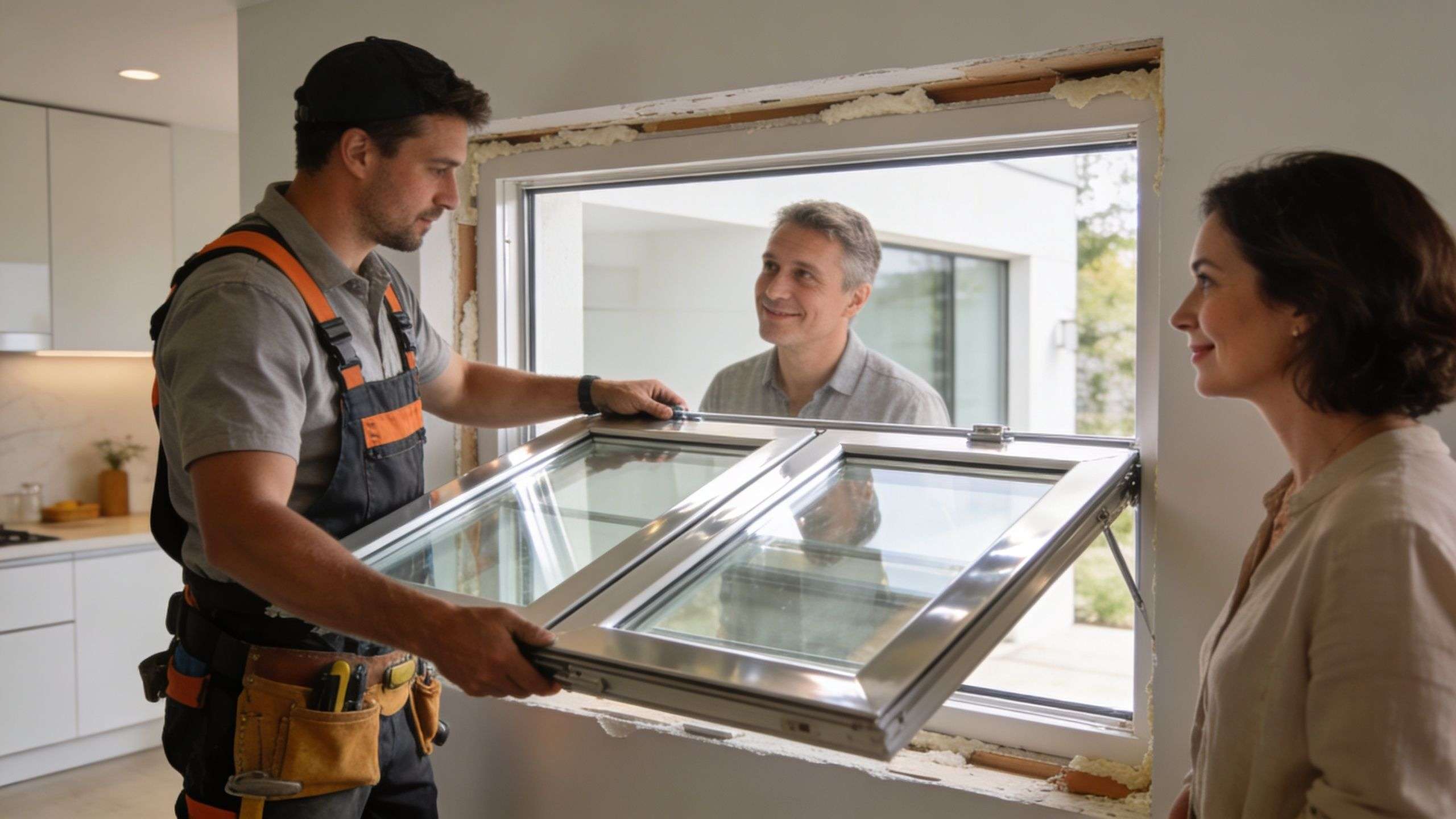
The critical work happens after the old unit comes out. In Gulf Coast conditions, the installer has to control three things at the same time: water, air, and material movement. Miss any one of them and the homeowner loses part of the energy benefit they paid for. In worse cases, the wall starts holding moisture around the new unit.
What happens before the new window goes in
Careful removal matters because the surrounding finishes often tell you what the old window was doing wrong. A rushed crew can tear up drywall, damage exterior trim, and miss early signs of sill rot or water staining that point to a larger drainage problem.
Once the opening is exposed, the frame, sheathing, and sill need to be checked for softness, staining, fastener damage, and out-of-square conditions. Houston homes regularly show some combination of humidity wear, old sealant failure, and minor framing movement. Covering those conditions with a new window only hides the problem for a while.
This is also the point where insert replacement and full-frame replacement stop being a pricing discussion and become a condition discussion. If the existing frame is sound and the drainage path is working, an insert can be a reasonable approach. If the sill is compromised, the brickmould detail has been leaking, or the old frame was never flashed correctly, full-frame work usually gives the better long-term result.
The opening has to shed water before it looks finished
A proper installation follows an order. The sill gets prepared to drain. The opening gets cleaned and corrected. Flashing, sealant, shims, and fastening all have to work together so the new unit stays square and any incidental water has a path back out.
That sequence matters more in Houston than it does in drier markets.
High humidity, wind-driven rain, and long cooling seasons put steady pressure on the opening. If the head detail is sloppy, if sealant is applied like a cosmetic bead instead of part of a water-control assembly, or if the sill is blocked from draining, moisture can sit where homeowners never see it until trim swells or paint starts to fail.
A few field details separate careful work from shortcut work:
- Shims go at load points. Random shimming can twist the frame and throw off sash operation.
- Fasteners need restraint. Overdriven screws can distort the unit and reduce weatherstrip contact.
- Low-expansion foam belongs around the frame. Standard foam can bow jambs and create operation problems.
- Sealants have to match the materials. Brick, fiber cement, wood trim, and vinyl do not all move the same way.
- Weep paths must stay open. A heavily caulked exterior can trap water instead of shedding it.
If a crew's entire moisture plan is "we'll caulk it well," that is a warning sign.
What good workmanship looks like while the crew is on site
Homeowners do not need to know every trade term to spot disciplined installation. They need to watch the sequence and the condition of the opening before it gets covered back up.
Look for these signs:
- The crew measures the opening again before setting the new unit.
- They check level, plumb, and diagonal measurements before final fastening.
- They treat the sill and flashing as functional parts of the assembly, not extras.
- They insulate the perimeter lightly and evenly instead of packing foam into every gap.
- They test operation before interior trim goes back on.
Crews that handle broader remodeling scope usually manage this part better because window work often affects drywall returns, casing, exterior trim, paint, and sometimes hidden repair work around the opening. H-Towne & Around Remodelers, Inc. handles window replacement as part of larger residential renovation work, which matters when the opening needs more than a basic swap and the finish trades have to tie back together cleanly.
Why closeout work matters
A good install is not finished when the sash opens and locks. Interior trim should fit without forcing the frame out of alignment. Exterior sealant lines should be continuous and neat, but not used to hide bad prep. Debris should be removed, floors protected, and the homeowner should get clear instructions on cure time, operation, and what to watch during the next rain.
A lot of callback work starts after the installer leaves. Trim joints open. Paint-ready surfaces get left rough. Small water entry points show up at the head or stool. In Houston, those small misses turn into stained casing, swollen trim, and damp wall cavities faster than many homeowners expect. The installation process has to account for that climate from the first cut to the final cleanup.
Navigating Houston's Unique Codes and Climate Demands
Houston window work sits at the intersection of building code, storm exposure, and moisture control. Homeowners don't need to memorize every requirement, but they do need to understand that this isn't a generic replacement category. A window here has to stand up to heat, wind-driven rain, and repeated humidity loading.
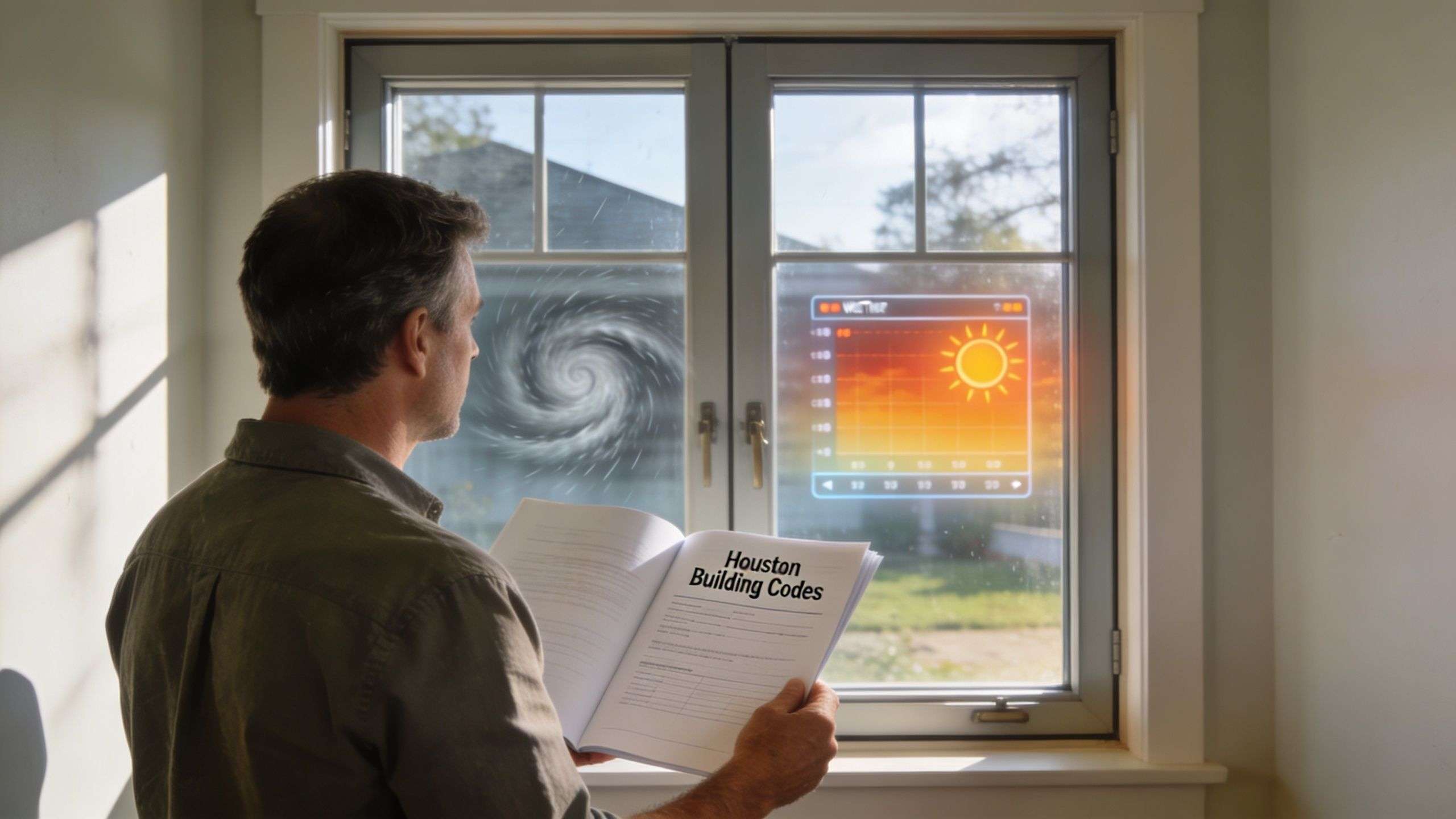
In Houston's IECC Zone 2A, installation flaws can cause 17% to 33% of a window's potential energy savings to disappear. The same research notes that improper head flashing accounts for 55% of failures, which is a direct warning for storm-prone homes where water intrusion can damage insulation and contribute to rot, according to this Houston climate installation risk analysis.
The code issue homeowners usually miss
Most homeowners think permit requirements are the hard part. Permits matter, but the bigger issue is whether the installed assembly matches the demands of the opening and the exposure.
A code-compliant product can still underperform if the field work is careless. The head detail can leak. The flashing can terminate badly. The sealant can bridge where drainage should happen. The opening can be left without a reliable path for incidental water to get back out.
Gulf Coast moisture changes the risk profile
In dry climates, an imperfect install may stay hidden longer. In Houston, humidity pushes those mistakes forward. Wet air finds small pathways. Materials stay damp longer. Repeated storms expose weak flashing and weak sealant work quickly.
That means the contractor needs to account for more than dimensions and finish color. The installation approach should reflect:
- Exposure to wind-driven rain
- Humidity load around the opening
- Compatibility between flashing, sealants, and existing cladding
- Drainage strategy at sill and head conditions
- Potential storm-related product requirements in applicable areas
Water doesn't need a big opening. It only needs one missed transition.
Why local experience matters
Regional judgment separates a durable install from a short-lived one. A contractor working routinely in the Texas Gulf Coast understands that the same house can have different risk levels on different elevations. The sunny front, shaded rear, and storm-exposed corner don't all behave the same.
That local awareness affects material choice, flashing strategy, and how much investigation the crew does before the order is placed. It also affects whether they treat trim staining, soft sheathing, or failed sealant as cosmetic issues or as warning signs that the opening needs correction before the new window is installed.
Choosing Your Contractor and Protecting Your Investment
A double-pane window can be a solid upgrade. A bad installation can turn it into an expensive patch. The contractor you hire decides which one you get.
The safest approach is to hire the company the same way you'd hire for a kitchen or bath remodel. You're not just buying a product. You're trusting someone to open the house, manage hidden conditions, and rebuild a weather-sensitive assembly correctly.
Use a short hiring checklist
These are the essential requirements:
- Licensed and insured: Ask for current documentation, not verbal assurances.
- Local project history: Look for Houston-area work, not generic manufacturer photos.
- Written scope: The proposal should state what happens if rot, trim damage, or wall repair is discovered.
- Labor warranty clarity: Manufacturer coverage on the window is not the same thing as coverage on the installation.
- Communication standards: You want a team that answers questions before the order, during the work, and after completion.
A contractor's public track record matters here. Homeowners comparing options can learn a lot from client testimonials from Houston remodeling projects, especially comments about communication, cleanliness, scheduling, and how the company handled issues after work began.
Ask sharper questions
During the estimate, don't stop at price. Ask what sealant system they use. Ask how they handle sill conditions. Ask whether they inspect for hidden moisture damage during removal. Ask who repairs the trim and interior surfaces after the install.
Those questions do two things. They show whether the contractor knows the assembly, and they show whether the company has a real process instead of a sales script.
Protect the windows after the crew leaves
Once the new units are in, maintenance is straightforward but important.
- Keep weep paths clear: Don't paint them shut or clog them with debris.
- Inspect sealant lines periodically: Especially on sun-beaten and storm-exposed elevations.
- Watch for operation changes: A window that starts dragging or locking poorly may be signaling movement or moisture issues.
- Address leaks immediately: Small stains and soft trim don't improve with time.
A good window project should make the house quieter, more comfortable, and less demanding to cool. It should not create a hidden moisture problem that shows up after the contractor is gone. That's why the hire matters as much as the glass.
If your home has hot rooms, aging windows, or signs that past installation work wasn't built for Gulf Coast conditions, H-Towne & Around Remodelers, Inc. can help you evaluate the openings, plan the right scope, and coordinate window replacement as part of a larger home improvement project in Houston and surrounding areas.