
You're standing in the hallway with water under your shoes, trying to decide whether the carpet can be saved, whether the walls are safe, and whether calling the insurance company before cleanup will slow everything down. Outside, Houston's air is already warm and wet. Inside, every hour matters because water can move behind baseboards, into insulation, beneath flooring, and through the air-conditioning system long after the visible puddles disappear.
Flood damage restoration in Houston isn't just a matter of pumping out water and replacing a few boards. The right response combines life safety, documentation, controlled drying, selective demolition, mold prevention, insurance coordination, and sometimes a permitted rebuild. The most important decision often comes after the water is gone, when the repair scope meets Houston's floodplain rules.
Table of Contents
- What Houston Homeowners Face When Floodwaters Hit
- First 24 to 48 Hours After Flood Damage in Houston
- The Professional Restoration Workflow From Extraction to Repairs
- Houston Costs, Timelines, and the Floodplain Permit Trigger
- Choosing a Licensed Houston Restoration Contractor
- Turning Restoration Into a Planned Remodel
- Your Next Steps After a Houston Flood
What Houston Homeowners Face When Floodwaters Hit
At three in the morning in a Meyerland ranch home, the first thing you notice is how ordinary the house still looks. The kitchen lights may be off, family photographs remain on the walls, and the furniture is where it was before the storm. But the garage door is sealed with plastic, water reaches the middle of the homeowner's shins across the tile, and the Gulf Coast humidity is climbing inside every closed room.
The visible water is only the beginning. Floodwater can carry sewage, lawn chemicals, sediment, and microbial contamination into flooring, wall cavities, ductwork, and mechanical equipment. A home may look cleaner after extraction while still holding moisture beneath the slab edge, behind cabinets, or inside insulation.
Houston's physical character makes the problem harder. Flat topography slows drainage, bayou-fed neighborhoods can receive water from several directions, and expansive clay soils retain moisture around slabs. Much of the local housing stock uses slab-on-grade construction, including homes built across the 1960s through the early 2000s. Those homes don't have basements to absorb or reveal water movement, so moisture can spread laterally through finishes and framing.
Why a Houston flood becomes a rebuilding project
Houston has faced repeated flood events, including Memorial flooding, Tax Day, Hurricane Harvey, Imelda, and Beryl. Each event has reinforced the same lesson: a home that needs flood damage restoration may also need electrical evaluation, HVAC inspection, material removal, and code review.
Hurricane Harvey remains the defining benchmark. NOAA estimated approximately $125 billion in total damage, making Harvey the second-costliest tropical cyclone in U.S. history, while the City of Houston reported nearly $16 billion in residential impact in its official needs assessment published by the City of Houston. That assessment found that about 30% of Houston's 700,000 households experienced some damage to their home or personal property, and 10% had floodwater inside their homes.
The Houston metro impact was broader still. FEMA reported more than 161,000 homes damaged, with 24% uninhabitable for at least 30 days, according to the same official assessment. That's why a professional response must account for displacement, mold remediation, contents loss, and interior reconstruction, not just water removal.
Practical rule: Treat floodwater as a building-system problem from the start. The floor, walls, air-conditioning system, wiring, cabinetry, and permit status may all belong in the first assessment.
First 24 to 48 Hours After Flood Damage in Houston
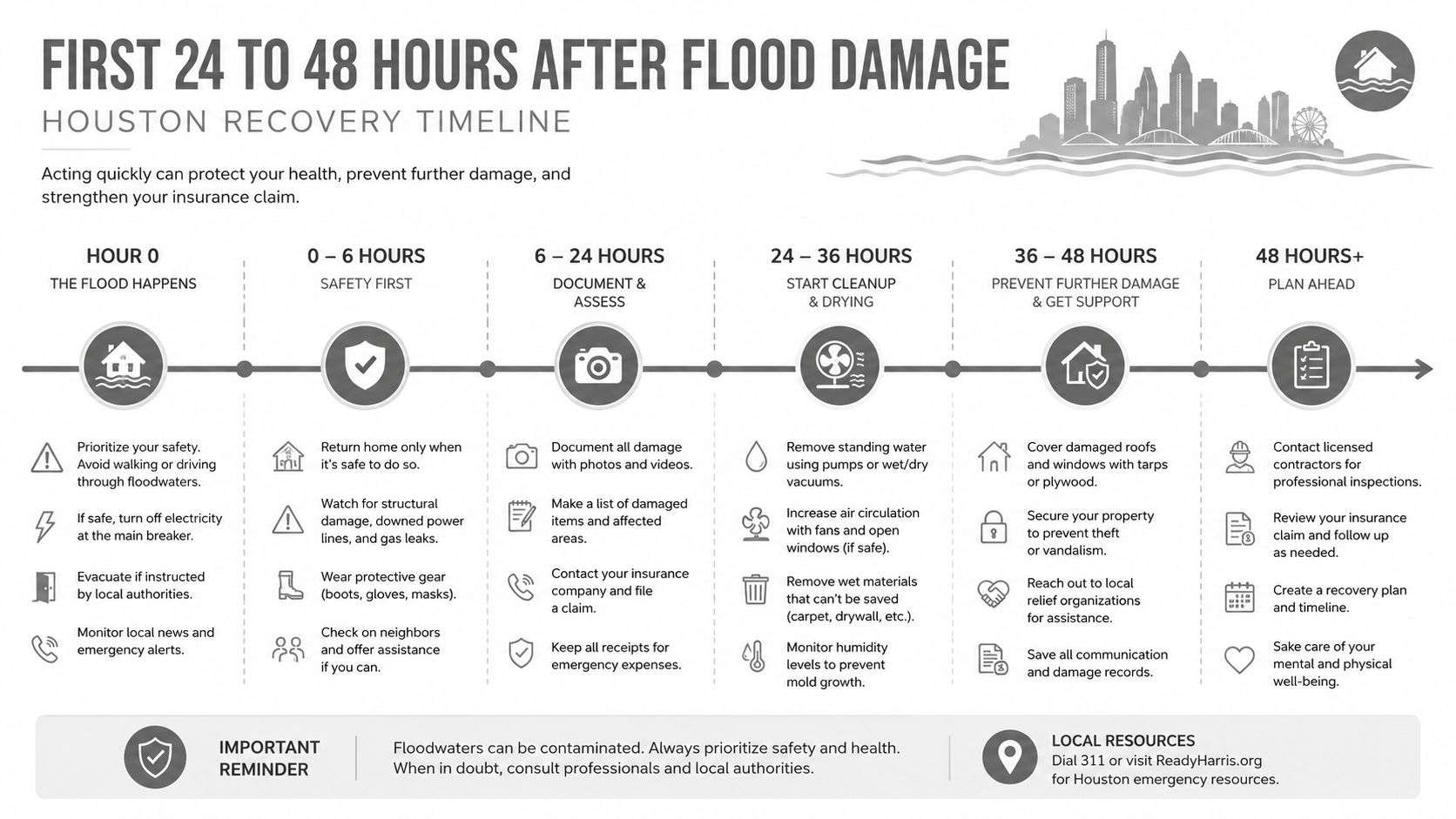
The first response should follow a strict order: safety, documentation, mitigation. Cleaning before documenting can erase evidence, while documenting without making the structure safe can put your family at risk.
Start with life safety
Leave children and pets out of the affected area. If water has reached outlets, switches, appliances, or electrical equipment, shut off power at the meter only if you can do so safely from a dry location. Don't walk through standing water when you can't confirm whether electrical current, sewage, chemicals, or structural hazards are present.
Watch for gas-line concerns around slab penetrations and damaged mechanical equipment. Don't restart the HVAC system until a qualified professional has inspected it, especially if floodwater reached the air handler, ductwork, or return-air path.
Document before disturbing the scene
Take one exterior photograph showing the waterline and the property's position. Then photograph wide interior views as you move room by room, followed by close-ups of baseboards, flooring, cabinetry, appliances, drywall, and personal property. Preserve timestamps, keep original files, and record damaged items in a written log.
A useful sequence is:
- Exterior context: Capture the waterline, doors, foundation area, and visible debris.
- Room-wide evidence: Photograph each wall and the relationship between rooms.
- Detail evidence: Record material damage, serial numbers, labels, and contents.
- Written notes: Add the date, room, estimated water depth, and actions taken.
- Expense records: Save receipts for extraction, temporary housing, materials, and emergency purchases.
For a broader explanation of claim preparation, keep this storm damage insurance claim process guide with your policy documents.
Begin mitigation quickly
Standing water should be extracted as soon as possible, ideally the same day. Remove wet contents from the affected area, separate salvageable items from contaminated porous materials, and pull wet baseboards where removal is safe. Technicians may open controlled drainage points in drywall so trapped water can escape, but those cuts should follow an assessment rather than random demolition.
CDC guidance says wet items and structures should be cleaned and dried within 24 to 48 hours. If a flooded building can't be dried in that window, mold growth should be assumed, and homes that remain wet for more than 48 hours after major floods commonly develop visible, extensive mold growth according to CDC disaster safety guidance.
Commercial dehumidifiers and air movers work differently from household fans. The crew should measure conditions, contain affected zones when needed, and adjust equipment based on readings rather than leaving machines running.
Call your insurance carrier and a licensed local contractor before cleanup progresses too far. If the property is in a mapped floodplain, ask immediately whether the planned work crosses Houston's floodplain development permit threshold, because that question can change the project before drywall or flooring goes back.
The Professional Restoration Workflow From Extraction to Repairs
A professional restoration project works as a chain. Extraction affects drying, drying determines demolition, demolition exposes the repair scope, and the repair sequence protects the work that follows.
Extraction and controlled drying
Crews begin by removing standing water and saturated contents. Carpet pad is often removed rather than dried in place because it holds contamination and can continue releasing moisture in Houston's humid conditions. Floating wood flooring, wet insulation, and porous items exposed to contaminated floodwater may also require removal.
Drying requires more than air movement. Technicians should document dry-bulb temperature, wet-bulb temperature, relative humidity, dew point, and grains per pound in each affected zone, then select air movers and dehumidifiers according to the material load. IICRC S500 guidance treats drying as complete only when wet materials return to pre-loss or unaffected-reference moisture levels and ambient relative humidity stabilizes at or below approximately 50% across consecutive readings in the IICRC S500 standard.
Houston structural drying can take several days, depending on the water volume, materials, ventilation, and weather. A crew that promises completion based only on elapsed time is skipping the measurement that proves whether the framing and subfloor are dry.
Demolition, mold control, and reconstruction
Once readings identify what won't dry in place, demolition becomes selective rather than destructive. Saturated drywall, insulation, swollen MDF cabinetry, damaged flooring, and contaminated porous contents may need removal. The cut line should account for the waterline and wicking, not merely the visible stain.
Mold prevention overlaps with drying. The response may include antimicrobial treatment, HVAC inspection, containment, and negative air when category 2 or category 3 water has affected the building. Surface spraying alone won't correct wet insulation or a closed wall cavity.
For homeowners evaluating flooring choices, this homeowner's water damage guide offers useful context on what flooring damage can mean beyond the visible finish. The key decision remains whether the substrate and surrounding materials are dry and uncontaminated enough to support a replacement.
Repairs should follow a controlled order:
- Rough systems: Complete approved plumbing, electrical, mechanical, and structural work first.
- Wall restoration: Install insulation and drywall only after moisture verification.
- Finishes: Prime repaired surfaces, apply the specified paint coats, and complete trim.
- Flooring last: Install new flooring after overhead and wall work to prevent avoidable damage.
A homeowner looking at the full sequence can also review this water damage repair and floor replacement resource. The practical point is simple: don't cover a wet assembly to make the room look finished.
Houston Costs, Timelines, and the Floodplain Permit Trigger
Restoration pricing depends on the water category, affected area, material loss, access, contents handling, and whether the work remains a repair or becomes a reconstruction project. A single-room cleanup and dry-out may fall around $3,500 to $7,500, while a major whole-home rebuild can reach $25,000 to $60,000 or more. These are planning ranges, not promises, and a floodplain review can change the scope more than the initial water-removal estimate.
Drying commonly takes 3 to 7 days, ordinary repairs may take 2 to 4 weeks, and structural rebuilding may extend to 2 to 4 months. The schedule lengthens when engineered plans, inspections, material lead times, contents decisions, or temporary housing are involved.
Houston flood restoration cost ranges by project scope
| Project Scope | Cost Range | Timeline | Floodplain Permit Triggered? |
|---|---|---|---|
| Single flooded room cleanup and dry-out | $3,500 to $7,500 | 3 to 7 days for drying | Possibly, if regulated repair costs reach the threshold |
| Multi-room restoration with demolition and finishes | Varies by damage and materials | 2 to 4 weeks for repairs after drying | Review required when applicable |
| Whole-home rebuild after major flood damage | $25,000 to $60,000 or more | 2 to 4 months when structural rebuilding is involved | Likely requires project-specific review |
The rule that can reshape the project
Houston's floodplain FAQ says a floodplain Development Permit is required when the total cost to repair to pre-damage condition is $10,000 or more. It also defines substantial damage as repair costs reaching 50% or more of the structure's market value in the City of Houston floodplain FAQ.
That threshold can turn a finish-repair quote into a regulated reconstruction project. Depending on the property and determination, the owner may face permitting, inspections, elevation documentation, engineered plans, or rebuilding requirements tied to current floodplain standards. Don't approve a low-looking scope until someone has checked whether the work is being evaluated as simple restoration, code-triggering reconstruction, or substantial damage.
For broader context on how restoration services are organized, this 2026 property restoration guide can help homeowners compare mitigation and reconstruction phases. For Houston-specific permitting coordination, review the Houston construction permits information before the repair scope is finalized.
Choosing a Licensed Houston Restoration Contractor
After a major storm, unfamiliar crews may arrive quickly with impressive promises. Speed matters, but the contractor who answers first isn't automatically the contractor who can manage permits, mold controls, insurance documentation, and a warranty after the emergency crews leave.
A Houston-based remodeler generally offers a different accountability structure than an out-of-town storm crew. Local teams can return for inspections, coordinate with Houston permitting offices, identify neighborhood-specific construction conditions, and close punch-list items without treating the project as a temporary stop between storms.
Compare what you can verify
Before signing, ask for evidence rather than general assurances:
- City registration: Confirm an active City of Houston contractor registration where the project requires it.
- Insurance documentation: Request current general liability coverage and any relevant flood or restoration coverage.
- Claim credentials: If the company handles insurance claims directly, verify the applicable Texas Department of Insurance licensing requirements.
- Mold qualifications: Ask for documented mold remediation training or certification, such as IICRC credentials or an equivalent qualification.
- Warranty terms: Get labor and material warranties in writing, including who handles callbacks.
- Physical location: Verify a Houston-area office address rather than relying on a PO box.
- Subcontractor list: Ask who will perform electrical, plumbing, HVAC, mold, and structural work.
A contractor should explain what insurance covers as like-kind replacement and what the homeowner would fund as an upgrade. Be cautious if anyone demands full payment upfront, pressures you to waive your right to file a claim, or refuses to identify subcontractors.
The step by step contractor vetting advice can provide a useful screening framework, but local verification still matters. Ask for permit responsibility in writing, not just a verbal promise that permits are “handled.”
Watch for the storm-chaser pattern
Out-of-town crews may subcontract much of the work, leave before the final inspection, or disappear when warranty issues surface. That doesn't mean every traveling crew is unqualified, but it does mean the homeowner must verify the business structure, insurance, licensing, address, and post-project contact before allowing demolition.
The right contractor will slow down long enough to separate emergency mitigation from permanent repair. That distinction protects both the building and the claim.
Turning Restoration Into a Planned Remodel
Flood damage exposes parts of a home that are normally hidden. Once drywall, cabinets, flooring, and insulation are removed, the contractor can see wiring paths, plumbing routes, framing, ventilation, and previous repairs. That opening is valuable, but only if the homeowner uses it to plan rather than add random upgrades under pressure.
Kitchen remodeling after flood exposure
A gutted kitchen may be the right time to reroute plumbing for an island, replace damaged cabinetry with a more water-tolerant layout, improve ventilation, or correct an inconvenient electrical arrangement. If the electrical panel, gas lines, drains, or walls change, the work generally moves beyond cosmetic remodeling and into permit-sensitive construction.
Bathroom remodeling during reconstruction
Bathroom restoration can create an opportunity for better exhaust ventilation, improved waterproofing behind tile, a curbless shower, or a more accessible fixture layout. Moving fixtures, changing drains, adding outlets, or altering walls can require approval, while painting, tiling, carpeting, and similar cosmetic work typically don't when regulated systems remain unchanged under Houston's residential remodeling guidance.
Houston's independent permit guidance also notes that moving a sink or adding outlets can trigger permitting, while cosmetic bathroom updates may not if plumbing and electrical stay in place in this Houston remodeling permit guide. The room name doesn't determine the permit. The scope does.
Whole-home remodeling requires clean accounting
Separate insurance-funded like-kind replacement from homeowner-funded improvements. Insurance may cover restoring damaged drywall, flooring, cabinetry, or finishes to comparable condition, while a larger island, upgraded fixtures, premium flooring, or layout change may be an owner expense.
A whole-home remodeling plan should document every upgrade for future resale and keep the restoration estimate, change orders, permits, and receipts organized. H-Towne & Around Remodelers, Inc. handles kitchen remodeling, bathroom remodeling, whole-home remodeling, and storm and flood restoration, so a homeowner can coordinate repair and improvement scopes with one project plan rather than opening finished work later.
Your Next Steps After a Houston Flood
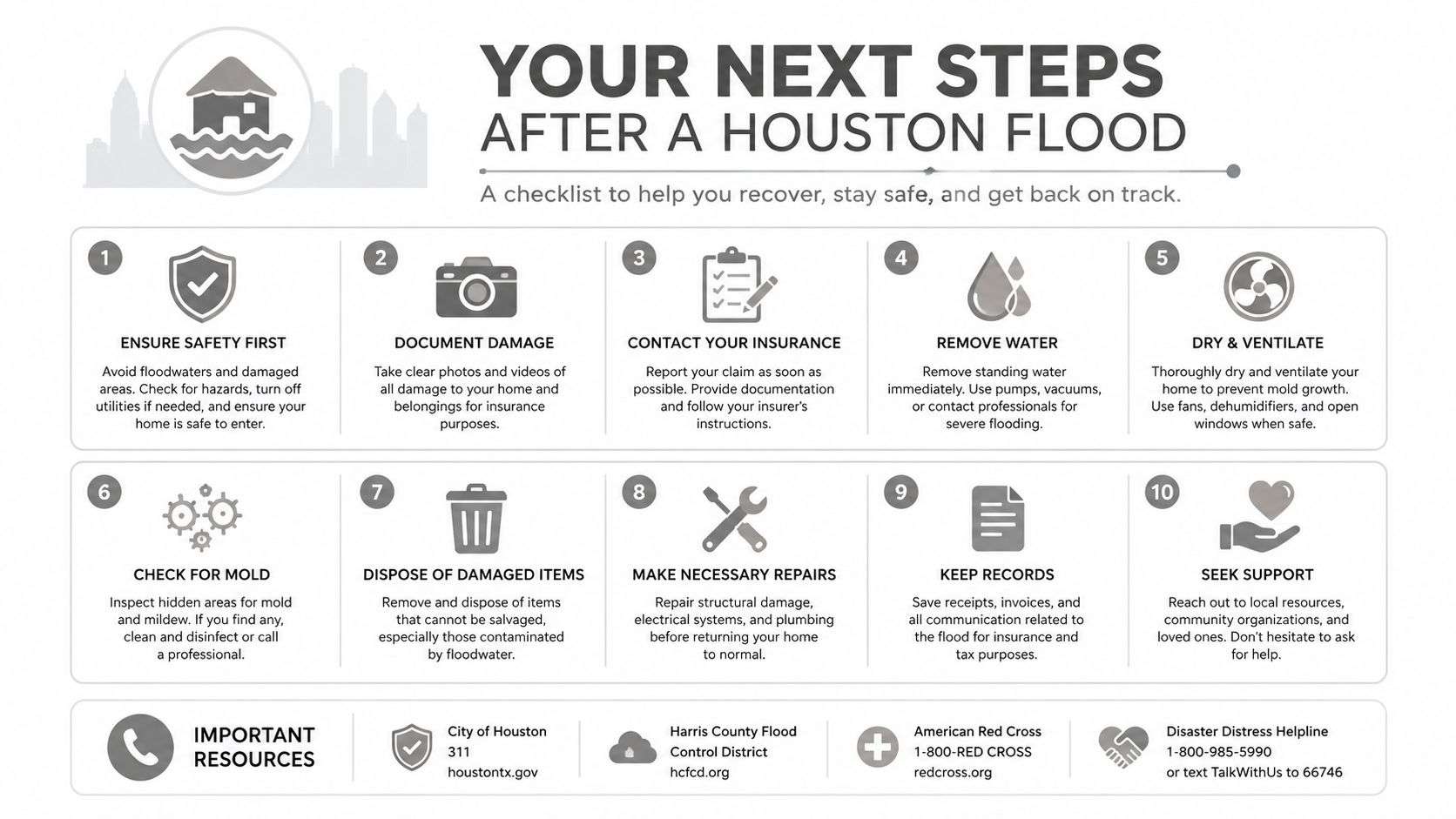
The first call today should go to a licensed Houston restoration contractor who can assess the property within 24 hours, document the loss for the insurance carrier, and flag whether the floodplain substantial-damage rule may apply.
Use this deadline-based plan:
- Same day: Move people and pets to safety, isolate electrical hazards, and photograph every room before cleanup.
- Within 48 hours: Start extraction, remove unsafe porous materials, and establish monitored drying.
- Within 7 days: Meet with the adjuster and provide the photo log, receipts, inventory, and contractor documentation.
- Within 30 days: Obtain a written scope of work that separates mitigation, like-kind restoration, upgrades, and permit-related work.
- Before drywall: Confirm the required City of Houston Construction Code permit and inspection path.
- Before signing: Request the contractor's TDLR information where applicable, mold remediation credentials, and City of Houston General Construction Company registration.
Keep receipts for emergency materials, temporary lodging, cleaning, storage, and related expenses. Don't let a contractor close the walls until moisture readings support the decision and the permit path is clear.
Before the day ends, call one licensed local contractor and ask for a documented assessment, a mitigation plan, and a floodplain permit review.
H-Towne & Around Remodelers, Inc. can coordinate flood damage restoration with kitchen remodeling, bathroom remodeling, or whole-home rebuilding across the Houston area, including documentation, permit assistance, and permanent repairs. Visit H-Towne & Around Remodelers, Inc. to request an assessment and discuss the next safe step for your home.