
You walk into the house, and the floor tells you something is wrong before you fully see it. A soft spot by the kitchen sink. Tile that sounds hollow. Hardwood edges lifting. In Houston, that can come from a burst line, a slow appliance leak, a storm push, or floodwater that found the lowest path into the house.
The hard part is that water damage repair and floor replacement usually isn't just about the top surface. The visible stain is often the smallest part of the job. Along the Gulf Coast, heat and humidity keep moisture active longer, and that changes what can be saved, what needs to come out, and which replacement materials make sense for the next storm season.
What To Do Immediately After Finding Water Damage
The first few hours matter more than most homeowners realize. Water damage and freezing make up about 22.6% of home insurance claims in the U.S. from 2019 to 2023, the average claim exceeded $15,000, and even 1 inch of water can cause up to $25,000 in damage, according to This Old House's water damage statistics roundup. In Houston, where moisture hangs in the air even after the visible water is gone, delay usually makes the floor problem bigger.
Quick action steps that actually help
- Shut off the source first: If the damage came from a supply line, water heater, refrigerator line, dishwasher, or washing machine, stop the flow before doing anything else.
- Cut power to the affected area if it's safe: Water and live circuits don't mix. If the panel is in a dry, safe location, shut off the affected room or area.
- Move furniture and rugs off the wet floor: Get wood legs, upholstery, and rugs out of contact with standing water so you don't create a second layer of damage.
- Start documenting right away: Take wide photos, close photos, and video before cleanup changes the scene. Include walls, baseboards, cabinets, thresholds, and any buckling or staining.
- Extract water if you can do it safely: A wet vacuum, towels, and mops help with surface water, but don't assume that means the structure is dry.
- Call mitigation before planning new floors: Drying comes before design. Replacing flooring too early traps moisture below.
- Separate floodwater from clean-water leaks in your mind: If outside water entered the house, treat the floor as a contamination issue, not just a drying issue.
Practical rule: If water reached baseboards, cabinets, or multiple rooms, assume the problem extends below the finish floor until testing proves otherwise.
What not to do
A few common reactions make the project worse.
- Don't run straight to new flooring samples: Material selection can wait until the subfloor, wall bottoms, and transitions are checked.
- Don't reinstall anything over a “dry-feeling” floor: Surface dry and internally dry are not the same thing in Houston conditions.
- Don't rely on fans alone for a major event: Air movement helps, but hidden moisture often remains in underlayment, subflooring, and wall cavities.
If you're dealing with active storm or flood cleanup, it's smart to compare practical restoration guidance like Savera Wood Floor Refinishing for water issues with a contractor who handles broader structural recovery, such as storm and flood damage restoration in Houston. The key is getting the house dry enough for an honest floor decision, not a rushed one.
How to Properly Assess Your Water Damaged Floors
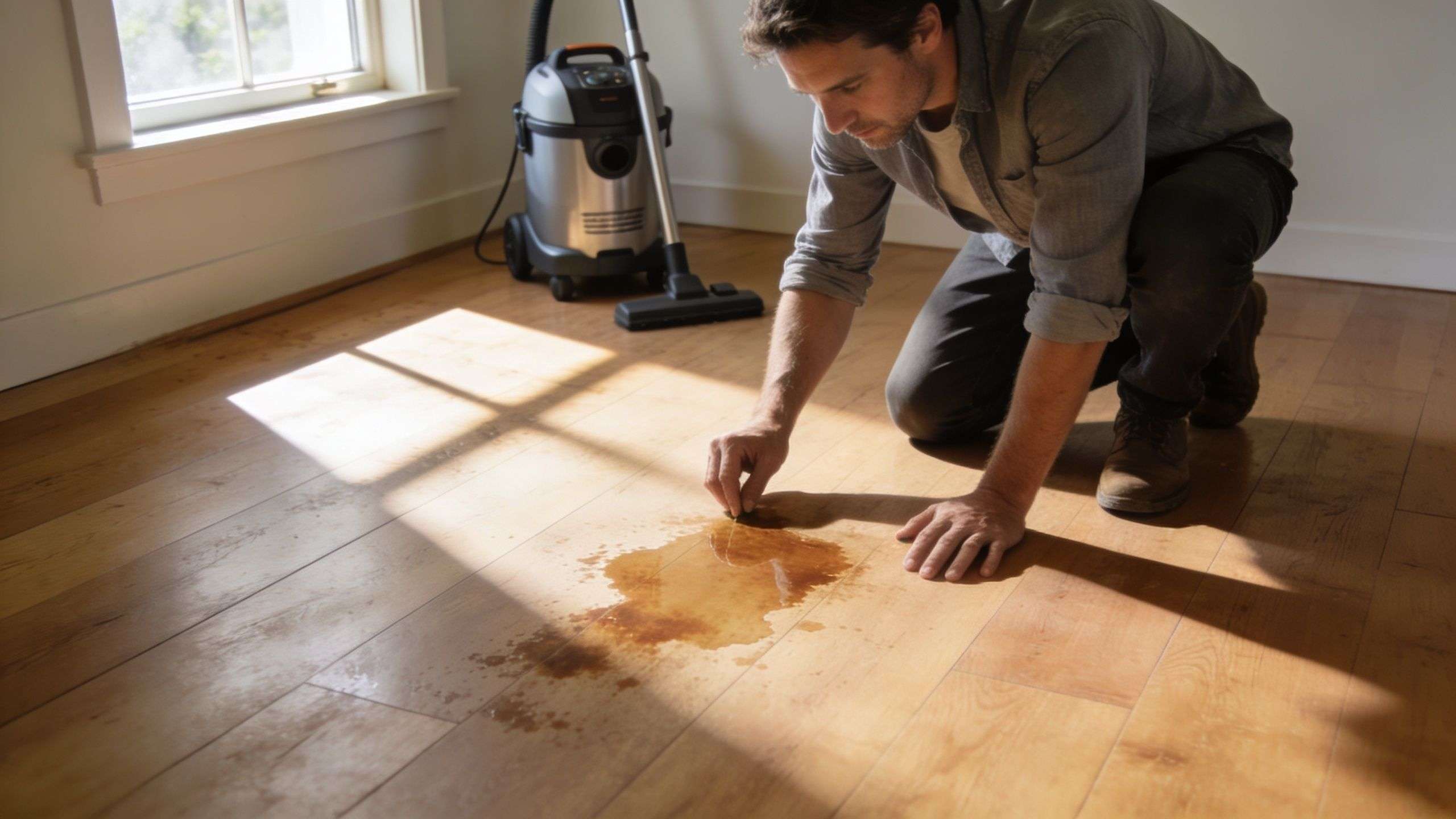
A homeowner can do a safe first look, but a real assessment goes beyond what your shoes feel underfoot. In many homes, the floor covering hides the worst of the problem. By the time you see staining, separation, or swelling, the moisture may already be in the underlayment, subfloor, lower drywall, or cabinet toe-kicks.
What you can check safely before a pro arrives
Start with what you can observe without pulling apart the house.
- Look for shape changes: Cupping wood, lifting edges, swollen laminate seams, loose tile, and soft vinyl spots all suggest water moved below the finish layer.
- Use your nose: A musty smell usually means moisture stayed trapped long enough to affect surrounding materials.
- Check transitions and room edges: Doorways, baseboards, and where one flooring type meets another often reveal swelling first.
- Notice the water source: Clean water from a supply line is different from outside floodwater or sewage backup. Flood-related contamination usually narrows the salvage options.
Why visual inspection isn't enough
Professional restoration relies on moisture mapping, not just visual inspection, because surfaces can feel dry while subfloors and wall cavities still hold moisture. Reinstalling flooring over a damp subfloor can lead to cupping, adhesive failure, and mold, as outlined in SafetyCulture's water damage restoration guidance.
That is why experienced crews use moisture meters and infrared imaging together. A moisture meter gives readings at suspect areas. Infrared helps identify temperature differences that can point to hidden damp zones. One tool confirms. The other helps find where to confirm.
A floor can look stable and still be wet where it matters most. The subfloor decides whether the repair lasts.
What a proper moisture map should cover
A real moisture assessment doesn't stop at the center of the wet spot.
| Area to check | Why it matters | Common hidden issue |
|---|---|---|
| Subfloor | It supports the finish floor | Swelling, loss of fastener hold, trapped moisture |
| Wall bottoms | Water wicks upward | Wet drywall and insulation |
| Cabinet bases | They trap moisture at the floor line | Particleboard expansion and mold risk |
| Adjacent rooms | Water travels farther than expected | Moisture under “dry-looking” flooring |
| Thresholds and transitions | Different materials react differently | Separation, edge curl, movement |
In Houston homes, I tell people to be suspicious of any room with poor airflow, slab-on-grade construction, or a recent leak that sat overnight. Those jobs often look manageable at first glance and then open up into a bigger subfloor repair once demolition starts.
The Critical Choice Repairing vs Replacing Your Floor
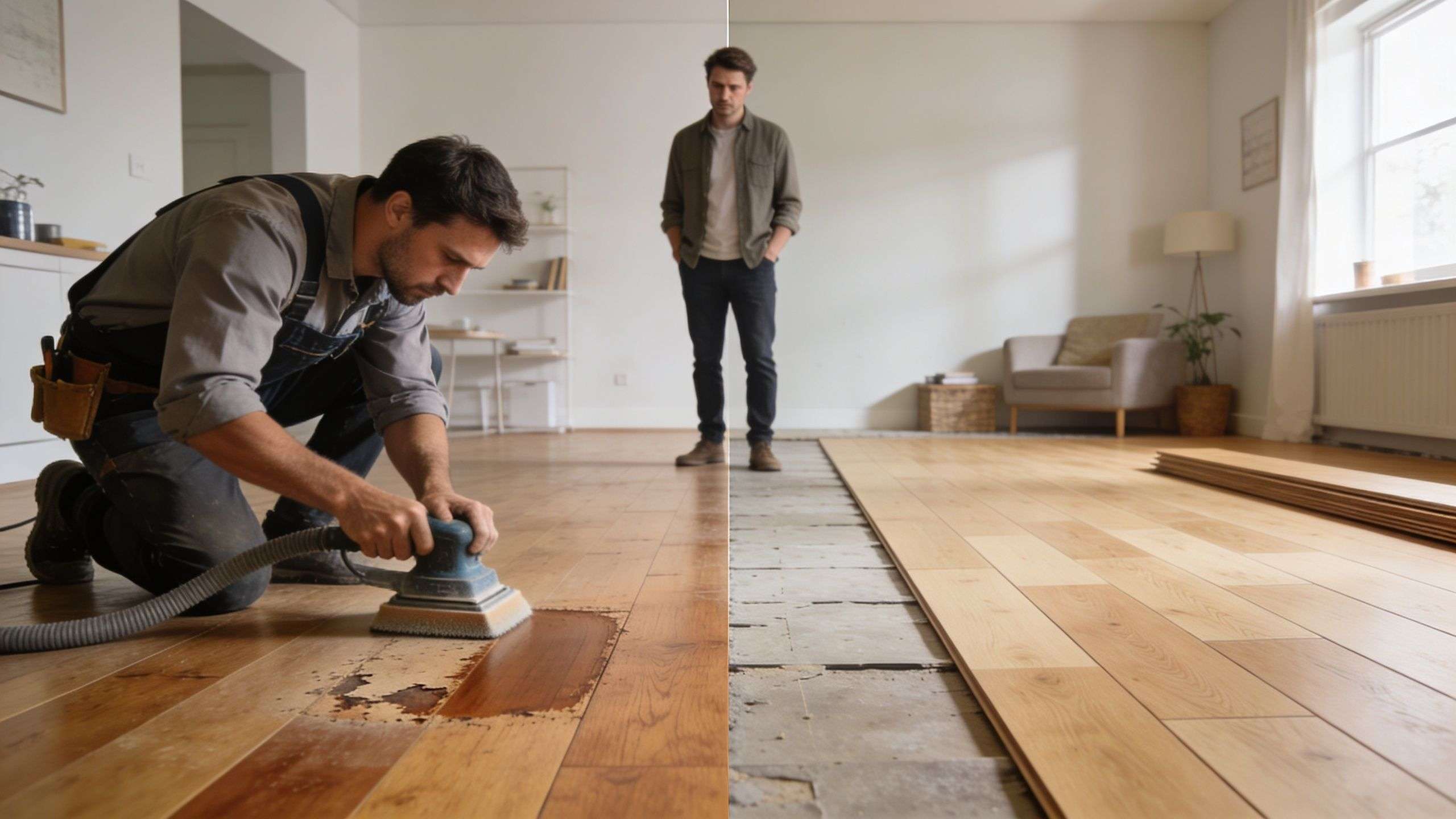
Most homeowners ask the same question first. Can this floor be saved, or do we need to replace it? The answer usually comes down to time, material, and subfloor condition. If one of those goes the wrong way, repair becomes a short-term patch.
Time changes the whole decision
Standing water for more than a day is a bad sign for floors. Once moisture sits long enough, the project often moves from drying and spot repair into removal of affected materials, especially when mold risk enters the picture.
Consider a kitchen cabinet with a failed sink supply line. On day one, you may be dealing with water extraction and drying. A day or two later, the same event can mean swollen toe-kicks, soft subfloor sections, and flooring that won't lay flat again.
Material matters more than homeowners expect
Different floors fail in different ways.
- Solid hardwood: Sometimes repairable if exposure was limited and the boards haven't lost structural stability.
- Engineered wood: More sensitive to prolonged moisture, especially if the core takes on water.
- Laminate: Often the least forgiving once edges swell.
- Tile: The tile itself may survive, but the substrate below can still fail.
- Sheet vinyl or LVP: Better at tolerating moisture on the surface, but they don't protect a damaged subfloor underneath.
A cosmetic surface fix on the wrong material is like repainting drywall that's still wet inside. It may look fine for a while, then telegraph the problem later.
The subfloor is the real decision point
Industry guidance is clear on one point. The repair-or-replace decision often hinges on subfloor integrity, because hidden structural components such as the subfloor, joists, or beams may have been weakened. Surface-level fixes over a compromised base usually fail later, as noted in SERVPRO's water restoration resource.
If the floor system below has lost strength, replacing only the finish layer is money spent in the wrong place.
A simple repair vs replace framework
Use this as a homeowner's filter when talking with a contractor:
- Repair is more realistic when the water event was caught quickly, contamination is limited, the material is salvageable, and moisture readings return to acceptable levels after drying.
- Partial replacement makes sense when damage is isolated, matching is possible, and the surrounding floor remains stable.
- Full replacement is the safer call when the floor has widespread swelling, odor, loss of adhesion, movement underfoot, or a compromised subfloor.
If a contractor only talks about the visible finish floor and never mentions moisture testing, underlayment, or structural support, that should concern you.
Best Replacement Flooring for Houston's Climate
Houston flooring has to live with two realities at the same time. High ambient humidity is normal, and severe water exposure is always possible. That means the best replacement choice isn't just what looks good in a showroom. It's what stays dimensionally stable, what cleans up well after a future leak, and what doesn't force another major tear-out because the material couldn't handle Gulf Coast conditions.
Navigating Houston's high humidity and occasional heavy rains requires specific flooring choices. Here's a comparison of top options.
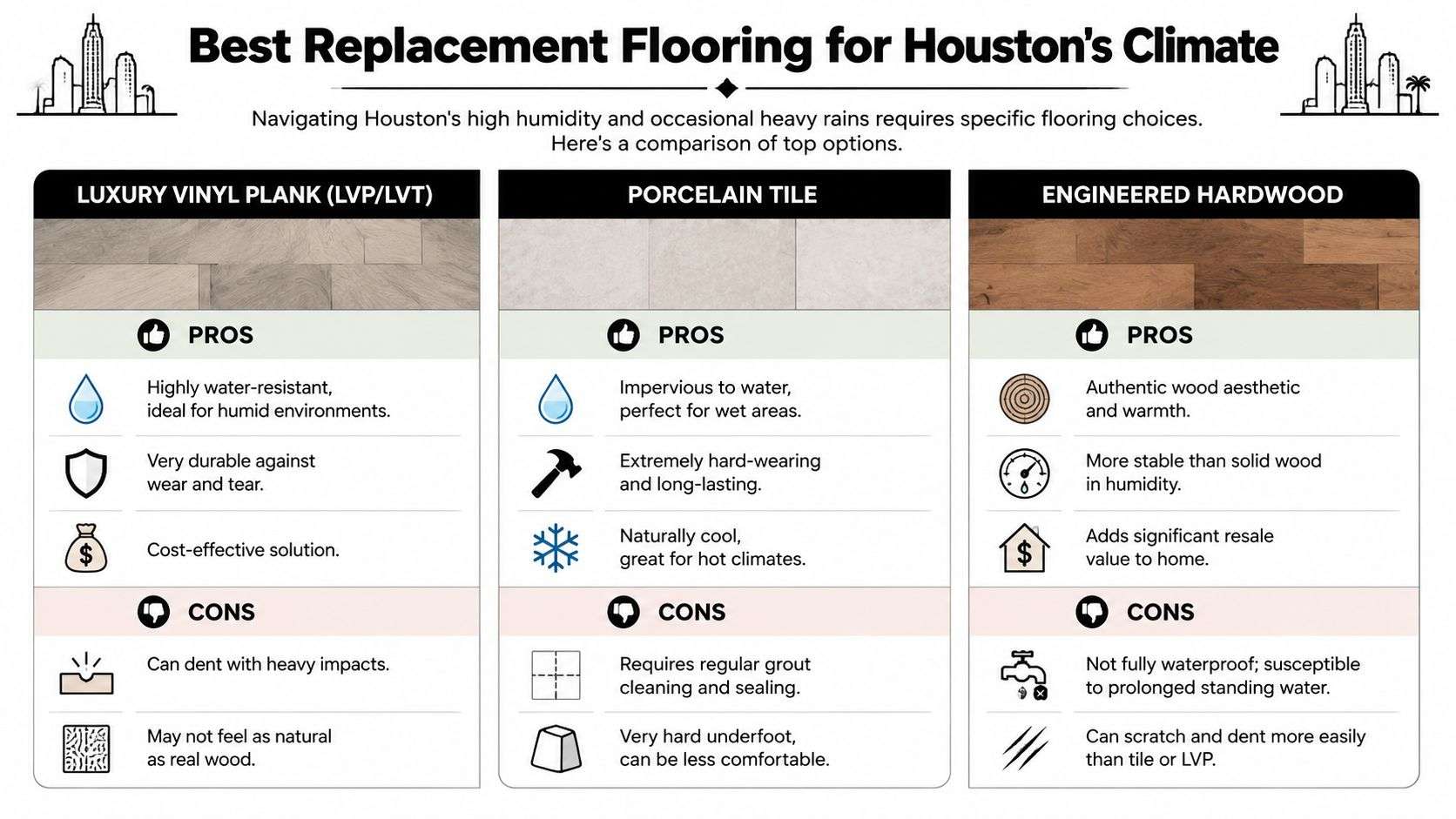
Houston-ready flooring comparison
| Flooring Type | Water Resistance | Best For | Houston Pro-Tip |
|---|---|---|---|
| Luxury Vinyl Plank LVP or LVT | High surface water resistance | Busy households, rentals, kitchens, living areas | Pair it with a properly dried and flat subfloor. The plank isn't the weak point if the base is sound. |
| Porcelain Tile | Excellent | Flood-prone ground floors, bathrooms, laundry rooms, whole-home installs on slab | Use it where storm season risk is highest. Check substrate prep and crack isolation details carefully. |
| Engineered Hardwood | Moderate, depends on product and exposure | Homeowners who want a wood look with better stability than solid wood | Better upstairs or in lower-risk areas than at a vulnerable first-floor exterior entry. |
What works well here
Luxury vinyl plank has become a practical choice for many Houston homes because it handles day-to-day moisture better than many traditional products and works well in open-plan remodels. It's especially useful where homeowners want a wood-look floor without the maintenance and moisture sensitivity of actual wood.
Porcelain tile is still one of the strongest options for Gulf Coast conditions. In homes with a flood history or a real chance of repeat water intrusion, tile gives you a finish layer that isn't the first thing to fail. It's also a strong fit for kitchens, baths, mudroom-style entries, and slab-on-grade first floors.
Engineered hardwood can work, but placement matters. In a controlled interior environment, it gives a warmer look than tile or vinyl and is generally more stable than solid hardwood in humidity. I like it better in areas less likely to take direct water hits.
What I steer homeowners away from on risky first floors
Some materials are less forgiving in this climate.
- Laminate in flood-prone areas: Once the core swells, it usually doesn't come back.
- Certain solid hardwood installations near exterior doors or slab-level wet zones: They can be beautiful, but they ask more from the house than many Houston homes can reliably give.
- Cheap underlayment systems: Even a decent finish floor can fail if the layers below it trap moisture or lose shape.
Houston homes do best with flooring that gives you time after the next leak, not flooring that punishes you for one bad afternoon.
Matching floor choice to the room
For a kitchen remodel, I usually think first about cleanup, appliance leaks, and traffic. For bathrooms, I think about repeated humidity and splash exposure. For whole-home remodeling after a flood, consistency matters, but so does not repeating the same mistake with a material that already struggled in the house.
One practical route in this market is to combine materials by risk zone. Tile or resilient flooring in the wettest first-floor spaces. Engineered hardwood where appearance matters and exposure risk is lower. That's often a smarter Houston answer than forcing one product through the entire home.
Understanding the Restoration Cost and Timeline
Homeowners usually want two things right away. How long will this take, and what kind of bill are we looking at? The honest answer is that the scope changes fast depending on how long the water sat, what kind of water entered the house, and whether the subfloor and adjacent materials can be saved.
What the cost ranges actually tell you
Water damage restoration ranges widely by severity. Minor repairs may run from $1,200 to $3,500, while extensive damage with full floor replacement can exceed $15,000 to $20,000+. Mold can begin within 24 to 48 hours, which is one reason costs climb quickly when action is delayed, according to Floorboys' breakdown of water-damage repair versus replacement.
Those numbers don't mean your project will fall neatly into a category. They do show the main rule of this work. The longer the moisture remains, the more layers get involved.
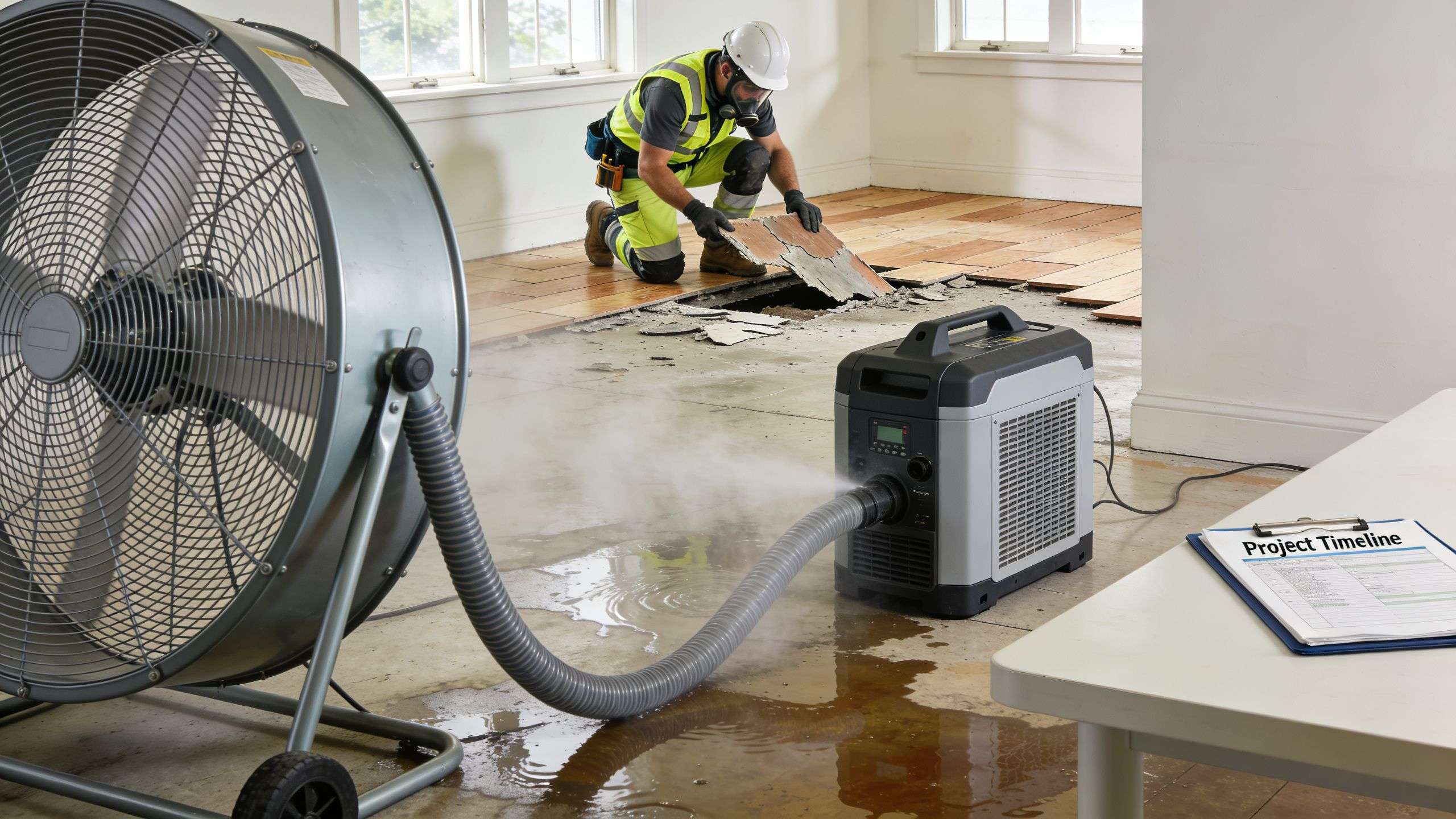
A typical project sequence
Most jobs move through these phases:
Emergency mitigation
Water extraction, containment, equipment setup, and initial moisture readings.Drying and monitoring
Dehumidifiers and air movers stay in place until readings stabilize. This phase decides whether materials can stay or need removal.Demolition
Damaged floor covering, underlayment, baseboards, and sometimes lower drywall come out.Subfloor and structural repair
Crews repair or replace compromised sections and verify the base is ready for new flooring.Rebuild and installation
New floor installation, trim, transitions, paint touch-up, and final punch-list items.
Where timelines stretch
The visible flooring install is rarely the longest part. Drying and verification often control the schedule. So do material lead times, insurance approval delays, and discovering hidden damage after demolition.
A homeowner should expect some disruption in normal living. Kitchens, bathrooms, and primary walk paths can be partially unusable during the process. If the project expands beyond flooring into cabinetry, drywall, or room-by-room repair, the right contractor matters as much as the flooring product. For broader rebuild work, some owners look at integrated providers for home restoration services when you need it, especially when floors are only one part of the damage.
What drives the final bill
| Cost driver | Why it changes the job |
|---|---|
| Water source | Floodwater and contaminated water often require more removal |
| Time before mitigation | Longer exposure increases damage depth |
| Material type | Some floors allow isolated repair, others don't |
| Subfloor condition | Structural repair adds labor and materials |
| Room complexity | Cabinets, islands, vanities, and built-ins make the work slower |
| Matching requirements | Partial replacement can become a broader finish job |
The best cost conversation happens after drying data and demolition reveal the actual scope, not before.
Navigating Insurance and Hiring a Local Contractor
Insurance gets confusing fast because homeowners often use the word “flood” to describe any water event, while the policy may treat a burst pipe, appliance leak, roof intrusion, and rising water very differently. That is why documentation matters from the first hour. The cleaner your record is, the easier it is for an adjuster to understand what happened and when.
How to protect your claim
A strong claim file usually includes:
- Before-cleanup photos and video: Show the water line, affected rooms, damaged flooring, baseboards, cabinets, and contents.
- A written timeline: Note when you discovered the damage, when the source was stopped, and when mitigation started.
- Material notes: Identify flooring type, age if known, and whether matching materials are still available.
- Moisture and scope documentation from the contractor: That helps connect visible damage to hidden damage.
One restoration source notes that claims can be difficult to manage, especially without insurance, and that some grant funding may exist for essentials like sub-flooring. For most homeowners, the most important tools are a well-documented claim and a contractor who can work with adjusters on a detailed scope of work, as discussed in RestorePro's overview of funding and water-damage restoration options.
Don't tell the adjuster only what looks bad. Show what was wet, what was removed, and why those removals were necessary.
What to look for in a Houston-area contractor
Water-damaged flooring in this market isn't just a flooring job. It often touches drywall, trim, cabinetry, paint, and room-to-room transitions. On bigger losses, it can overlap with kitchen remodeling, bathroom rebuilding, or whole-home restoration.
Look for a contractor who can explain the drying record, subfloor findings, and rebuild sequence in plain language. They should also understand Houston permitting realities, humidity-related material performance, and the difference between patching a room and restoring a house to stable condition. If you want a local benchmark for service area and project type, Houston remodeling and restoration coverage is the level of local fit you should be looking for.
Ask direct questions:
- Who is verifying the subfloor before new flooring goes in?
- How will you handle room transitions and material matching?
- If demolition reveals more damage, who updates the scope and how?
- Are you insured for this kind of work, and who is on site doing it?
H-Towne & Around Remodelers, Inc. is one example of a licensed, insured Houston-area company that handles flood and storm damage restoration alongside remodeling work, which matters when the flooring loss extends into kitchens, bathrooms, or larger home repairs.
Houston Water Damage Flooring FAQ
Can I keep my floors if they look dry now
Maybe, but appearance isn't enough. A floor can feel dry while moisture remains in the subfloor or wall base. That's why moisture testing matters before any reinstall or refinishing decision.
Is tile always the safest replacement after flooding
For many ground-floor Houston applications, tile is one of the most durable choices. But it still depends on the condition of the substrate below. A sound tile surface over a bad base is still a bad floor system.
Should I move out during the work
That depends on how many rooms are affected and whether kitchens or bathrooms are offline. If displacement becomes part of the problem, resources like Murphy's Corporate Housing Associates disaster relief can help homeowners think through temporary housing options after a flood event.
Can you replace only part of a room
Sometimes. The biggest issues are hidden damage boundaries and whether adjacent materials can be matched cleanly. Partial replacement works best when the damage is isolated and the remaining structure is stable.
What flooring do you trust most on a Houston first floor
In higher-risk areas, I usually lean toward porcelain tile or a quality resilient floor, depending on the room, the slab condition, and how the homeowner uses the space.
If your home has water-damaged flooring and you need a practical rebuild plan, H-Towne & Around Remodelers, Inc. can help evaluate the damage, identify what can be saved, and handle the repair or replacement work needed to get the house functional again.