
A typical full-home window replacement in Cypress ranges from $3,000 to $18,000 or more, and proper sealing against heat and humidity matters more than the window style. In Texas homes, replacing single-pane windows with ENERGY STAR-certified units can reduce cooling costs by 20% to 30% during demanding summer conditions, according to Texas window replacement energy guidance.
That cost range only tells part of the story. In Cypress, a window can look beautiful in the showroom and still perform poorly if the frame, flashing, and perimeter seal aren't handled correctly. The Gulf Coast climate attacks weak installation through intense sun, heavy cooling demand, wind-driven rain, and humid outdoor air.
After years of work across the Texas Gulf Coast, I've learned that the most reliable window replacement starts with the opening itself. We inspect the surrounding framing, verify the product ratings, and treat air sealing as seriously as the glass package. The right style improves the home, but the right installation protects comfort, durability, and the HVAC system.
Table of Contents
- Window Replacement Cost in Cypress TX
- Choosing the Right Window Style for Your Home
- Understanding Energy Ratings and Texas Codes
- The Step-by-Step Window Replacement Process
- Storm Protection and Hurricane-Rated Windows
- Why Choose a Local Cypress Remodeling Team
- Get Your Free Window Replacement Estimate
Window Replacement Cost in Cypress TX
A full-home replacement in Cypress commonly falls between $3,000 and $18,000 or more. The final estimate depends on the number of openings, frame material, glass package, access, and repairs uncovered during removal. Treat that range as a planning guide, not a promise. Standard vinyl units in a smaller home may fall near the lower end, while custom sizes, premium frames, difficult openings, and extensive trim work can push the project higher.
The Gulf Coast adds costs that showroom appearance does not reveal. Cypress windows must limit heat transfer, keep humid air outside, and manage wind-driven rain. Replacing single-pane windows with ENERGY STAR-certified units typically reduces cooling costs by 20% to 30%. Modern Low-E units replacing older double-pane windows can provide an additional 10% to 15% cooling reduction, according to Texas-specific window energy savings guidance.
Where the money goes
A dependable estimate separates the window itself from the work required around it:
- Frame and glass: Vinyl is generally the economical option. Composite and other premium materials raise the purchase price.
- Opening condition: Rot, deteriorated sheathing, failed sill areas, and damaged trim must be corrected before the new unit can perform properly.
- Installation method: Replacement inserts may preserve existing trim. Full-frame installation exposes more of the opening and permits broader repairs.
- Interior and exterior finishes: Painting, casing, siding transitions, and masonry details affect labor and the finished appearance.
- Access and size: Oversized units, second-story openings, and unusual shapes require more careful handling.
For a home spending $200 per month on summer electricity, a 20% to 30% cooling-cost reduction could represent about $40 to $60 in monthly savings. That estimate concerns cooling demand, not the entire electric bill. Actual results depend on insulation, duct performance, thermostat settings, shading, and installation quality.
Budgeting also means deciding whether to repair or replace each opening. Homeowners comparing window work with other improvements can review practical financing considerations, including ways to pay for plantation shutters. For a damaged or marginally repairable unit, a window repair resource for Houston homes can help frame that decision. Repair makes sense when the frame and seal remain sound. A failed assembly with compromised framing usually deserves replacement rather than another temporary fix.
Choosing the Right Window Style for Your Home
Cypress homes face long, hot summers, strong sun, humidity, and sudden weather changes. Window style should match each room's ventilation needs, exposure, maintenance access, and the home's exterior design. The three common choices, casement, double-hung, and picture windows, solve different problems.
| Window Style | Best For | Key Benefit |
|---|---|---|
| Casement | Kitchens, living areas, and rooms needing strong ventilation | Crank-out operation captures breezes and provides an open view |
| Double-hung | Bedrooms, traditional exteriors, and rooms needing flexible airflow | Both sashes support vertical ventilation and a familiar appearance |
| Picture | Living rooms, rear elevations, and scenic backyard views | Fixed glass delivers abundant light with minimal visual obstruction |
Casement windows
Casements open outward on hinges, usually with a crank. Their open sash can catch moving air more effectively than a sliding unit, while the uninterrupted glass area suits kitchens and living spaces. That airflow can help during mild Cypress weather, although it should not replace mechanical cooling during peak summer heat.
The trade-off is reach and maintenance. Hardware must remain functional, the sash needs clearance outside, and cleaning the exterior becomes harder on upper levels. Casements also require accurate perimeter sealing. A poorly adjusted sash can allow air infiltration around the locking points, reducing comfort and increasing the load on the air conditioner.
Double-hung windows
Double-hung units offer a classic look that fits many Cypress homes. Opening the upper and lower sashes creates a vertical airflow path, while tilt-in designs make interior cleaning easier. They suit bedrooms and front-facing rooms where familiar proportions matter.
These windows contain more moving parts than fixed units, including sash balances and locks. Components need proper alignment, and low-quality hardware can become frustrating over time. Even so, double-hung windows often provide the best balance of ventilation, easy operation, and curb appeal for traditional elevations.
Picture windows
Picture windows do not open, so they cannot ventilate a room. Their strengths are daylight, sightlines, and a clean architectural statement. They work well beside operable windows or in rooms where the homeowner wants a broad view without dividing rails or moving sashes.
A fixed window can also reduce the number of moving seals and hardware components that require service. Its performance still depends on correct glass selection, frame construction, and installation. For Cypress homes, consider the direction of the opening, especially where afternoon sun can increase indoor heat.
Qualifying energy-efficient windows may receive a federal tax credit covering 30% of project cost up to $600 per year, subject to applicable requirements. Review the current eligibility details in Texas guidance on window and door tax credits before including that credit in your budget.
Understanding Energy Ratings and Texas Codes
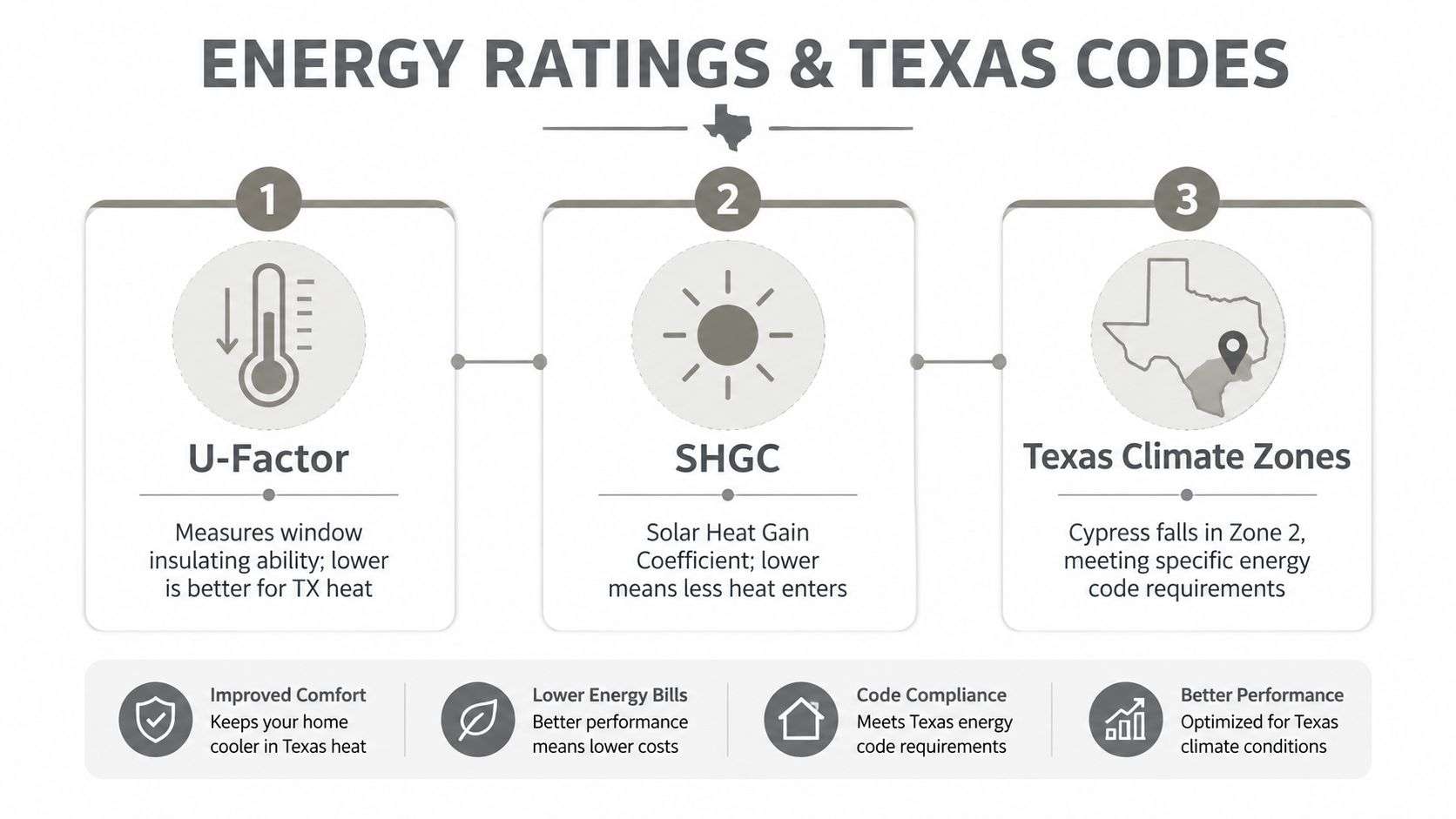
In Cypress, the window label is only part of the performance decision. The opening must handle Gulf Coast heat, strong sun, humidity, and air movement. Compare U-factor, SHGC, and air leakage, then confirm that the selected values fit the applicable Texas requirements. The Texas fenestration code reference provides the technical framework for checking compliance.
What the ratings mean
U-factor measures heat transfer through the window. A lower value generally indicates better insulation. In Cypress, that helps reduce outdoor heat passing through the glass and frame, though it cannot correct gaps around a poorly installed unit.
SHGC measures the fraction of solar energy transmitted through the window. A lower SHGC limits sun-driven heat entering the room. This matters on sunny southern and western exposures, where a window can have respectable insulation and still make an interior feel hot.
Air leakage measures airflow through joints and seals. Texas requirements address maximum leakage and area-weighted performance. Many compliant products target 0.3 cfm/ft² or below, as described in the code reference. The rating has practical value only when shims, fasteners, flashing, and perimeter sealants preserve the assembly's airtightness.
Glass technology isn't the whole assembly
Low-E coatings help control radiant heat while preserving daylight. Insulated glass units add a thermal barrier, and gas-filled spaces can support that barrier. None of these features makes up for a crooked opening, poor drainage, or an unsealed perimeter.
Review the installation principles in this guide to energy-efficient double-pane window installation. Glass, frame, flashing, shims, and sealants must work together. Local permitting and inspection requirements should also be confirmed before work begins, especially when the opening size or structural details change.
Field rule: For Cypress rooms exposed to strong sun, choose the lowest practical SHGC, verify documented air-leakage performance, and require careful perimeter sealing.
The Step-by-Step Window Replacement Process
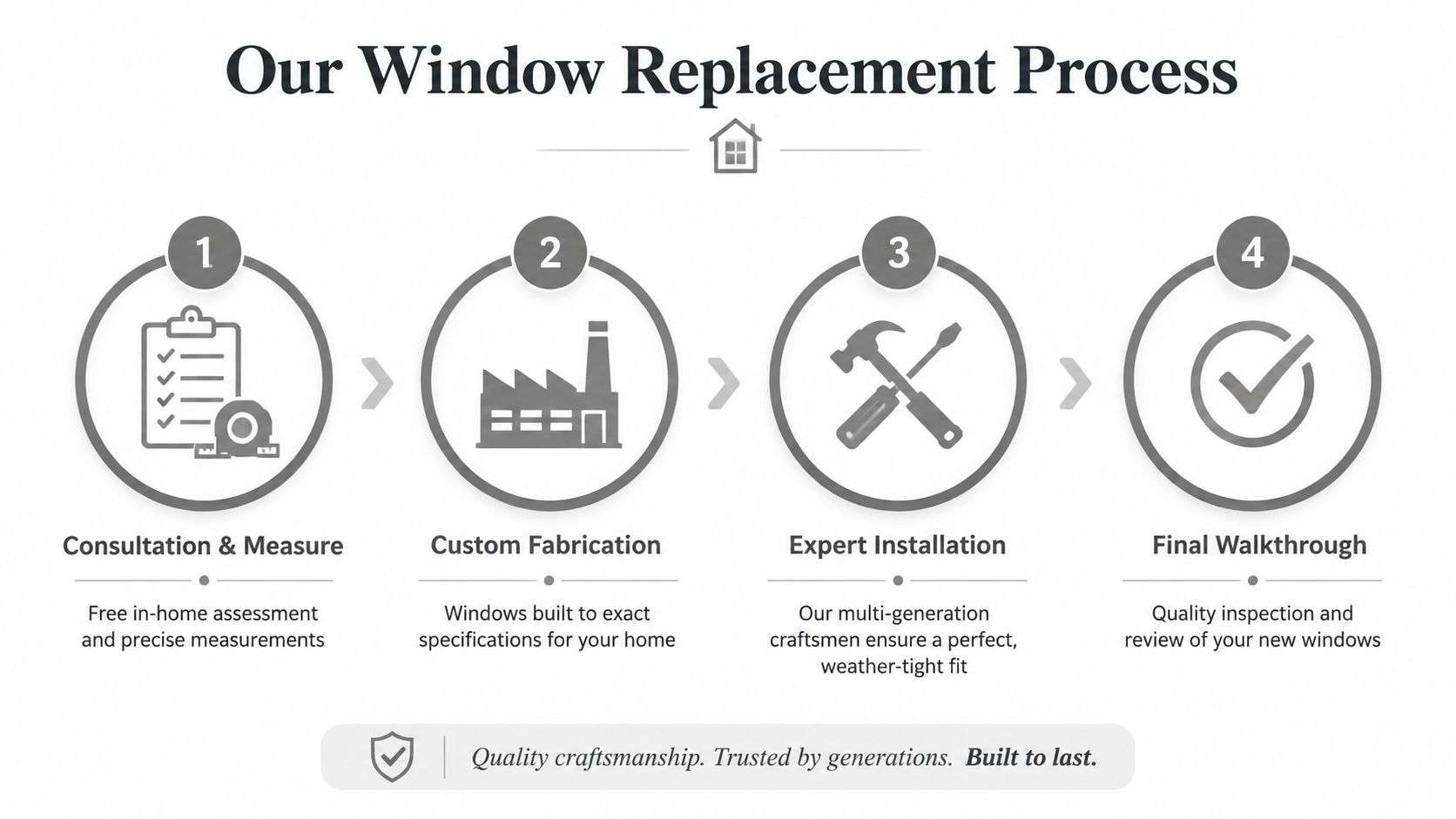
Window replacement succeeds when each stage protects the next one. A rushed measurement creates fabrication problems, and a rushed installation can erase the performance promised on the label.
1. Consultation and measurement
The process starts with an in-home review of every opening. Measurements should account for width, height, square, sill condition, trim, drainage, and the chosen installation method. We also discuss room function, sun exposure, ventilation, cleaning, and the architectural character of the home.
A good consultation identifies problems before an order is placed. It also separates necessary work from optional upgrades, which makes the proposal easier to understand.
2. Product selection and fabrication
Once measurements are verified, the window is ordered to the opening's exact specifications. The selection should include the required U-factor, SHGC, air-leakage performance, glass configuration, frame material, hardware, and color.
Style and performance meet. A fixed unit may suit a large view, while an operable unit may be necessary for ventilation or emergency egress. Fabrication must match the approved dimensions because field improvisation creates weak points.
3. Removal and installation
The crew removes the old unit without damaging surrounding finishes whenever possible. Once exposed, the opening is checked for rot, moisture damage, loose framing, and failed previous repairs.
The installer then sets the new window plumb, level, and square. Shims support the frame, flashing manages water, and compatible sealants close the perimeter. Air sealing isn't cosmetic. It keeps hot, humid outdoor air from entering the wall and living space.
4. Inspection and walkthrough
Operation, locks, drainage paths, glass condition, trim, and sealant lines should all be checked before the crew leaves. The homeowner should receive an explanation of operation and care, along with documentation for the installed products and warranty terms.
Permitting requirements depend on the project and jurisdiction. A local remodeling team should confirm the applicable City of Houston or local authority process rather than assuming every replacement follows the same path.
Storm Protection and Hurricane-Rated Windows
After a Gulf Coast storm, the most revealing damage often appears around the window rather than in the center of the glass. Wind-driven rain finds loose trim, failed sealant, and poorly flashed corners. Once water reaches the wall assembly, the repair can become much larger than a glass replacement.
A post-storm restoration should begin with an opening inspection. The crew needs to determine whether the frame is sound, whether the sill drained correctly, and whether surrounding drywall, insulation, sheathing, or trim absorbed moisture. Installing a new unit over hidden damage only conceals the problem.
Impact-resistant windows use laminated glass designed to remain together when damaged. That can help preserve the building envelope, but the glass alone doesn't make the installation storm-ready. The frame, anchors, fasteners, rough opening, and perimeter seal must work as one assembly.
What storm-conscious homeowners should verify
- Product documentation: Confirm the unit has the performance documentation required for the intended application.
- Opening preparation: Look for damaged framing, wet materials, and failed sill conditions before installation.
- Anchoring: The installer must secure the window according to the product and wall construction requirements.
- Water management: Flashing and sealant should direct water outward instead of trapping it behind trim.
- Interior protection: A properly sealed assembly helps limit wind-driven rain and humidity intrusion.
The same practical mindset applies to other restoration work, including lessons in durable shelter and community rebuilding found in Notes From The Field Tanzania. For Cypress homeowners, the immediate priority is a documented assessment and a weather-tight repair plan. A broader hurricane-resistant home exterior remodeling approach may make sense when the damage extends beyond the windows.
Why Choose a Local Cypress Remodeling Team
Local experience matters because Cypress homes differ in construction, age, exterior finishes, drainage, and repair history. After years of Gulf Coast installations, a qualified team should recognize when a failing window is connected to trim, framing, siding, or moisture control.
A distant office may sell a standardized package, while the opening still requires site-specific decisions. A local contractor can coordinate measurements, permit questions, installation, warranty communication, and follow-up with people who understand the property and remain accountable after the crew leaves.
Practical rule: Ask who will measure the openings, who will install the windows, and who will return if a seal or operating component needs attention.
Code compliance is part of workmanship
Energy ratings and structural performance only help when the installed product satisfies applicable local requirements. The contractor should explain the selected U-factor, SHGC, air-leakage documentation, installation method, and inspection steps for the project.
Paperwork protects both sides. The proposal should identify product allowances, removal, disposal, trim repair, flashing, sealants, painting, permits, and warranty responsibilities. A clear scope also states how concealed damage will be handled instead of leaving that decision to the jobsite.
Use a neutral checklist to find local window service companies, then ask each candidate the same questions. Confirm licensing and insurance information, request references suited to the project, and verify that the installation supervisor understands Gulf Coast moisture control.
H-Towne & Around Remodelers, Inc. handles window replacement alongside kitchen, bathroom, room addition, exterior, and whole-home remodeling work. Its local service model includes permit assistance, design support, written proposals, and warranties tied to the completed project.
If the window work is part of a broader renovation, the earlier cost discussion provides the relevant project ranges without repeating them here. The local-team advantage is coordination: kitchen, bathroom, or whole-home work can be scheduled with window installation when layouts, exterior walls, or the building envelope are already being changed. That planning reduces conflicting scopes and helps keep permit responsibilities clear.
Get Your Free Window Replacement Estimate
An estimate should specify the existing-condition work, product performance ratings, perimeter-sealing method, and finish work remaining after installation. In Cypress, that scope should also account for humidity, wind-driven rain, and the permit requirements tied to changes in the building envelope.
Walk the home with the estimator and identify rooms that overheat, windows that stick, visible condensation, damaged trim, outside noise, water staining, and noticeable air movement. These observations connect the proposed window package to actual problems instead of placing the same unit in every opening.
Request a written scope covering:
- Existing-condition work: Removal, disposal, framing repairs, rot treatment, and moisture-related corrections.
- Product details: Frame material, glass type, Low-E treatment, U-factor, SHGC, air-leakage documentation, hardware, and color.
- Installation details: Flashing, shimming, sealants, insulation, exterior transitions, and interior casing.
- Project administration: Permit responsibility, inspection coordination, schedule, payment stages, cleanup, and warranty coverage.
Ask who will obtain Cypress permits, schedule inspections, and document any concealed damage discovered after removal. Those responsibilities should be assigned before work begins, not settled at the opening.
If window replacement is part of a larger renovation, compare proposals by installation scope rather than headline price. Kitchen, bathroom, and whole-home work can involve layout changes, cabinetry, electrical and plumbing adjustments, flooring, paint, or exterior repairs, so confirm which trades, repairs, disposal, and finish work are included. Review the Houston kitchen remodeling cost guide, Houston bathroom remodeling cost guide, and Houston whole-home remodeling cost reference for broader planning context, then request a complimentary Cypress estimate with a clearly separated window scope.
H-Towne & Around Remodelers, Inc. provides window replacement, storm and flood restoration, kitchen remodeling, bathroom remodeling, and whole-home renovation services for Cypress and Greater Houston homeowners. Visit H-Towne & Around Remodelers, Inc. to request an estimate and discuss a properly sealed window project with a local remodeling team.