
A cosmetic tile bathroom refresh in Cypress usually runs $8,000 to $15,000 and takes 1 to 2 weeks of active construction, while a mid-range remodel typically falls between $15,000 and $40,000 over 3 to 5 weeks. In real life, most homeowners should plan on 12 to 18 weeks from first consultation to final reveal once design decisions, ordering, permits, and scheduling are included.
If you're staring at an older bathroom with worn tile, a cramped tub, dated finishes, or grout lines that never seem clean, you're in the same spot as a lot of Cypress homeowners. The bathroom still works, but it doesn't work well. It feels old, it holds moisture, and every shortcut from the last remodel starts showing up at once.
Tile bathroom remodeling in Cypress TX isn't just about picking a pretty wall tile and a new vanity. This market has its own pressure points. Humidity is real. Subfloor prep matters. Foundation movement can telegraph through rigid finishes. Permits and approvals can slow a job down if nobody plans ahead. Big-box advice rarely covers any of that.
The good news is that bathroom remodeling sits inside a large and durable renovation market. The U.S. bathroom remodeling market was valued at $68 billion, and broader U.S. home renovation spending rose from $328 billion in 2019 to $472 billion in 2022, with a forecast of $485 billion in 2024 according to bathroom remodeling market data and renovation spending figures. That tells you this isn't a niche project. Homeowners are investing in spaces that function better, age better, and hold up under daily use.
Table of Contents
- Your 2026 Guide to Tile Bathroom Remodeling in Cypress TX
- Mapping Your Project Scope and Timeline
- Setting a Realistic Remodeling Budget
- Selecting Tile and Materials for the Texas Climate
- Waterproofing and Prep Work That Prevents Failure
- How to Hire a Licensed Cypress Contractor
- Cypress Bathroom Remodeling FAQs
Your 2026 Guide to Tile Bathroom Remodeling in Cypress TX
Most bathroom frustration starts with small things that build up. The shower feels dark. The floor tile looks tired. The tub takes up too much room. Storage is poor, and the room never quite dries out the way it should. Once that starts, homeowners usually realize they don't need a cosmetic patch. They need a plan.
In Cypress, the right remodel balances appearance, moisture control, and layout. Tile has to look good, but it also has to survive a room that gets wet every day. That means the decisions under the surface matter as much as the finish materials you see.
What homeowners usually want
Some projects are simple updates. Others are full reworks of the room. The most common goals tend to include:
- A better shower layout: Replacing a bulky tub, opening the entry, or making the shower easier to clean.
- More durable finishes: Swapping out builder-grade surfaces for tile and trim that hold up better.
- Improved function: Adding storage, correcting weak lighting, or improving ventilation.
- A cleaner visual line: Larger-format tile, simpler grout patterns, and fewer awkward transitions.
Practical rule: If the room has moisture problems, cracked grout, soft walls, or a shower that was built without clear waterproofing details, solve the assembly first and the style second.
What generic remodel advice misses in Cypress
A lot of national bathroom content assumes a flat, predictable remodel path. Cypress homes don't always cooperate. Houston-area humidity puts more pressure on ventilation and drying. Slight structural movement can show up in tile installations if the substrate isn't handled correctly. Material lead times can affect sequencing. Local review and permit expectations can add time before a hammer even swings.
That's why a good remodel starts with field conditions, not Pinterest boards. Measure the room. Check plumb and level. Look at how the existing shower was built. Find out whether the floor feels solid, whether the exhaust fan is doing its job, and whether past water exposure has reached framing or adjacent finishes.
Homeowners who approach tile bathroom remodeling in Cypress TX this way usually make better choices. They spend money where it changes performance, not just where it changes the photo.
Mapping Your Project Scope and Timeline
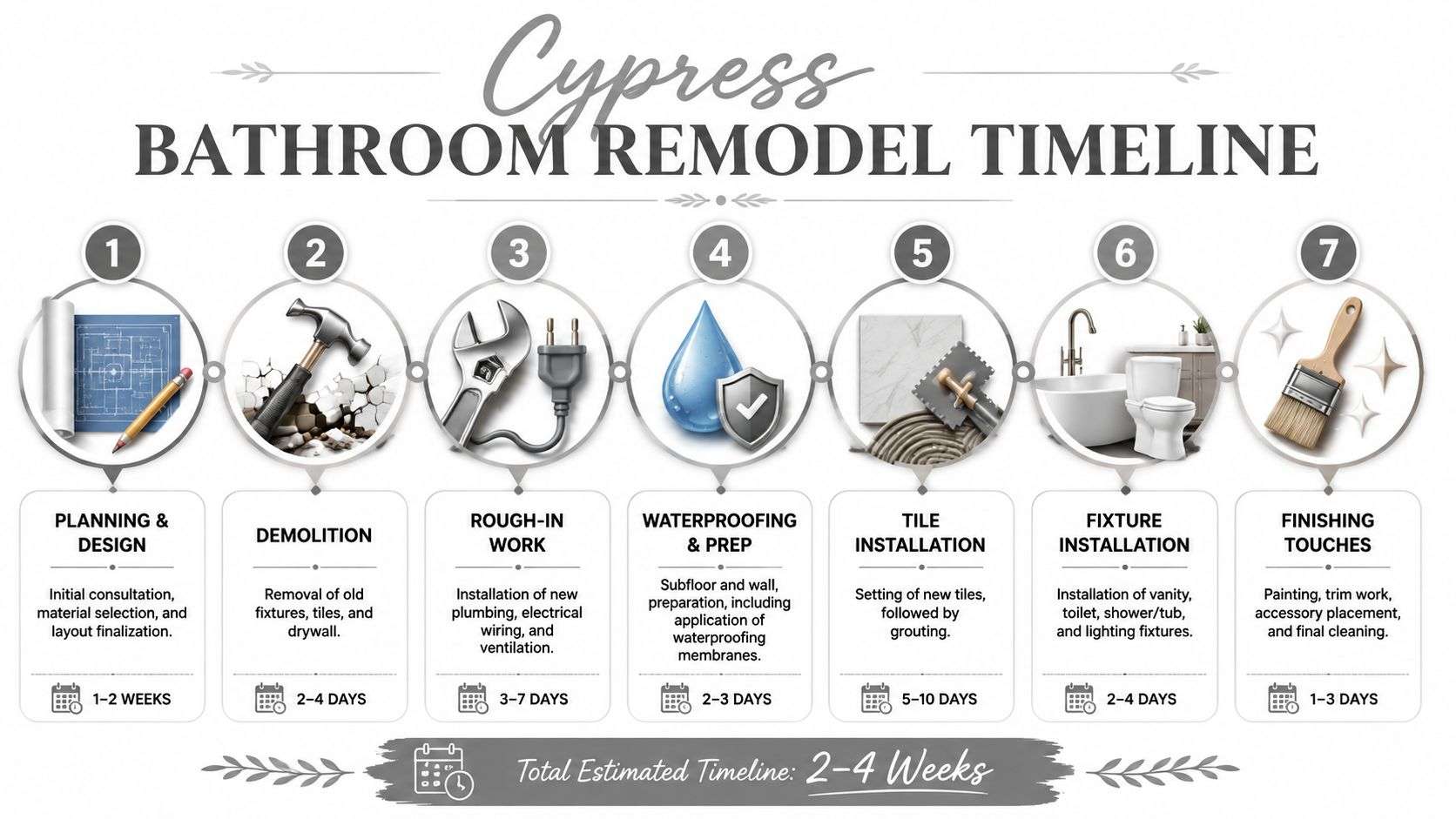
A bathroom remodel feels much more manageable when you know the order of work. Most problems on remodeling jobs don't start with tile. They start when selections are late, rough-in changes happen after walls are closed, or prep work gets rushed.
What happens before demolition
The front end decides whether the rest of the job runs cleanly. In Cypress, bathroom remodel pricing and scheduling commonly fall into these tiers: a cosmetic refresh is typically $8,000 to $15,000 over 1 to 2 weeks, a mid-range remodel is $15,000 to $40,000 over 3 to 5 weeks, and a full tub-to-shower conversion with new tile can reach $40,000 to $100,000+ with 5 to 8 weeks of active construction. Total elapsed time from consultation to reveal is often 12 to 18 weeks once design selections, permits, and approvals are included, based on Cypress bathroom remodel cost and timeline guidance.
Before demo starts, a solid contractor will usually lock down:
- Scope. Keep the same layout, or move plumbing and electrical.
- Selections. Tile, grout color, plumbing trim, glass, vanity, lighting, and paint.
- Approvals. HOA requirements if they apply, plus local permit handling when required.
- Ordering and scheduling. Materials need to be on site or confirmed before tear-out.
If a homeowner changes the tile size, drain location, or niche layout after rough-in starts, the whole sequence gets tighter. That's where delays start.
What happens once construction starts
The build stage usually follows a predictable order:
- Demolition and removal: Old tile, drywall, fixtures, and damaged substrates come out first.
- Rough-in work: Plumbing, electrical, and ventilation get adjusted to match the new plan.
- Prep and waterproofing: Wall boards, floors, slopes, corners, and penetrations get ready for tile.
- Tile installation: Layout lines are set first. Then tile goes in, followed by grout and cure time.
- Fixture set and trim-out: Toilet, vanity, plumbing trim, mirrors, lights, and accessories go in.
- Punch list and final walkthrough: Small corrections, cleaning, and owner review wrap it up.
The smartest schedule is the one that leaves room for inspection, cure time, and material verification. Bathrooms fail when crews stack trades too tightly and force the next step before the previous one is ready.
A homeowner can usually stay in the house during a single-bathroom remodel if there's another working bathroom. The harder part isn't noise. It's temporary inconvenience, dust control, and losing access to one of the most used rooms in the house. Good scheduling and clean daily staging matter more than homeowners often expect.
Setting a Realistic Remodeling Budget
The budget question isn't just "what does a bathroom cost?" The better question is "what level of work are you buying?" Homeowners often compare two proposals that look similar on paper, even though one includes full prep and the other assumes the existing conditions are good enough. That's where price confusion starts.
What changes the price
Three bathrooms can all be called a remodel and still be very different jobs.
A cosmetic refresh usually keeps much of the existing layout and focuses on visible upgrades. A mid-range remodel often adds more substantial finish replacement and functional improvement. A full tile-heavy conversion usually means deeper demolition, shower reconfiguration, and more custom labor. The numbers in Cypress reflect that spread, but the true driver is scope, not just square footage.
The cost tends to rise when you add work such as:
- Layout changes: Moving drains, valves, or lighting usually adds labor and coordination.
- Custom tile detailing: Niches, benches, accent bands, wrapped corners, and complex patterns all slow installation.
- Hidden repairs: Water damage, framing correction, and subfloor issues don't show up until demolition.
- Material jumps: Tile itself may not break the budget, but premium trim pieces, specialty glass, and plumbing finishes can.
A useful planning step is to first estimate bathroom renovation expenses in broad categories, then compare that rough worksheet against a local contractor's scope line by line. That helps homeowners see whether they're paying for appearance, infrastructure, or both.
Where homeowners overspend
A lot of waste happens in places that don't improve performance.
One common mistake is buying an expensive tile and pairing it with weak installation planning. Another is stretching for a full custom shower while leaving ventilation, storage, or lighting untouched. The bathroom may photograph better, but it won't necessarily function better.
A smarter budget usually follows this order:
- Fix the assembly first: Structure, moisture control, and rough-in issues.
- Spend on the surfaces you touch daily: Flooring underfoot, shower walls, valves, vanity top.
- Simplify where it doesn't matter: Overly busy patterns, too many tile sizes, or decorative elements that increase cuts without improving use.
Homeowners rarely regret paying for better prep. They often regret paying for decorative complexity that makes cleaning harder and adds no real function.
If a quote looks low, check what's missing. Ask whether it includes demolition haul-off, substrate replacement, waterproofing, trim pieces, shower glass coordination, permit handling, and final punch work. A low number can be perfectly valid for a small cosmetic job. It can also be a sign that key parts of the build haven't been priced.
Selecting Tile and Materials for the Texas Climate
Tile choice in Cypress isn't only about color and pattern. The room gets steam, standing water, cleaning chemicals, and regular temperature swings. That makes porosity, surface texture, and maintenance demands just as important as style.
How the main tile categories compare
Some materials are more forgiving in a humid bathroom.
| Material | Porosity | Durability | Maintenance | Best For |
|---|---|---|---|---|
| Porcelain | Low | High | Low | Shower walls, shower floors, bathroom floors |
| Ceramic | Moderate | Good | Moderate | Wall tile, lighter-duty floor areas |
| Natural stone | Varies | Good to high | Higher | Feature areas, upscale looks, owners willing to maintain it |
Porcelain is usually the most practical choice for wet areas. It tends to handle daily use well and gives homeowners a wide design range without asking for much maintenance. Ceramic can work well too, especially on walls, but it may not be the first pick for every floor or shower application. Natural stone looks strong in the right design, but it asks more from the owner in sealing, cleaning, and long-term upkeep.
For more design-focused guidance on color, scale, and pattern, this guide on how to pick bathroom tile is useful once you've narrowed your material type.
What works better in Cypress bathrooms
The best bathrooms here usually keep the palette simple and the assembly disciplined.
A few practical choices hold up well:
- Porcelain on shower walls: Reliable, easier to maintain, and available in both clean modern styles and traditional looks.
- Smaller or textured tile on shower floors: Better traction and easier slope fitting around the drain.
- Larger-format tile on main floors and walls: Fewer grout joints and a quieter visual field, if the room is flat enough to support it.
- Matte or satin finishes in wet zones: More forgiving for slip resistance and water spotting than highly polished surfaces.
Choose tile for the way you live, not just the showroom board. A family bathroom, a guest bath, and a primary suite don't all need the same surface strategy.
The wrong material isn't always obviously wrong at installation. Problems usually show up later. A slick floor gets annoying. A high-maintenance stone starts looking tired. Busy grout joints become a cleaning burden. In this climate, the best material choice is usually the one that still looks good after repeated use, not just after final cleanup.
Waterproofing and Prep Work That Prevents Failure
The most important part of a tile bathroom remodel is the part you won't see after the job is done. Homeowners naturally focus on the tile, but tile is only the finish surface. The actual defense is the system beneath it.
What sits under the tile matters more
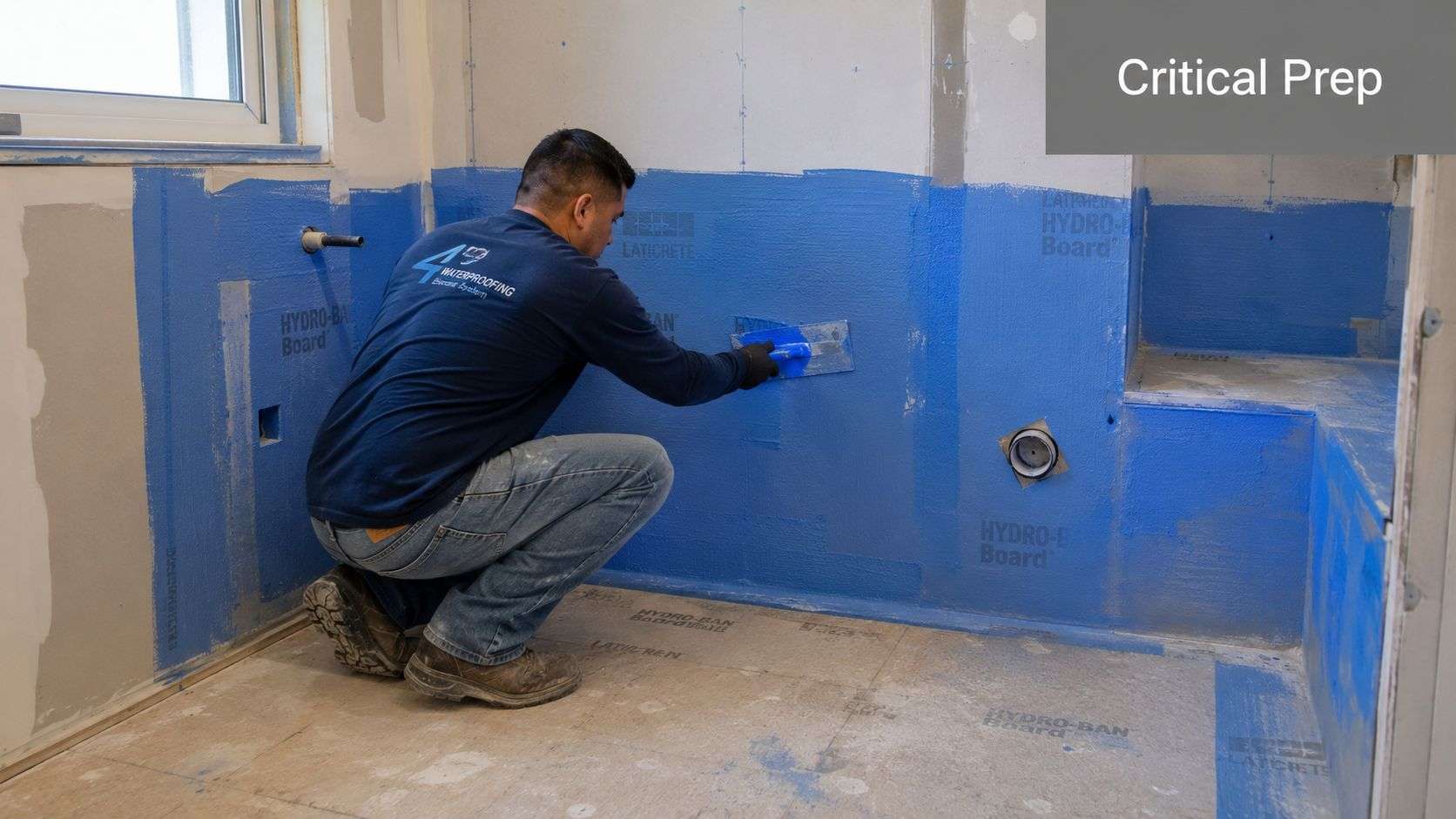
In a humid Gulf Coast climate like Cypress, the main technical risk is moisture reaching the framing. A continuous waterproofing membrane is essential because grout is porous and does not serve as a water barrier, making the substrate system the true defense against water damage and tile failure, as explained in this overview of bathroom waterproofing and substrate protection in Cypress.
That means a proper shower build needs more than cement board alone. The board provides a stable tile backing. It doesn't solve water management by itself. Waterproofing has to continue across seams, corners, fastener areas, niches, benches, pan transitions, and pipe penetrations.
Prep details that separate lasting work from callbacks
The failures I see most often are basic. Flat shower pans. Weak corner treatment. No clear membrane strategy. Tile bonded over surfaces that should've been corrected first. Those jobs may look finished, but they aren't built to stay finished.
A solid prep sequence should include:
- Substrate evaluation: Floors and walls need to be firm, aligned, and suitable for tile.
- Waterproof continuity: The wet area needs one clear water-management plan from top to bottom.
- Correct slope and drainage: Water has to move to the drain instead of sitting at the perimeter.
- Movement treatment: Changes in plane need proper sealant strategy, not rigid filling everywhere.
If you're comparing shower details, this article on caulking tiles in bathroom is a useful reminder that finishing joints correctly is part of the system, not an afterthought.
Grout finishes the surface. It does not waterproof the shower. If a contractor talks about "sealed grout" as the water barrier, keep asking questions.
This is the stage where quality shows up years later. Homeowners don't call back because a membrane looked good during install. They call back because corners cracked, trim leaked, or moisture migrated where it never should've reached. Good prep prevents those calls.
How to Hire a Licensed Cypress Contractor
Choosing the contractor is less about hearing the best sales pitch and more about hearing clear answers. A bathroom remodel touches plumbing, electrical, waterproofing, finish carpentry, and scheduling. If the contractor can't explain how those parts connect, the job usually gets harder once walls open up.
Questions worth asking before you sign
Ask direct questions and listen for direct answers.
- Who is managing the job daily: You want to know who coordinates trades, selections, and punch work.
- How do you handle permits and local requirements: Cypress projects can involve permit coordination and, in some neighborhoods, HOA review.
- What is your waterproofing method: If they can't explain their shower assembly in plain language, that's a problem.
- What happens if demolition exposes damage: Good contractors have a change-order process instead of making field guesses.
- What insurance and documentation do you carry: Ask to verify what protects the homeowner and the crew.
When the discussion gets technical, it's fair to ask how they build the shower base and contain water at the floor assembly. This explainer on a shower pan liner helps homeowners understand one of the most important details hidden under the tile.
For homeowners who want a local starting point, bathroom remodel contractor in Cypress TX is one example of a service page that outlines bathroom remodeling work in this market. H-Towne & Around Remodelers, Inc. handles bathroom remodeling as part of its residential remodeling work in Cypress and the broader Houston area.
Red flags that usually cost homeowners later
A bad fit often announces itself early.
Watch for these warning signs:
- Large cash demands upfront: Deposits and draw schedules should be documented and tied to work.
- No written scope: If tile prep, demo limits, or fixture allowances aren't described, assumptions will fill the gap.
- Vague warranty language: "We'll take care of it" isn't the same as a written workmanship commitment.
- No physical business presence: Homeowners should know who they're hiring and how to reach them after the job closes.
- Pressure to decide immediately: A bathroom remodel is too invasive for rushed decisions.
A trustworthy contractor doesn't get annoyed by detailed questions. Bathroom remodeling is detailed work. The conversation should reflect that.
The best hiring outcome is boring in the best way. The contractor documents the plan, orders the right materials, protects the house, communicates clearly, and builds the shower correctly. That's the standard to look for.
Cypress Bathroom Remodeling FAQs
Can I stay in my home during the remodel
Usually, yes. If the house has another working bathroom, most families stay put. The bigger issue is inconvenience. Expect noise, dust control measures, workers moving through the home, and stretches where water may be briefly shut off during specific tasks.
How are unexpected issues handled once demolition starts
The right way is with documentation and a written change process. If demolition reveals damaged framing, plumbing corrections, or old moisture problems, the contractor should stop, show you what was found, explain the repair path, and price the added scope before proceeding.
Do you need permits or HOA approval in Cypress
Some bathroom projects need permit coordination, especially when plumbing, electrical, ventilation, or structural work changes. Some neighborhoods also require HOA review for project activity or waste handling rules. This should be discussed before demolition, not after materials arrive.
What kind of tile work lasts longer
Tile work lasts when the substrate is stable, the waterproofing is continuous, the shower drains correctly, and movement joints are handled properly. Homeowners often focus on tile brand or grout color first, but long-term performance comes from the assembly under the surface.
Should I convert a tub to a shower
That depends on how you use the room. In a primary bath, a walk-in shower often improves daily function. In a hall bath that serves kids or guests, keeping a tub can still make sense. The right answer is based on household needs, room size, and resale considerations for your specific home.
How should I prepare before the project starts
Clear personal items, confirm product selections early, and decide who has final say on design changes. The smoother the decision-making, the smoother the schedule.
If you're planning a bathroom update and want practical guidance from a licensed, insured remodeler that works in Cypress and the Greater Houston area, H-Towne & Around Remodelers, Inc. is a straightforward place to start. Reach out for a conversation about your layout, tile goals, moisture-control needs, and the scope that makes sense for your home.