
If you're living in Cypress, you may already feel the tension that pushes a lot of renovation decisions. The house still works, but the kitchen bottlenecks every morning, the bathroom looks dated beside newer homes nearby, or the whole layout feels built for a different stage of life. That's usually when home renovations in Cypress TX stop being a someday idea and become a practical decision.
The local market gives that decision real weight. Cypress sits in a fast-growing part of the Houston metro, and that growth affects what owners expect from their homes and what buyers compare them against. In a place where people regularly move, upgrade, and resell, renovations aren't just about looks. They're about function, durability, and making sure the house holds up against newer inventory.
Table of Contents
- Why Renovate Your Home in Cypress Today
- Popular Home Remodeling Projects in Cypress
- Budgeting for Your Cypress Renovation Costs and ROI
- The Renovation Timeline From Design to Completion
- How to Hire the Right Cypress Remodeling Contractor
- Cypress Codes and Storm Resilient Renovations
- Start Your Cypress Home Renovation with H-Towne
Why Renovate Your Home in Cypress Today
You feel it the first week after a hard rain. The house still looks fine from the street, but inside, the weak spots show up fast. Humidity lingers in the bath, the back door swells, the old flooring telegraphs every dip in the slab, and the kitchen layout still fights the way your family lives.
That is why many Cypress homeowners renovate now instead of waiting for a bigger failure or a forced move. Local housing market data shows Cypress homes in May 2026 were selling at about 98% of list price, or roughly 2.0% below asking on average, which means buyers still have options and condition still matters (local Cypress housing market data). In a market with steady new inventory nearby, older homes do not just need updated finishes. They need better function, better moisture control, and better resistance to the wear that Gulf Coast weather puts on materials.
A smart renovation closes that gap.
In Cypress, the strongest projects improve appearance and reduce future risk at the same time. That could mean replacing finish materials that absorb moisture, correcting ventilation problems before they turn into mold callbacks, upgrading exterior transitions around additions, or reworking a floor plan so the home lives better during normal weeks and recovers faster after a storm. If the house is in the right neighborhood and the structure is sound, that work usually makes more sense than trading into a higher mortgage just to get features you can build into the home you already own.
I tell clients to judge the house in two categories. First, does it support daily life? Second, will the materials and assemblies hold up in Cypress conditions?
If the answer is no on either one, renovation deserves a serious look.
Common triggers are practical. The kitchen has square footage but poor circulation. The primary bath feels dated and never fully dries out. A formal room sits empty while the living area is overloaded. An undersized home office pushes someone to the kitchen table every day. In those cases, a well-planned remodel or precision-built room addition in Cypress can fix layout pressure without giving up a location that already works for school routes, commute patterns, and community ties.
Homeowners usually fall into three groups:
- Established-home owners who need to modernize aging finishes, correct deferred maintenance, and keep pace with newer resale competition
- Recent buyers who purchased for location and lot value, then want to customize the house for storage, workflow, and longer service life
- Long-term owners who care less about listing soon and more about durability, insurance headaches, and avoiding repeated repair costs
The best return often comes from solving the expensive hidden problems while the walls are already open. That is the right time to address ventilation, insulation gaps, water-prone transitions, window performance, and material selection, not just cabinet doors and paint colors. Budget discipline still matters, and homeowners who are comparing scope options can pick up useful planning ideas from Endless Storage's budget remodel guide, then adjust those ideas to fit Cypress construction realities.
Pretty helps resale. Resilience protects the investment.
That combination matters more here than in milder climates. A renovation done well gives you a house that looks current, works better every day, and stands up better to heat, moisture, and storm stress over the next decade.
Popular Home Remodeling Projects in Cypress
The most successful remodels in Cypress do two jobs at once. They improve how the house looks and feels, and they reduce the wear that Gulf Coast heat, humidity, wind, and heavy rain can put on finishes and building systems.
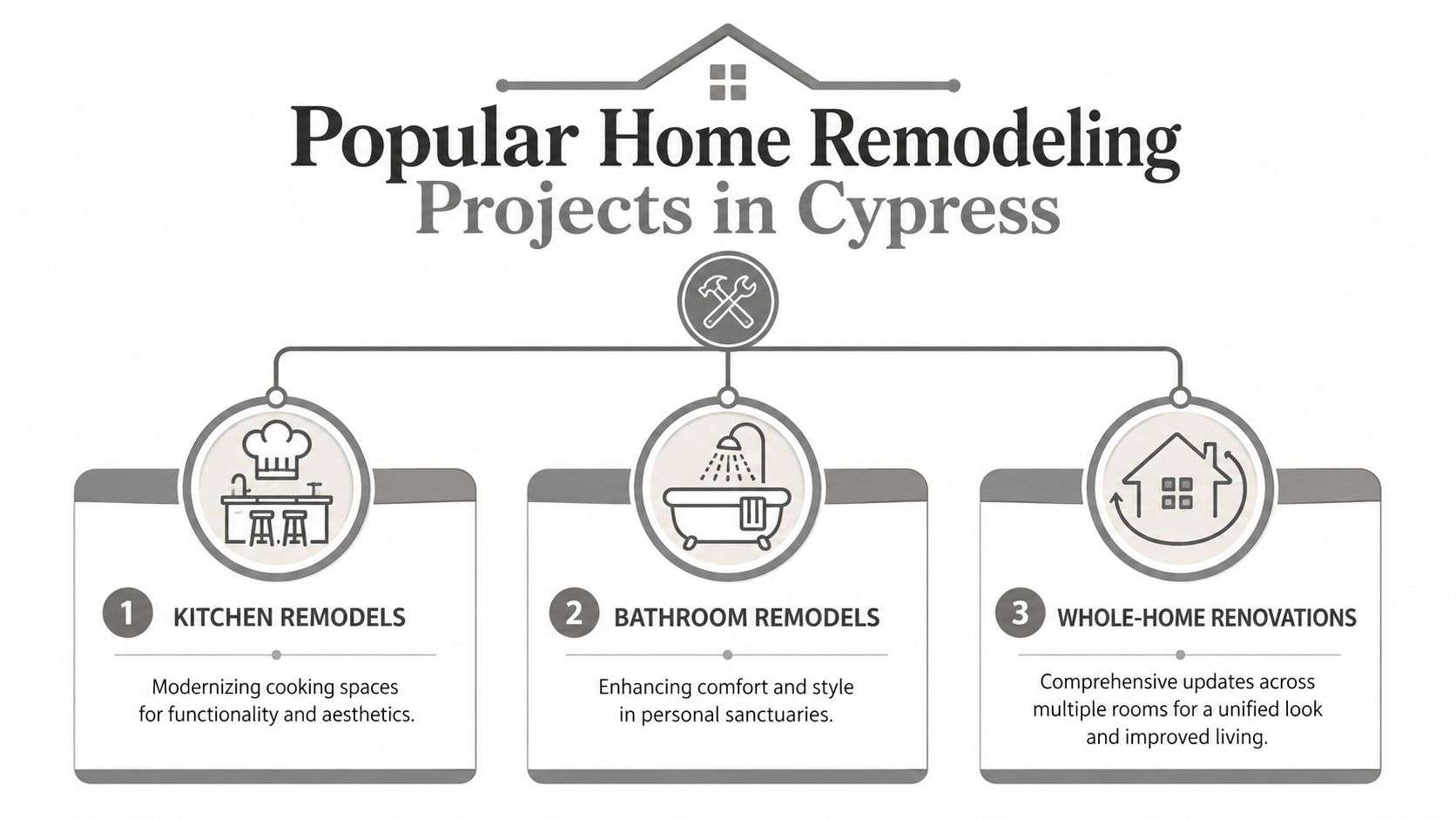
In practice, three project types come up again and again: kitchens, bathrooms, and whole-home renovations. Each one gives homeowners a chance to improve daily use while fixing weak points that often show up later as swelling trim, persistent moisture, poor airflow, or repeated maintenance calls. The best projects are not the flashiest ones. They are the ones that still perform well after several Cypress summers and storm seasons.
Kitchen remodels that solve daily friction
Kitchen work usually starts with a workflow problem. Traffic cuts through the cook zone. Storage is shallow and awkward. Counters are crowded. Lighting leaves prep areas dim. Those are design issues, but in Cypress they connect directly to durability as well.
A smart kitchen remodel often includes better ventilation, materials that stay stable under humidity, and cabinet layouts that reduce daily abuse. Quartz counters, quality cabinet boxes, proper vent hood sizing, and moisture-resistant paint systems usually hold up better than trend-driven selections that look good for a year and then start showing wear. Layout changes can also improve safety by keeping kids and guests out of the busiest work triangle.
Common kitchen priorities include:
- Better circulation: Islands and appliance spacing that reduce cross-traffic and tight pinch points
- Storage that fits real use: Deep drawers, pantry organization, tray storage, and cabinet planning based on how the household cooks
- Durable finishes: Surfaces, flooring, and coatings chosen for cleanup, humidity resistance, and long service life
- Mechanical upgrades: Ventilation, task lighting, and outlet placement that support daily cooking and reduce moisture buildup
Budget choices matter here. Homeowners comparing scope options often benefit from the planning mindset in Endless Storage's budget remodel guide, especially the distinction between function-first improvements and finish upgrades that can wait.
Some houses do not have a kitchen problem alone. They have a square-footage problem. In those cases, precision-built room additions in Cypress may produce a better result than overworking the existing footprint.
Bathroom remodels that balance comfort and function
Bathrooms are finish-heavy on the surface and system-heavy underneath. Homeowners see tile, glass, and fixtures first. Long-term performance depends on slope, waterproofing, exhaust ventilation, backing, drainage details, and how carefully every transition is built.
That is why bathroom remodeling in Cypress should be approached as a moisture-control project as much as a design project. A curbless shower can look clean and modern, but it needs proper floor prep and drainage planning. Large-format tile can reduce grout lines, but only if the substrate is flat enough to support it. Better exhaust fans, easier-to-clean wall finishes, and slip-resistant flooring often deliver more long-term value than decorative upgrades alone.
The strongest bathroom remodels usually combine comfort with practical use:
- Water management: Correct waterproofing methods, quality drain assemblies, and solid tile prep
- Daily comfort: Better lighting, improved storage, quieter fans, and layouts that feel less cramped
- Accessibility: Wider entries, curbless showers, grab-bar blocking, and clearances that support aging in place
- Lower maintenance: Materials and fixture choices that clean up easily and hold up under constant moisture
A bathroom should feel calm, but it also needs to be easy to maintain and hard to damage.
Whole-home renovations that create consistency
Whole-home remodeling makes sense when the house has been updated in pieces over many years and the result feels disconnected. Flooring changes abruptly. Lighting color shifts from room to room. One area is modern, another is dated, and the plan never fully supports how the family lives.
A full-house renovation gives you the best chance to fix those issues in one coordinated scope. It also creates the right opening to address insulation gaps, aging windows, drafty exterior doors, moisture-prone trim details, and other performance problems that are hard to solve one room at a time. In Cypress, that coordination matters because durability often depends on how systems and finishes work together across the entire house.
Good whole-home projects usually focus on:
- Visual consistency: Flooring transitions, trim style, hardware finish, and lighting temperature that feel intentional
- Functional flow: Better circulation, storage placement, and room use based on current family needs
- Envelope improvements: Window, door, insulation, and air-sealing upgrades that support comfort and storm resilience
- Long-term maintenance: Material selections that reduce repainting, swelling, and repeated repair work
A house can look current and still be vulnerable. The better remodel standard in Cypress is a home that looks sharp, handles moisture well, and recovers better from the climate stress this area sees year after year.
Budgeting for Your Cypress Renovation Costs and ROI
Budget conversations go wrong when people talk only about finishes. The bigger cost drivers are usually scope, labor intensity, infrastructure changes, and how many decisions require opening walls.
There's also a broader reason homeowners keep investing in these projects. The U.S. home-renovation market grew from $328 billion in 2019 to $472 billion, and the bathroom remodel market alone was valued at $68 billion, according to H-Towne's bathroom renovation market summary. That doesn't tell you what your project will cost. It does confirm that kitchens and bathrooms remain central renovation priorities for owners nationwide.
What drives the budget
A modest-looking remodel can cost more than expected if the underlying work is complex. A visually dramatic remodel can be more straightforward if the layout stays put.
The main variables are usually:
- Layout changes: Moving plumbing, walls, or major electrical runs increases labor and coordination.
- Material level: Cabinet construction, tile size, fixture quality, and custom work all move the budget.
- Hidden conditions: Water damage, framing repairs, code corrections, and subfloor issues can change scope once demolition starts.
- Project type: A kitchen, bath, and full-house remodel each allocate money differently across trades.
- Permit and review needs: Structural work and major system changes usually carry more administrative work than surface-level updates.
Homeowners who want a more project-specific planning framework should review how to estimate home renovation costs. It's a practical way to think through scope before selections start multiplying.
Estimated Renovation Costs & ROI in Cypress TX 2026
The ranges below are planning ranges, not universal pricing. Final costs depend on scope, existing conditions, and finish choices.
| Project Type | Typical Cost Range | Potential ROI |
|---|---|---|
| Kitchen remodel | Moderate to substantial, depending on layout changes and cabinet level | Often strong when the design improves function, storage, and overall buyer appeal |
| Bathroom remodel | Moderate to substantial, especially when waterproofing, tile work, and plumbing changes are involved | Commonly viewed as a high-impact investment because bathrooms directly affect daily use and resale perception |
| Whole-home renovation | Broad range due to multi-room scope, hidden-condition risk, and system coordination | Best when it corrects layout problems, updates multiple dated areas, and creates a cohesive result |
A useful way to think about ROI in Cypress is to separate it into three buckets.
- Lifestyle return. The home becomes easier to live in every day.
- Market return. Updated spaces compare better against newer homes in the area.
- Resilience return. Better materials and smarter detailing may reduce repair exposure later.
Budget check: Spend first on layout, envelope performance, waterproofing, and workmanship. Decorative upgrades matter, but they don't rescue a weak scope.
The Renovation Timeline From Design to Completion
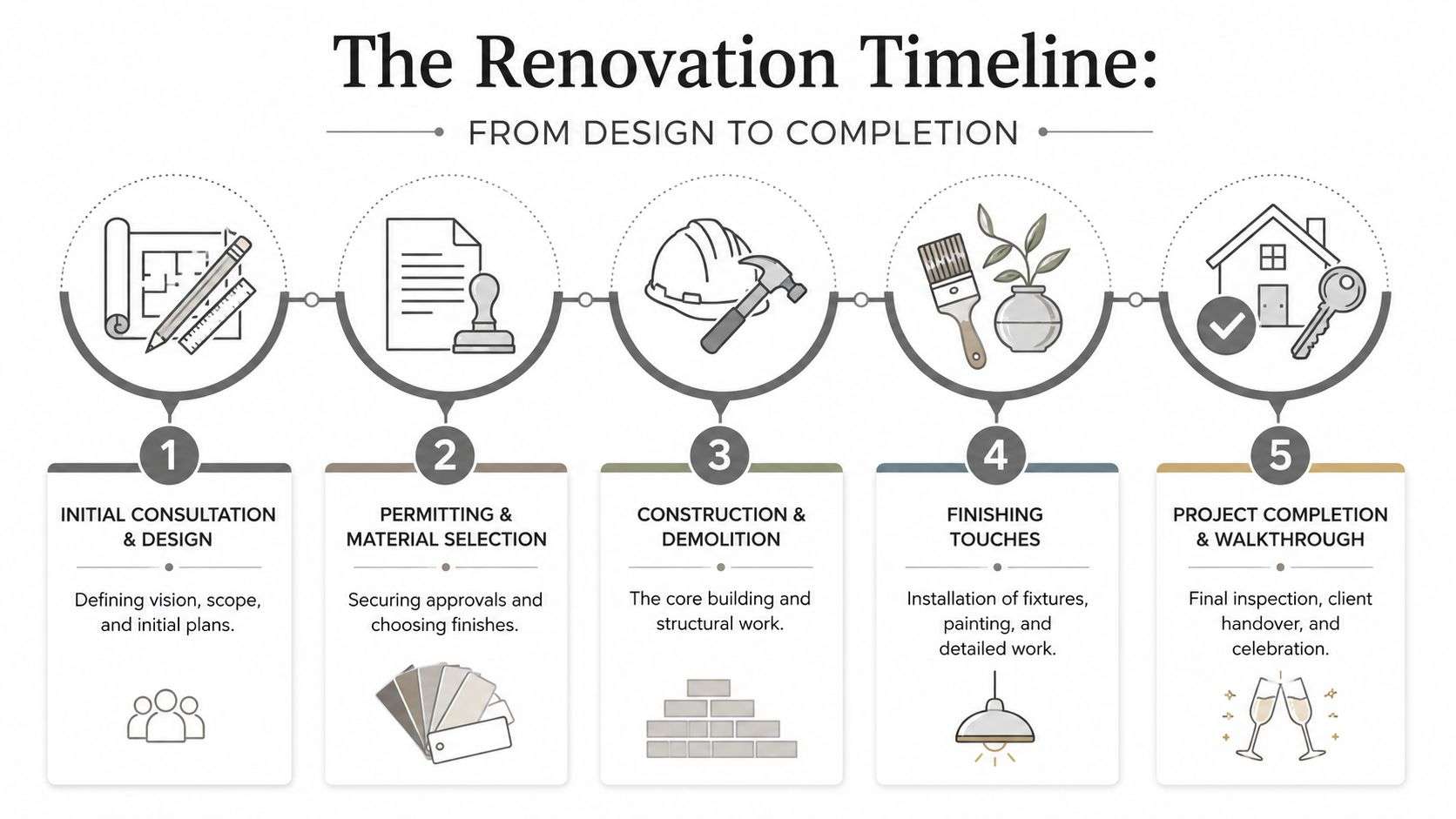
Most renovation stress comes from not knowing what happens next. A well-run project has a clear sequence, and each phase depends on decisions made earlier.
What happens in each phase
Initial consultation and design starts with measurements, goals, problem areas, and budget alignment. Homeowners must be candid. If the priority is storage, flood resilience, aging in place, or making room for a larger household, that needs to be said early.
Permitting and material selection usually happen together. Plans are refined, structural items get clarified, and finish decisions are locked tightly enough that ordering can begin. Delayed selections can disrupt the schedule even when the crew is ready.
Demolition and construction is where the hidden truth of the house shows up. Walls open. Past repairs become visible. Mechanical conflicts get solved. Good project management matters most here because this phase involves sequencing several trades without creating avoidable rework.
Installation and finishes feels more rewarding because the project starts looking complete. Cabinets, tile, plumbing trim, lighting, flooring, and paint all come together. This phase still needs discipline. Finish work suffers when earlier steps were rushed.
Final walkthrough and punch list is the closeout stage. Small adjustments, touchups, and corrections are identified, documented, and resolved before handoff.
Where homeowners help the project move smoothly
The owner's role is bigger than many people realize.
- Make selections on time: Waiting on tile, hardware, or fixtures can stall the crew.
- Respond clearly: When a field question comes up, fast decisions help protect momentum.
- Protect the scope: Mid-project changes are possible, but they often affect schedule, cost, and coordination.
- Prepare the home: Clear access routes and temporary living plans reduce stress during active work.
If the project exposes framing or exterior-adjacent areas, it's also smart to review expert tips for renovation termite control before the build moves too far. Prevention is easier when assemblies are open than after finishes are installed.
How to Hire the Right Cypress Remodeling Contractor
Choosing the contractor shapes everything that follows. The design can be promising and the finish choices can be excellent, but poor management, unclear pricing, or weak trade supervision will still show up in the final result.

What separates a real remodeling company from a patchwork operation
A serious remodeling contractor does more than provide labor. The company should define scope clearly, coordinate trades, manage permits where needed, communicate scheduling, document changes, and stand behind the finished work.
That matters more in Cypress because many projects touch structural details, moisture-prone areas, or storm-related rebuilding concerns. A cosmetic installer may handle visible finishes well enough. That same person may not be equipped to manage waterproofing transitions, tie-in flashing, inspection requirements, or structural sequencing.
One local option that handles kitchen remodels, bathroom remodels, additions, and whole-home work is H-Towne & Around Remodelers, Inc. The relevant point isn't brand preference. It's that homeowners should look for a licensed, insured company with a defined process for planning, permits, communication, and warranty follow-through.
Cheap bids often hide expensive omissions. If waterproofing, prep, protection, or cleanup aren't written clearly, ask what's actually included before you compare totals.
Questions worth asking before you sign anything
Use the interview process to find out how the contractor thinks, not just what number appears at the bottom of the proposal.
- Who manages the project day to day? You need to know who answers field questions and tracks progress.
- How is scope documented? Clear line items reduce misunderstandings later.
- What happens if hidden damage is found? The contractor should explain change-order handling before demolition starts.
- How do you protect occupied homes? Dust control, access planning, and site cleanliness matter.
- What work is self-performed and what is subcontracted? Neither model is automatically better, but the supervision must be clear.
- How are permits and inspections handled? The answer should be direct and specific.
- What kind of warranty is provided? Ask what is covered and how service requests are handled after completion.
References matter too, but ask useful questions when you call them. Don't just ask whether they liked the finished room. Ask whether the contractor communicated well, handled problems transparently, and closed the punch list without excuses.
Cypress Codes and Storm Resilient Renovations
A Cypress remodel has to do two jobs at once. It needs to look current and it needs to handle humidity, wind, and water exposure that can shorten the life of a renovation if the assembly details are weak.
Floodplain rules can change the scope faster than homeowners expect
Homes in or near mapped flood-risk areas need closer review before plans are finalized. A kitchen update or first-floor reconfiguration can trigger code and permitting questions about elevation, materials, electrical placement, and what counts as an improvement to conditioned living space. That is why we check site conditions early, not after selections are made and demolition is scheduled.
The finish choices matter, but the hidden details matter more in these zones. Raised outlets and switches, water-tolerant lower-wall materials, closed-cell insulation in the right locations, and assemblies that can dry after incidental moisture all reduce repair costs if water reaches the house. A beautiful room built with poor recovery potential often looks great on day one and becomes expensive after one storm event.
Additions and major structural changes need a continuous load path
For additions, patio conversions, and second-story work, the main question is how new framing transfers roof and wall loads back to the foundation. In this part of Greater Houston, wind resistance is not a cosmetic issue. Connectors, fastening schedules, roof tie-ins, sheathing, and flashing all have to work together.
The weak point is usually the transition between old construction and new construction.
If that connection is underbuilt or poorly flashed, the problems usually show up as roof leaks, cracked finishes, door movement, or moisture trapped in the wall cavity. Good-looking trim can hide that for a while. It does not fix it.
A resilience-focused remodel usually includes a few practical upgrades:
- Higher electrical placement in vulnerable areas: Reduces the chance that minor water intrusion ruins devices and wiring.
- Moisture-managed wall and roof assemblies: Helps materials dry instead of trapping humidity inside the assembly.
- Stronger tie-in detailing at additions: Proper flashing, fastening, and water management protect the joint where failures often start.
- Durable access and opening choices: Wider openings, better-performing windows, and low-threshold entries can improve daily use and post-storm recovery.
Exterior work deserves the same level of planning as interior finishes. If you are updating cladding, roofing edges, windows, soffits, or other exposed assemblies, hurricane-resistant home exterior remodeling strategies for Cypress homes can help you plan upgrades that improve both appearance and storm performance. For household readiness beyond the remodel itself, this survival guide for home emergencies is a useful reference before storm season.
Start Your Cypress Home Renovation with H-Towne
The strongest home renovations in Cypress TX don't chase appearance alone. They solve the friction you feel every day, protect the house against local weather realities, and make the investment easier to justify over time.
That's the balance worth aiming for in a kitchen remodel, a bathroom upgrade, or a whole-home renovation. The layout should work better. The finishes should hold up. The construction details behind the walls should make sense for Cypress, not just for a showroom photo.
If your home feels dated, undersized, storm-vulnerable, or not aligned with how your family lives now, the next step is a serious planning conversation. Good remodeling starts with clear scope, realistic budgeting, and decisions that respect both style and structure. That approach avoids the most expensive mistake in this market, spending heavily on visible upgrades while ignoring the technical details that determine durability.
If you're ready to plan a kitchen remodel, bathroom renovation, room addition, or whole-home update, contact H-Towne & Around Remodelers, Inc. for a complimentary estimate. A well-planned renovation can give you a better-looking home, a more functional layout, and construction details that make sense for Cypress conditions.