
You're probably standing in your kitchen right now, looking at cabinets that have seen better days, counters that never gave you enough workspace, and a layout that slows down every meal. You may also be wondering how bad the disruption will get, how much this is really going to cost, and whether you should play it safe or finally build the kitchen you want.
That's the right mindset. A kitchen remodel in Northwest Houston isn't just a decorating project. It's a construction project inside the busiest room in your home, in a climate that punishes weak material choices. If you want this investment to hold up, you need a plan that balances design, budget, and resilience.
Table of Contents
- Phase 1 Planning and Designing Your Houston Kitchen
- Understanding Realistic Remodeling Costs in Northwest Houston
- Navigating Timelines and Permits for Houston Remodels
- Choosing Materials for Houston Beauty and Resilience
- How to Vet and Hire Your Northwest Houston Remodeler
- Exploring Your Kitchen Remodel Financing Options
- Frequently Asked Questions from Houston Homeowners
Phase 1 Planning and Designing Your Houston Kitchen
A good kitchen remodel starts with three pillars. Function, flow, and feel. If you skip any one of them, the project gets expensive fast.

Start with function flow and feel
Function means being honest about how your household uses the room. Do you cook nightly, host family gatherings, pack lunches at the same time every morning, or need better storage for bulk groceries? Write those down before you look at cabinet colors.
Flow means how people move through the kitchen. In many Northwest Houston homes, the problem isn't square footage. It's traffic. A refrigerator door that blocks the walkway, an island that pinches circulation, or a dishwasher that traps the cook is what makes a kitchen feel cramped.
Feel is the design direction. Homeowners often begin here, but it should come third. According to Houzz's kitchen remodeling trends report, transitional style leads at 25%, and flooring choices are closely grouped with vinyl or resilient flooring at 22%, hardwood at 21%, and ceramic or porcelain tile at 20%. That tells me many homeowners want kitchens that look current without feeling trendy, and materials that stay practical.
Practical rule: If a design choice looks great in photos but creates a daily annoyance, it's a bad choice.
Ask yourself these questions before meeting a remodeler:
- Who uses the kitchen most: One cook, two cooks, kids, guests, or everybody at once?
- Where does clutter collect: On counters, around the pantry, near the microwave, or by the entry?
- What do you want fixed first: Storage, prep space, lighting, layout, ventilation, or all of it?
If you're also thinking about how indoor and outdoor cooking areas should connect, this guide on creating a functional outdoor kitchen is useful because the same flow principles apply. Prep zones, traffic paths, and clear task areas matter in both spaces.
Turn inspiration into a real plan
Don't hand a contractor a folder full of random photos and call it a vision. That creates confusion. Build a short design brief instead.
Include your must-haves, your nice-to-haves, the finishes you like, and what you refuse to repeat from the current kitchen. Then tie that list to a rough layout direction. L-shape, U-shape, galley, or open concept with an island. If you want a practical place to start, this page on kitchen layout remodeling ideas in Houston helps homeowners think through circulation and work zones.
A strong design brief should cover:
- Storage priorities. Deep drawers, pantry access, tray storage, trash pull-outs.
- Work zones. Prep, cooking, cleanup, serving.
- Household habits. Coffee station, charging space, breakfast seating, homework spot.
Keep it simple. If you can explain your kitchen in one page, you're ready to price it accurately and build it correctly.
Understanding Realistic Remodeling Costs in Northwest Houston
Let's get straight to it. Kitchen remodeling in Northwest Houston TX is not cheap. It shouldn't be. You're paying for demolition, skilled labor, materials, coordination, and in many cases, problem-solving once walls are opened.
What the Houston market says right now
According to Houzz's 2026 Houston kitchen cost data, the median cost is $55,000 for a major kitchen remodel, about $20,000 for a minor kitchen renovation, and $75,000 for a major remodel in kitchens over 250 square feet.
Here's the cleanest way to think about those figures.
| Remodel Scope | Median Cost | Typical Inclusions |
|---|---|---|
| Minor kitchen renovation | $20,000 | Surface-level updates, selective replacement of finishes, limited scope changes |
| Major kitchen remodel | $55,000 | Broader replacement of cabinets, counters, finishes, and more substantial construction work |
| Major remodel for kitchens over 250 square feet | $75,000 | Full-scale renovation in a larger footprint with more materials and labor |
Those are medians, not promises. Your number can move quickly if you change the layout, choose premium finishes, uncover old plumbing issues, or need electrical upgrades.
The biggest mistake I see is homeowners budgeting for finishes and forgetting the cost of making the room function properly.
Where budgets usually stretch
The final price depends on scope more than wishful thinking. Homeowners often focus on visible selections, but labor and hidden conditions are what cause sticker shock.
Here's where costs tend to rise:
- Layout changes. Moving plumbing, electrical, or walls can turn a straightforward project into a much larger one.
- Older homes. Once demolition starts, crews may find outdated wiring, plumbing repairs, or framing issues.
- Bigger kitchens. More floor area means more cabinets, more countertop, more flooring, and more labor.
- Material upgrades. Cabinet construction, countertop choice, appliance specs, and specialty storage all add up.
A smart budget has three parts. Your expected spend, your key priorities, and your contingency for the unknown. If you want help framing that discussion before you request bids, this resource on how to estimate home renovation costs is a useful starting point.
Don't shop this project by lowest price alone. A kitchen that looks cheap in the estimate often gets expensive during construction.
Navigating Timelines and Permits for Houston Remodels
Homeowners usually ask, “How long will I be without a kitchen?” The honest answer is this. The timeline depends less on demolition and more on planning, approvals, selections, and coordination.
What slows kitchen projects down
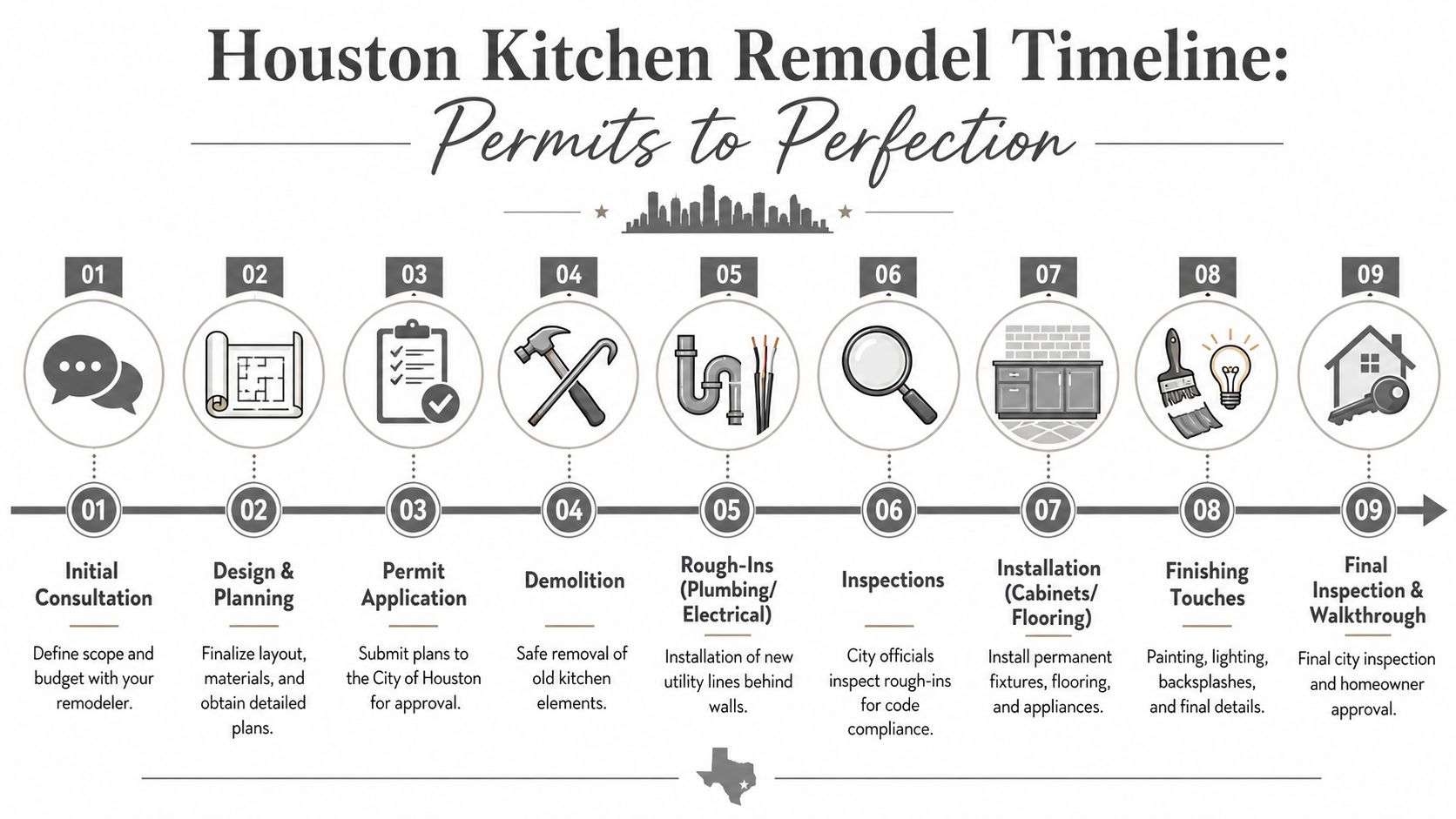
The work itself follows a predictable sequence. Design, selections, permits if required, demolition, rough-ins, inspections, installation, finish work, and final walkthrough. What throws projects off isn't usually one dramatic event. It's small delays stacking up.
Common causes include:
- Late decisions. A homeowner changes tile, hardware, or cabinet configuration after orders are placed.
- Hidden issues. Crews open walls and find repairs that have to happen before the next trade can proceed.
- Product lead times. Custom items and specialty finishes can hold up the entire schedule.
The less ambiguity you bring into construction, the smoother the job goes. That means finish selections made early, drawings finalized, and allowances kept to a minimum.
Why permits matter more than homeowners think
Permits aren't red tape for the sake of it. They protect you when work affects structure, plumbing, electrical, or other code-regulated parts of the house. If a contractor tells you permits are optional when they clearly aren't, that's a warning sign.
A proper permit process does three things. It creates a paper trail, it triggers inspections, and it reduces future headaches when you sell the home or file an insurance claim after storm damage. This guide to Houston construction permits and remodeling approvals gives homeowners a good overview of what's typically involved.
A permit isn't just permission to build. It's proof the work was important enough to inspect.
Good remodelers treat permits like part of the job, not a burden they push onto the homeowner. That's how it should be.
Choosing Materials for Houston Beauty and Resilience
In this market, material selection isn't a style exercise. It's risk management. Northwest Houston homes deal with humidity, heavy use, and in some areas, repeated storm concerns. Choose fragile finishes and you'll pay for them twice.
Countertops and floors that make sense here
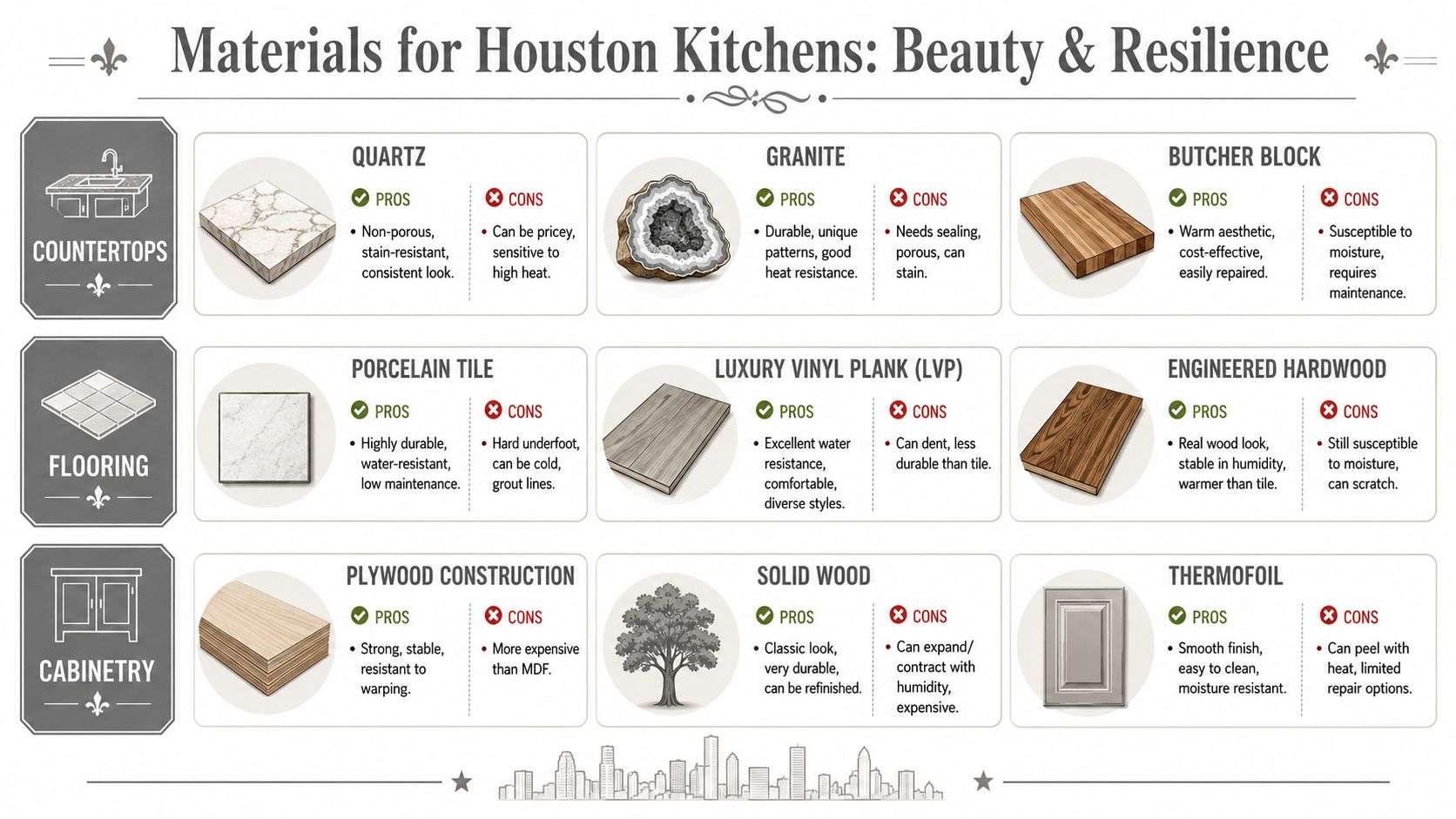
For countertops, Houston-area Houzz reporting says engineered quartz and granite are the leading materials, and quartz is often favored for its low-porosity maintenance profile. That matters here. A lower-porosity surface is easier to live with when humidity, spills, and everyday messes are part of the routine.
My take is simple:
- Choose quartz if you want easier maintenance, a more consistent appearance, and less worry about staining.
- Choose granite if you want natural variation and strong heat resistance, and you're comfortable with the care natural stone requires.
- Be careful with wood-heavy surfaces in a humid environment unless you're committed to maintenance.
Flooring deserves the same level of discipline. A kitchen floor in Houston needs to handle moisture, dropped pans, pet traffic, and frequent cleaning. That's why resilient flooring and tile remain common choices in practical remodels.
Here's how I'd frame the decision:
| Material area | Better for lower maintenance | Better for traditional character |
|---|---|---|
| Countertops | Quartz | Granite |
| Flooring | Vinyl or resilient options, porcelain tile | Hardwood or engineered wood in the right application |
Build for humidity repairability and daily wear
Cabinets matter as much as counters and floors. Homeowners get caught up in door style and paint color, but box construction, edge durability, and how the finish handles moisture are what determine whether the kitchen still looks good years later.
Focus on these points:
- Cabinet construction. Prioritize stability and durability over decorative upgrades that don't improve performance.
- Ventilation. A good vent hood helps remove heat, grease, and moisture. That's not a luxury in Houston.
- Repairability. In a storm-prone region, materials that dry faster and can be repaired in sections deserve serious consideration.
- Lower maintenance finishes. Easy-clean surfaces save time and hold up better under daily wear.
The best kitchen in Northwest Houston often isn't the most luxurious one. It's the one that still works well after humidity, spills, and hard use test it.
Homeowners should think beyond showroom appeal. If your house has any history of water intrusion, or you want to reduce future maintenance, make resilience part of the specification. Moisture-aware flooring, durable cabinet construction, and sensible countertop choices will serve you longer than fragile trends.
How to Vet and Hire Your Northwest Houston Remodeler
You do not feel the quality of a remodel on day one. You feel it six months later, when cabinet doors still close straight, the vent hood clears humidity fast, and trim joints have not opened up after a long Houston summer. That is why hiring the right remodeler matters more than any finish selection.
Your contractor checklist
Start with proof, not charm. A polished sales conversation means very little if the company cannot show clear documentation, a detailed process, and local project history.
Use this checklist:
- Licensing and insurance. Ask for current proof and read it. General liability and workers' comp are not paperwork details. They protect you when something goes wrong.
- Northwest Houston experience. You want a remodeler who understands older subdivisions, newer master-planned homes, permit expectations, and how heat and humidity affect materials and installation.
- A written scope of work. If the proposal is vague, the final bill will not be.
- Jobsite leadership. Ask who will run your project day to day, who will be in your house, and who has authority to solve problems.
- Communication standards. Get a clear answer on update frequency, response times, and how selections, delays, and change orders are documented.
- Recent references and photos. Ask for kitchens completed in the last year, not a greatest-hits album from five years ago.
Local experience matters here more than homeowners realize. In Northwest Houston, a remodeler is not just installing cabinets and counters. They are making judgment calls about ventilation, moisture-prone areas, substrate condition, and product choices that need to hold up through heavy use and Gulf Coast humidity.
What a solid proposal should include
A real proposal reads like a build plan. It should spell out what is included, what is excluded, who pulls permits, how allowances work, what cleanup is included, and how hidden conditions are handled once walls or flooring are opened up.
Ask these questions before you sign anything:
- Who is responsible for permits and inspections?
- How are change orders approved, priced, and documented?
- What assumptions are built into this estimate?
- How do you handle damaged deliveries, backorders, or field conditions that differ from the original plan?
- What steps do you take to protect the rest of the house from dust, heat, and daily disruption?
Pay close attention to the answers. Good remodelers are plainspoken. They can explain the process without dodging, overpromising, or hiding behind generic language.
One Houston-area company homeowners may come across is H-Towne & Around Remodelers, Inc. If you consider that firm or any other, expect the same basics on paper: licensing, insurance, permit responsibility, scope clarity, and a documented process from demolition through punch list.
If a remodeler is fuzzy before the contract, the project will be harder once your kitchen is torn apart.
Trust documentation over chemistry. You are not hiring a personality. You are hiring a team to make thousands of small decisions in your house, under pressure, in a climate that exposes shortcuts fast.
Exploring Your Kitchen Remodel Financing Options
Once you know the likely scope, the next question is how you want to pay for it. Don't choose financing based on what feels easiest today. Choose it based on how it fits the life of the project and your tolerance for monthly payment pressure.
Common ways homeowners pay for a remodel
A HELOC gives you a revolving line of credit tied to home equity. It can work well if your project will happen in stages or if you want flexibility during construction. The tradeoff is that payment amounts can shift, and some homeowners don't like that uncertainty.
A home equity loan is more predictable. You borrow a fixed amount and repay it on a set schedule. That's often easier for households that want a defined payment from day one.
A cash-out refinance can make sense if refinancing the full mortgage improves your overall financial position, not just the remodel funding. It's a bigger move, so don't treat it casually.
A personal loan is usually better suited to smaller projects or partial renovations. It can be faster to arrange, but the payment structure may be less forgiving for a large kitchen project.
How to choose the least painful option
Use a simple filter:
- Need flexibility during construction: Look at a HELOC.
- Want fixed payments: Consider a home equity loan.
- Already planning to restructure your mortgage: Explore cash-out refinance.
- Only doing a lighter update: A personal loan may be enough.
The wrong financing choice creates stress even when the remodel itself goes well. Talk to your lender early, before design decisions outpace your budget.
Frequently Asked Questions from Houston Homeowners
Should I keep the same layout to save money
Usually, keeping the footprint helps control costs. But “usually” is not a rule. In older Houston homes, that advice can backfire.
According to this Houston kitchen remodeling market page, a common debate is whether to keep the existing footprint to save money, but that logic doesn't always hold up in older housing stock where moving a wall may be necessary to address outdated plumbing or electrical. I agree with that. If a layout change solves bad circulation, code issues, or chronic functional problems, it may be the better long-term value even with higher upfront cost.
A smarter question is this: does the current layout deserve to be preserved? If the answer is no, don't let fear of scope lock you into a kitchen that still won't work.
Other questions homeowners ask before signing
Can I live at home during the remodel?
Sometimes, yes. But living through a kitchen renovation is tiring. You'll deal with dust, noise, temporary utility interruptions, and a makeshift meal setup. If the job is broad enough, it's worth reviewing options for renovation stays so you can compare short-term living arrangements before construction starts.
What should I decide before demolition begins?
Cabinet layout, appliance specs, plumbing fixture choices, lighting plan, flooring direction, countertop selection, and backsplash. The more decisions you make late, the more likely your schedule drifts.
What matters most for resale?
A kitchen that feels coherent, functions well, and doesn't look overbuilt for the house. Buyers notice layout, storage, lighting, and finish quality fast. They also notice when a remodel looks cosmetic but ignores basic usability.
Should I prioritize beauty or resilience?
In Northwest Houston, pick both, but if you're forced to choose, take resilience first. Beautiful materials that don't hold up in a humid, storm-aware environment become expensive disappointments.
What's the one mistake to avoid?
Starting construction before scope and selections are nailed down. That's when budgets loosen, tempers rise, and compromises pile up.
A kitchen remodel goes smoother when the homeowner makes hard decisions early instead of expensive decisions late.
If you're ready to plan your kitchen remodel with clear pricing, practical design guidance, and a build approach that fits Houston conditions, contact H-Towne & Around Remodelers, Inc. to discuss your project and next steps.