
In Cypress, a full bathroom remodel usually runs $18,000 to $25,000, while a premium kitchen remodel often falls between $45,000 and $60,000. Most standard bathroom renovations take 6 to 8 weeks, and more involved high-end bath projects can stretch to 12 to 14 weeks.
If you're reading this, you're probably standing in a kitchen that doesn't work the way your family lives, or using a bathroom that feels dated, cramped, or harder to clean every year. In this part of the Houston area, remodeling isn't just about making a house prettier. It's about making it function better in a humid climate, protecting the investment from storm exposure, and getting the work done legally, cleanly, and with a plan you can follow.
Located in Houston the primary projects that H-Town would like to undertake are; kitchen remodeling, bathroom remodeling, & whole home remodeling. That focus matters because these projects affect the rooms you use hardest, the systems behind the walls, and the long-term value of the home. A real kitchen and bathroom remodeling company in Cypress TX should be able to explain costs, permits, scheduling, material trade-offs, and Gulf Coast durability without hand-waving. That's the difference between a smooth remodel and a long, expensive lesson.
Table of Contents
- Why a Professional Remodel Is Your Best Investment in Cypress
- Your Remodeling Roadmap from Design to Completion
- Understanding Kitchen and Bathroom Remodeling Costs in Cypress
- Navigating Permits and Building for the Gulf Coast Climate
- Inspiring Kitchen Bath and Whole Home Remodeling Ideas
- How to Choose the Right Remodeling Company in Cypress
- Frequently Asked Questions About Cypress Home Remodeling
Why a Professional Remodel Is Your Best Investment in Cypress
A Cypress remodel usually starts the same way. The kitchen feels tight when two people cook at once, the primary bath holds moisture too long, or storage keeps spilling into dining and hallway space. Homeowners ask for better finishes, but true value comes from fixing how the room performs in a house that has to handle heat, humidity, heavy use, and occasional storm disruption.
That is why professional remodeling pays off here. The job is not just new tile, cabinets, or fixtures. It is corrected layout, longer-lasting assemblies, code-compliant mechanical work, and material choices that fit Gulf Coast conditions.
Value comes from function, durability, and fewer do-overs
The strongest remodel investments in Cypress solve expensive problems before they are covered up. In kitchens, that often means correcting traffic flow, improving task lighting, updating old electrical circuits, and building storage around how the family cooks. In bathrooms, it usually means proper waterproofing, better ventilation, and a layout that gives enough clearance at the vanity, toilet, and shower.
Those decisions affect resale, but they also affect ownership costs. A room that works well is less likely to need patchwork fixes a year later.
For owners looking at a property through an investment lens, understanding ARV for flip projects helps tie renovation scope to after-repair value instead of wish lists alone. The same discipline helps owner-occupied homes. Spend on changes that improve use, reliability, and service life.
A good rule in Cypress is simple. Put money into the parts of the room that get wet, carry load, use power, or take daily abuse first. Surface upgrades matter, but substrate prep, cabinet construction, ventilation, and fixture placement usually decide whether the remodel still feels like a smart investment five years from now.
What professional work changes behind the finish line
Professional remodeling protects the project in ways a finish sample never shows. It starts with planning, but the value shows up in execution.
- Layout that fits the house: A bigger island is not always an improvement. In many Cypress homes, preserving clear walk paths and appliance swing space matters more than adding bulk.
- Better coordination between trades: Plumbing locations, venting, lighting, GFCI protection, and tile prep have to line up before walls close and finishes go in.
- Assemblies built for Houston-area moisture: Shower pans, waterproofing membranes, sealants, exhaust ventilation, and paint selection all matter more in a humid climate.
- More predictable cost control: Clear scope, allowances, and change-order procedures reduce the budget drift that frustrates homeowners.
This is also where experience saves money. A contractor who has handled Cypress-area remodels knows where older homes hide undersized wiring, out-of-level floors, previous leak damage, and ventilation problems. Catching those issues before finish work starts is cheaper than tearing completed work back out.
If homeowners want a clear picture of how a well-run project is typically staged, this step-by-step kitchen remodel process shows the sequence that keeps decisions, inspections, and construction work aligned.
A professional remodel gives you a room that looks better, works better, and holds up better under local conditions. In Cypress, that is what makes it an investment instead of an expense.
Your Remodeling Roadmap from Design to Completion
Most remodeling stress comes from uncertainty. Homeowners can handle noise, dust, and disruption far better when they know what's happening, who's responsible, and what comes next.
Here's the process in a format that matches how professional jobs should run.
The first decisions shape the whole job
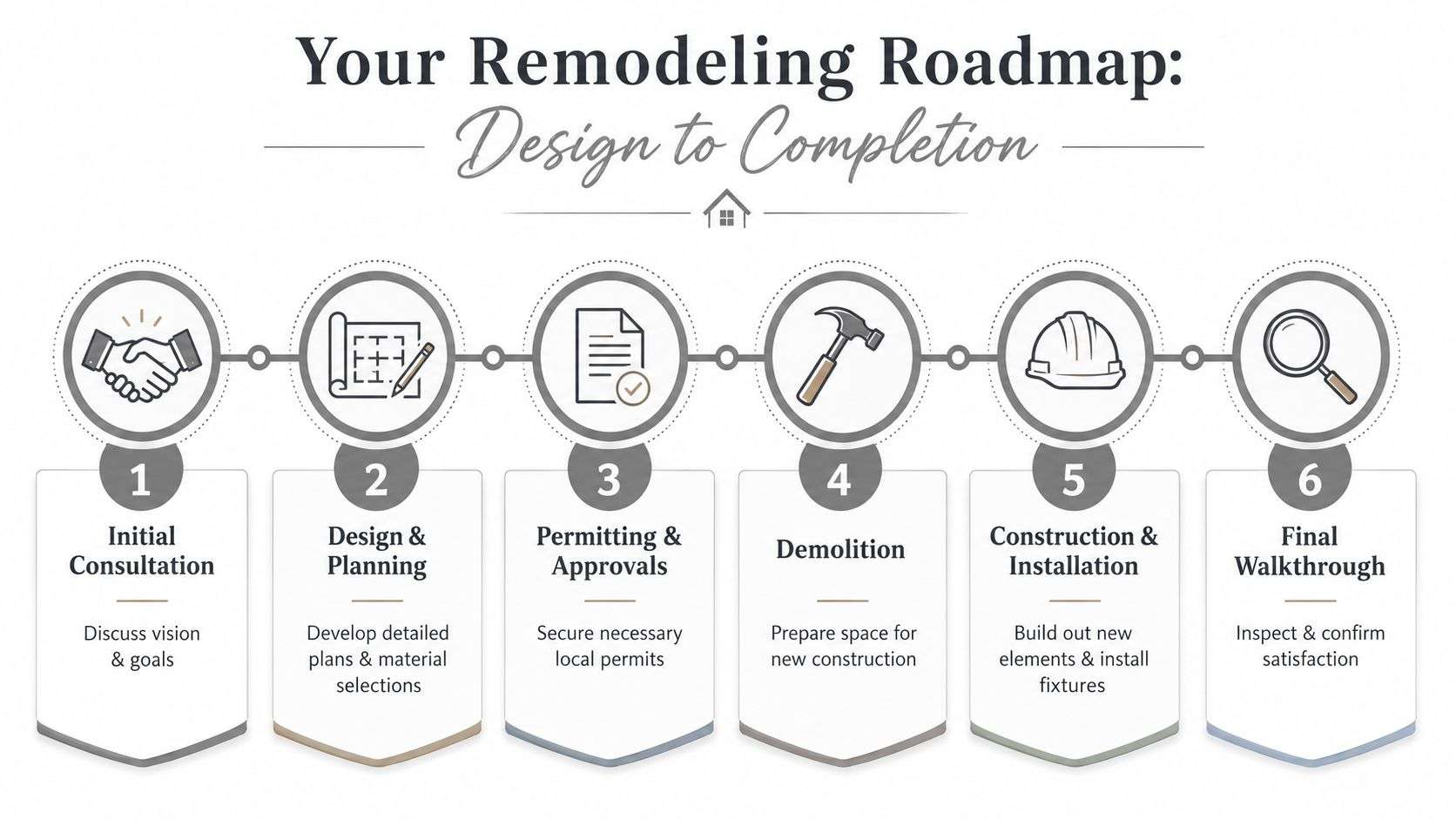
Step one is the consultation. That's where the true goals come out. Not just “new cabinets” or “a bigger shower,” but what's failing now. Poor storage. Tight walk paths. Old tile assemblies. Weak lighting. A tub nobody uses. If the problem isn't defined clearly, the design won't fix it.
Next comes design and planning. During this stage, material selections, layout revisions, fixture locations, and scope details are finalized. In kitchens, that can include cabinet configuration, appliance clearances, island sizing, and countertop decisions. In baths, it often means shower size, waterproofing approach, vanity layout, and ventilation upgrades.
A useful walkthrough of a professional sequencing approach appears in this guide to a step-by-step kitchen remodel.
A good plan reduces field improvisation. Most expensive remodeling mistakes don't start during installation. They start when nobody fully resolved the design before demo.
After planning comes permitting and approvals. In Cypress-area work, permit needs depend on the scope. If you're moving plumbing, altering electrical, changing structural elements, or making other code-relevant updates, permit review isn't optional. It protects you during the project and when the home is later sold.
What happens once construction starts
The build phase usually follows this sequence:
Site protection
Floors, adjacent rooms, and access paths need protection before demolition starts. This is basic professionalism, not a premium add-on.Demolition
Demo should be controlled and purposeful. The goal isn't speed at all costs. It's exposing the space cleanly so the crew can inspect framing, plumbing, and electrical conditions.Rough-in work
Plumbers, electricians, and other trades handle behind-the-wall changes at this stage. If a layout changed on paper, it becomes tangible during this phase.Inspection and prep for finishes
Before tile, cabinets, trim, and paint, the room has to be square enough, flat enough, and dry enough to receive them properly.Installation and punch list
Cabinets, countertops, tile, fixtures, glass, lighting, paint, and trim come together near the end. Final punch work should be expected, not treated like a problem.
A professional handoff includes a final walkthrough, scope confirmation, and warranty discussion. H-Towne & Around Remodelers, Inc. operates with complimentary estimates, design assistance, permit help, transparent pricing, and warranties as part of its service model, which is the kind of framework homeowners should look for in any serious remodel partner.
Understanding Kitchen and Bathroom Remodeling Costs in Cypress
Costs move fast once homeowners start changing scope, materials, or layout. That's why the useful question isn't “What does a remodel cost?” It's “What kind of remodel am I planning?”
What drives the number up or down
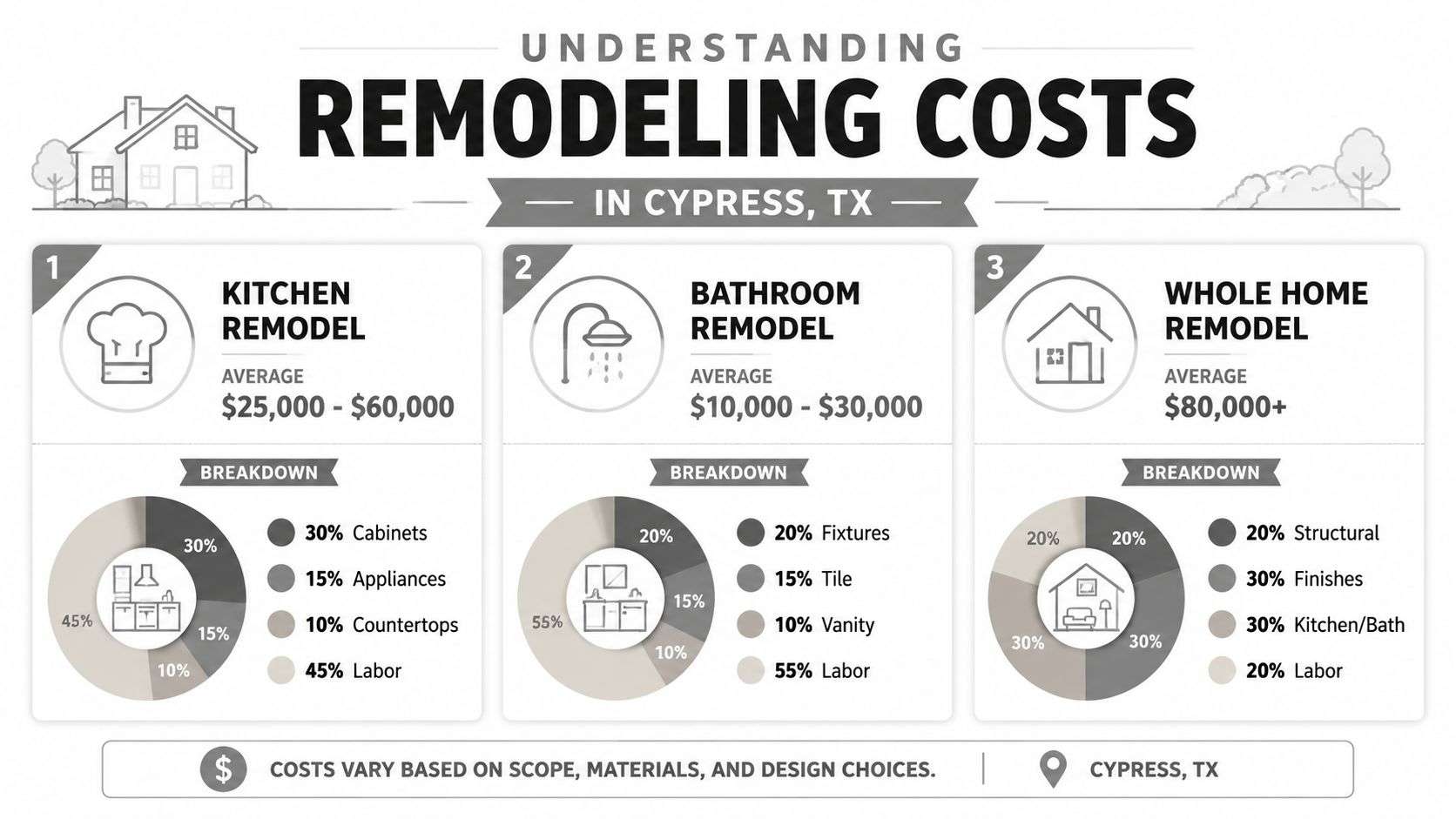
In Cypress, a full bathroom remodel typically ranges from $18,000 to $25,000, while premium kitchen remodels can reach $45,000 to $60,000, depending on scope and materials (current Cypress remodeling cost ranges). Those are useful anchor points, but they don't tell the whole story.
A kitchen lands near the higher end when the project includes layout changes, substantial cabinet work, upgraded counters, appliance integration, and finish coordination across multiple trades. A bathroom can climb quickly when it includes a wet-area rebuild, custom tile work, new glass, relocated plumbing, or premium fixtures.
Three choices usually have the biggest budget impact:
| Cost driver | Lower-cost direction | Higher-cost direction |
|---|---|---|
| Scope | Keep layout in place | Move walls, plumbing, or electrical |
| Materials | Standard finishes and stock options | Custom fabrication and premium surfaces |
| Labor complexity | Straightforward install conditions | Detailed tile work, custom trim, or structural adjustments |
One example is shower construction. If you're comparing enclosure types early, this guide on the cost of one piece shower stalls can help you think through one practical branch of the decision before you commit to a fully tiled assembly.
How to budget without guessing
The cleanest way to budget is to separate the project into decisions you must make now versus choices you can phase later.
Use this filter:
- Must-do work: Structural fixes, water-damaged materials, code-related upgrades, waterproofing, ventilation, core cabinetry.
- High-impact upgrades: Countertops, tile selections, lighting, storage improvements, fixture quality.
- Optional enhancements: Nice-to-have accent details, specialty features, or lower-priority adjacent room work.
That framework keeps a project from drifting. It also helps you compare bids accurately. If one proposal includes demolition, permit coordination, moisture-resistant backing, fixture install, and cleanup, and another doesn't, they aren't priced on the same scope.
For homeowners trying to frame a realistic budget before final design, this breakdown on estimating home renovation costs is a practical starting point.
Budget clarity comes from scope clarity. “Remodel my bathroom” is not a scope. “Replace the tub with a walk-in shower, keep plumbing in place, retile wet walls, and install a double vanity” is a scope.
Fixed-price contracts don't remove every surprise. Homes can still hide damage. But a detailed contract does force the key assumptions into the open before work begins, and that protects the homeowner far better than a vague allowance-heavy proposal.
Navigating Permits and Building for the Gulf Coast Climate
A remodel in Cypress has to do more than look finished. It has to be legal, moisture-aware, and durable enough for Gulf Coast conditions.
Permits are part of protecting the project
Permits can feel like paperwork until a project gets flagged, an inspection fails, or a home sale raises questions about unpermitted work. Kitchens and bathrooms often touch plumbing, electrical, mechanical, and sometimes structural elements. That means permit review can be central to the job, not incidental.
If you're trying to understand what local approvals may apply, this overview of Houston construction permits gives a useful baseline for the process.
The practical point is simple. Permit handling should be addressed before demolition, not after materials are ordered. Homeowners should know who is pulling the permit, what inspections are expected, and whether the scope triggers code-related upgrades.
Material choices matter more on the Gulf Coast
Cypress homeowners also face a local problem that generic remodeling advice usually misses. An underserved issue is designing for disaster resilience. In 2025, 68% of Texas Gulf Coast homeowners delayed resilient remodeling because they feared insurance non-compliance, even as severe weather events increased by 42%. That hesitation is understandable. Many people want flood- and storm-aware improvements, but they don't want to make choices that create insurance questions later.
That's where experienced planning matters. In high-humidity and storm-exposed environments, some materials perform better:
- Moisture-resistant substrates: Cement board or treated plywood in the right applications.
- Non-porous finishes: Quartz or engineered stone where water exposure and humidity are constant.
- Thoughtful cabinet selections: Especially in lower areas or rooms with known moisture risk.
- Ventilation upgrades: Because even excellent finishes fail sooner when steam and humidity linger.
Build the room for the climate it lives in. A beautiful finish over the wrong substrate is still a bad remodel.
Disaster-aware remodeling doesn't mean every room needs to look commercial or overbuilt. It means the project team understands how local weather, moisture, insurance, and code compliance affect material selection before installation starts.
Inspiring Kitchen Bath and Whole Home Remodeling Ideas
A good remodel starts with a real problem in the house. In Cypress, that usually means a kitchen that bottlenecks at the island during school mornings, a primary bath that never had enough storage, or a whole-home update where finishes were patched together over twenty years and no longer work as one plan.
Kitchen updates that earn their keep
The best kitchen ideas improve daily use first. In practice, that often means better clearances, more effective storage, and surfaces that stay serviceable in a busy house. A larger island sounds appealing, but if it pinches the walkway to the range or refrigerator, it creates a traffic problem instead of fixing one. I usually advise clients to decide how the room needs to function before choosing statement features.
Storage does more work than ornament. Deep drawer banks for pots, tray dividers near the oven, pantry pull-outs, and an appliance garage can remove clutter from the counters and make the kitchen easier to clean. Quartz remains a common choice because it handles heavy use well, and a full-height backsplash can reduce maintenance better than smaller decorative layouts with extra grout joints.
Good kitchen design also depends on details homeowners do not always see on the first walk-through. Vent hood routing, under-cabinet lighting placement, floor leveling, and cabinet depth all affect how finished the room feels once it is in use. In Cypress homes, I also pay attention to where water lines, shutoffs, and exterior walls fall before finalizing the layout, because those decisions can change labor cost and schedule.
Bathrooms and whole home ideas that improve how the house lives
Bathrooms usually deliver fast quality-of-life gains because small changes can correct old layouts. A curbless or low-threshold shower, a vanity with usable drawer storage, stronger task lighting, and better niche placement make the room easier to use every day. The trade-off is budget discipline. Moving drains, enlarging the footprint, or relocating walls can be worth it, but only when the new layout solves a clear problem.
Whole-home remodeling works best when the plan is coordinated from room to room. Flooring transitions should be intentional. Trim profiles should relate to the age and style of the house. Lighting color should stay consistent, and sightlines should make sense from the entry through the main living areas. That kind of continuity is what makes a remodel feel finished instead of pieced together in phases.
These are the project directions Cypress homeowners ask for most often:
- Primary bath reset: Larger shower, better storage, improved lighting, and finishes that are easier to maintain in a humid environment.
- Family kitchen rework: More prep space, stronger pantry function, and circulation that supports both weekday traffic and weekend hosting.
- Whole-home modernization: Consistent flooring, updated trim and paint, repaired wear, and a layout that feels connected rather than fragmented.
Older homes sometimes reveal problems after demolition starts, especially around supply lines, drain connections, or previous repairs hidden behind cabinets and tubs. If a renovation exposes an urgent leak or failed line, quick access to emergency plumbing assistance can keep the project stable while rough work is corrected before finishes go back in.
How to Choose the Right Remodeling Company in Cypress
A remodel in Cypress usually looks straightforward on paper. Then demo starts, an older shower pan has been leaking for years, the electrical is undersized for the new layout, or the permit scope changes because the work touches plumbing and mechanical systems. The right remodeling company plans for those realities before materials are ordered and walls come open.
Start with operational proof
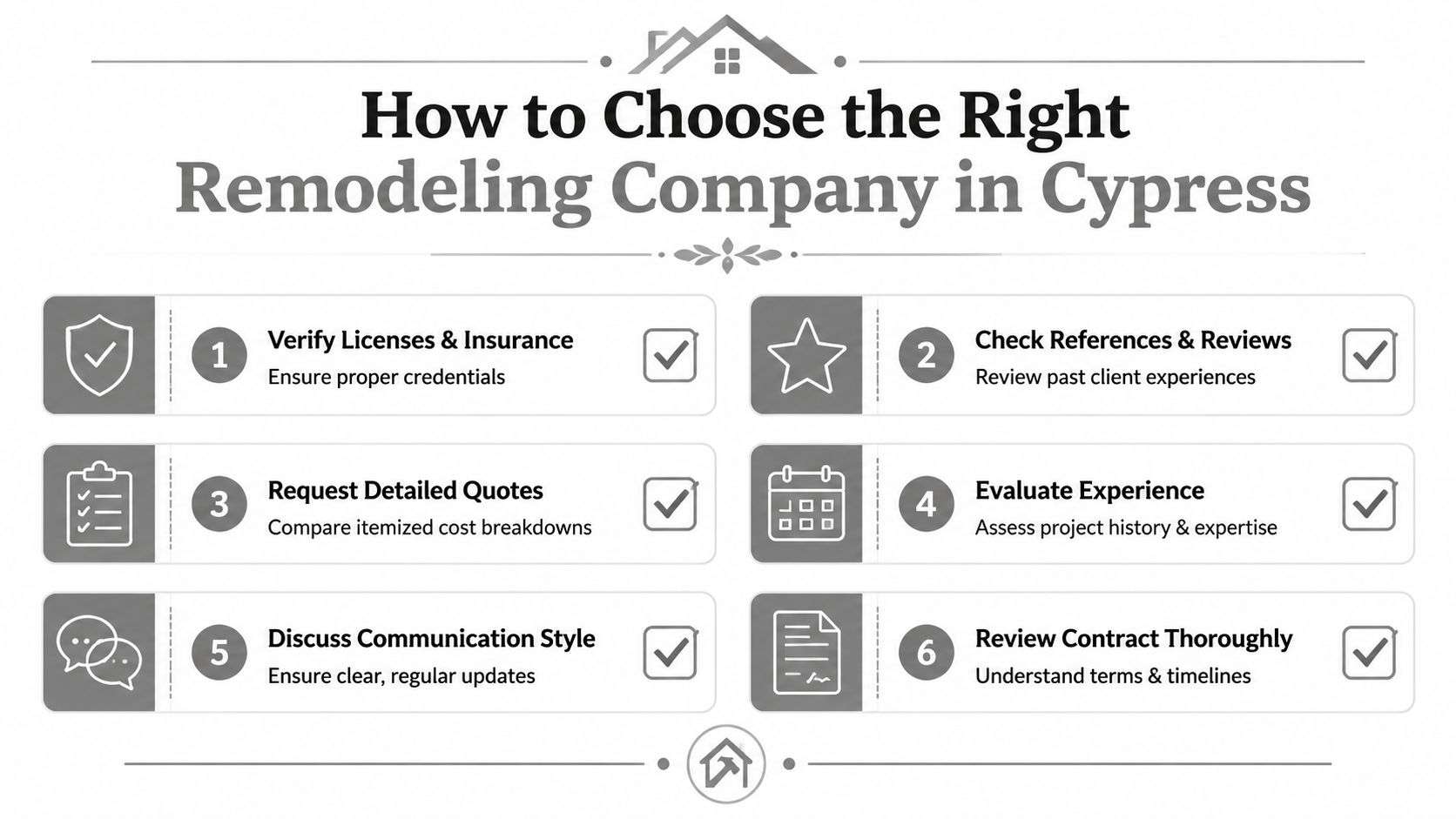
Good design matters, but execution decides whether the project stays on budget and passes inspection. Ask a contractor to explain how they handle permit applications, trade scheduling, lead times, inspection corrections, and moisture control during construction. In the Cypress and greater Houston market, those details separate a sales process from a real production system.
Credentials still matter. Confirm that the company is licensed and insured for the work proposed, and ask what type of projects they complete most often. A firm that does mainly cosmetic updates may struggle with a kitchen or bath remodel that includes reworked plumbing, new circuits, ventilation changes, or structural corrections.
Local experience should show up in the answers. A contractor who works regularly in this area should be able to speak clearly about municipal permit requirements, humidity-related material performance, flood and storm recovery concerns, and how to protect the home if a project runs during heavy rain season.
Use a screening list that gets past marketing language:
- Verify insurance and scope fit: Ask for current coverage and confirm that the company regularly handles your type of remodel.
- Ask who manages the job daily: You need the name of the project manager or lead contact before work begins.
- Check permit responsibility: The contract should state who pulls permits and who meets inspectors on site.
- Review trade coordination: Cabinet delivery, tile installation, plumbing trim-out, and countertop templating have to be sequenced correctly or the schedule slips fast.
- Ask how hidden conditions are handled: Older Cypress homes can hide water damage, failed venting, or previous patchwork repairs behind finishes.
Read the contract like a construction document
A solid contract should define the exact scope of work, material specifications, payment schedule, allowance amounts, cleanup standards, and change-order procedure. If the project includes owner-selected finishes, the document should also spell out when those selections are due, because late decisions can stall production just as much as labor shortages.
Watch for vague wording. "Update bathroom" is not a scope. "Remove existing tub and surround, install new shower system, waterproof walls, replace valve, set tile, install glass, paint, and complete final plumbing and electrical trim" is a scope. That level of detail reduces disputes and makes it easier to compare proposals fairly.
These questions usually expose weak planning early:
- Who is my day-to-day contact once work starts?
- How are change orders priced, documented, and approved?
- What floor, dust, and pathway protection is included?
- Who orders materials, and what happens if lead times change?
- How do you close out punch-list items after substantial completion?
A contractor earns trust by being specific about the problems that can affect cost and schedule.
Choose a company that fits the project, not just the price
The lowest bid often leaves out supervision, prep work, permit handling, or realistic allowances. That does not make it cheaper. It usually means the actual price shows up later through change orders, delays, or finish compromises. A higher proposal can still be the better value if it includes tighter scope definition, stronger project management, and materials suited to Cypress humidity and storm exposure.
Service fit matters too. H-Towne & Around Remodelers, Inc. is a licensed and insured residential remodeling company serving the Greater Houston area, including Cypress, and it specializes in kitchen remodeling, bathroom remodeling, and whole home remodeling. That is the kind of factual alignment homeowners should verify with any firm before signing, especially on projects that require design coordination, permits, and multiple trades working in sequence.
Frequently Asked Questions About Cypress Home Remodeling
A remodel in Cypress usually starts with practical questions, not design buzzwords. Homeowners want to know how long the job will take, whether the county or city will require permits, which materials will hold up in Gulf Coast humidity, and how much disruption to expect once demolition starts.
Common homeowner questions
How long does a kitchen or bathroom remodel usually take in Cypress?
The honest answer depends on scope, permitting, and material lead times. A hall bath that keeps the same layout moves much faster than a primary bath with custom glass, relocation of plumbing, and new exhaust work. Industry schedule guides from the National Kitchen & Bath Association and the National Association of Home Builders support the broader point that bathrooms and kitchens often run several weeks to a few months once design, ordering, inspections, and construction are included. In Cypress, storm delays, backordered tile, and permit review can add time, so the schedule should be built around your exact scope rather than a blanket promise.
Do you need permits for kitchen and bathroom remodels?
Often, yes. If the work affects plumbing, electrical, HVAC, gas lines, or structure, permit review may apply through the local authority having jurisdiction, which can vary by address in the Cypress area. A cosmetic update like paint, cabinet hardware, or surface replacement may not trigger permits, but homeowners should confirm that before demolition starts.
What kind of materials hold up best in Cypress humidity?
Materials that resist swelling, mold growth, and repeated moisture exposure perform better here. In bathrooms and kitchens, that usually means moisture-resistant backer materials, quality ventilation, stable cabinet construction, and finish surfaces that do not absorb water easily. The right choice is not always the most expensive one. It is the one that fits the room's moisture load, cleaning routine, and budget.
Do remodeling companies help with design and selections?
They should on any project with more than straightforward fixture swaps. Layout decisions affect plumbing locations, cabinet sizing, lighting, ventilation, and inspection requirements. Selections affect lead times too. A tile or plumbing trim choice that arrives six weeks late can hold up an otherwise well-run project.
How do you keep the house livable during construction?
Good planning matters more than promises. The crew should define dust control, floor protection, debris routes, parking, delivery staging, and daily cleanup before work begins. For occupied homes in Cypress, I also recommend talking through rain-day protection and material storage, because Gulf Coast weather can turn an ordinary delivery day into a mess if no one planned for it.
What about HOA communication?
It can matter more than homeowners expect. Interior work usually has fewer HOA issues, but some communities still regulate work hours, dumpster placement, parking, and access gates. If the project touches windows, exterior doors, additions, or anything visible from the street, HOA review may become part of the timeline.
Do whole-home remodels make sense if only a few rooms feel outdated?
Sometimes. If the kitchen, baths, flooring, electrical updates, and paint are all tied together, doing the work in one coordinated phase can reduce repeat demolition, repeat mobilization, and finish mismatches. If the issues are isolated, a focused remodel is often the better financial move.
If you're planning a kitchen, bathroom, or whole-home renovation in Cypress and want a clearer path from first sketch to final walkthrough, H-Towne & Around Remodelers, Inc. is one option to explore. The company serves Greater Houston, including Cypress, and offers design assistance, permit help, transparent pricing, and warranty-backed remodeling for homeowners who want the process explained plainly before work begins.