
You can stand on a Houston patio with a tape measure in one hand and a grill catalog in the other, and the project can still feel simple at first. Then the questions start. Do you need a gas line, a sink, a hood, a permit, a floodplain review, or just a slab and a cooktop under the cover you already have?
That's where outdoor kitchen Houston planning either stays smooth or turns into a costly reset. In this market, the right answer depends less on how the finished space looks on day one and more on how it handles humidity, wind, rain, clay soil, and Houston's permitting rules for anything that's tied into utilities or built in a flood-prone area. A good build is part cooking station, part exterior structure, and part code-compliant installation.
Table of Contents
- Why Houston Is a Prime Market for Outdoor Kitchens
- How Much an Outdoor Kitchen in Houston Really Costs
- Houston-Ready Materials and Appliances
- Site and Layout Planning for Houston Lots
- Permits, Codes, and the Floodplain Question
- Hiring a Houston Outdoor Kitchen Contractor
- Timelines, ROI, and Long-Term Maintenance
- Key Takeaways and Common Houston Questions
Why Houston Is a Prime Market for Outdoor Kitchens
A homeowner in Memorial or The Heights can look at a bare slab under a covered patio and already see the next version of the house. The grill becomes the anchor, then the sink, then a place for prep, drinks, and seating, and suddenly the patio stops being a pass-through space and starts working like a real outdoor room.
That vision fits Houston better than most cities. The local climate keeps outdoor living usable for much of the year, and Houstonians have long treated patios and covered spaces as extensions of the house rather than decorative extras. The market data backs up that behavior, too. In a 2026 Houzz-covered survey, 95% of renovating homeowners building an outdoor kitchen said they're constructing it from scratch AOL reporting on the Houzz-covered survey. That tells you this category is still custom-heavy, utility-heavy, and early enough that most projects start with a blank slate.
What that means on a Houston jobsite
The demand pulls in specialized crews, appliance suppliers, masons, and fabricators who already know what Houston weather does to materials. It also means homeowners expect more than a grill cutout. The same reporting noted that the share of homeowners adding plumbing, electrical, or heating systems rose to 68%, while the share adding appliances rose to 61% versus 2024 AOL reporting. In Houston, that shift matters because once utilities enter the picture, the project starts behaving like infrastructure.
Practical rule: if the plan includes gas, water, power, or a covered structure, treat the outdoor kitchen like a small exterior room, not a weekend accessory.
Houston also sits inside one of the strongest U.S. outdoor living corridors. A 2026 market report said California, Texas, and Florida together account for more than one-third of U.S. outdoor kitchen sales Grand View Research report. That concentration helps explain why local sourcing is mature. Stone, steel, masonry, and appliance supply are all available, but so are shortcuts. In a climate like ours, the difference between the two shows up fast.
How Much an Outdoor Kitchen in Houston Really Costs
Cost in Houston isn't just about finish level. It's about how much of the project is a true build versus a kit, how many utilities you're adding, and whether the patio already exists. The moment you add plumbing, electrical, gas, drainage, or structural work, the budget stops behaving like a grill purchase and starts behaving like a remodel.
National pricing helps frame the market. The outdoor kitchen category has reached major scale, and one 2026 industry release estimated the U.S. outdoor kitchen market at $10 billion Grand View Research report. That same release said cooking systems represent nearly 43% of total category spend and that a well-executed outdoor kitchen can return between 100% and 200% of its cost at resale, with 83% of real-estate agents ranking it among the top features for increasing home value Grand View Research report. Those figures aren't a promise, but they do explain why scope matters so much.
Typical Houston pricing bands
| Tier | What's Included | Typical Houston Price |
|---|---|---|
| Starter kit | Modular grill island, concrete countertop, no utilities run | $4,000 to $8,000 |
| Mid-range custom build | Masonry island, 304 stainless grill, sink, fridge, stone countertop, gas line | $10,000 to $18,000 |
| Fully built outdoor environment | Custom pergola, 316 stainless, masonry pizza oven, full appliance suite, lighting, audio | $25,000+ |
Those bands reflect real scope choices. A homeowner who keeps the project modular and reuses an existing slab can stay at the lower end. A homeowner who wants a custom masonry base, sink, refrigeration, gas run, and a finished patio cover usually moves into the middle. Once you add a pergola, premium appliances, specialty cooking, and integrated lighting, the project becomes a full outdoor living build.
Houston-specific cost drivers push in the same direction. If the site is in a floodplain, elevation and foundation details can add complexity. If the kitchen needs a gas line run from the meter, that adds labor and coordination. On expansive clay soil, a heavier or better-prepared foundation matters because movement and settling are expensive to fix later. Cost is really a durability decision wearing a finish schedule.
Houston-Ready Materials and Appliances
The quickest way to judge a quote is to look for the words that indicate the builder understands Houston. If the material list is vague, coated, or indoor-grade, the quote is probably wrong for the Gulf Coast. The climate here doesn't forgive soft specs.
The material choices that hold up
Start with metal. Houston's humidity and moisture exposure accelerate corrosion, so 304 stainless steel is the practical baseline for grills and doors, while 316 stainless steel is the better choice for coastal-adjacent areas and places with stronger chloride exposure Stono Outdoor Living guidance. The issue isn't only rust on the visible face. Moisture gets into seams, fasteners, and burner compartments, and that hidden degradation shortens service life.
For structure, CMU and poured concrete bases handle Houston's soil and moisture better than wood-framed islands that can wick water. Use welded or tightly sealed joints, stainless fasteners, powder-coated aluminum or marine-grade cabinetry, and countertops with low water absorption. Dense granite, quartzite, or ultra-compact surfaces fit that requirement better than porous stone Stono Outdoor Living guidance.
A quote should tell you how the builder is handling seams, fasteners, and enclosure details. If it only names the grill brand, it's not enough.
On appliances, don't blur indoor and outdoor use. Outdoor refrigeration needs to be rated for exterior conditions, and the hood or vent needs to match the cooking load and the cover above it. A wind-rated enclosure matters when storms move through, because a pretty surround that isn't built for weather doesn't protect the appliances underneath. If you're selecting countertops, the same logic applies, which is why a good countertop plan should be reviewed with the overall material stack in mind, not chosen in isolation. A useful starting point is the internal guide on how to choose kitchen countertops.
If a quote lists coated steel, MDF, or unsealed limestone outdoors, the spec is wrong for Houston. That doesn't mean the project has to be expensive. It means the materials have to match the climate.
Site and Layout Planning for Houston Lots
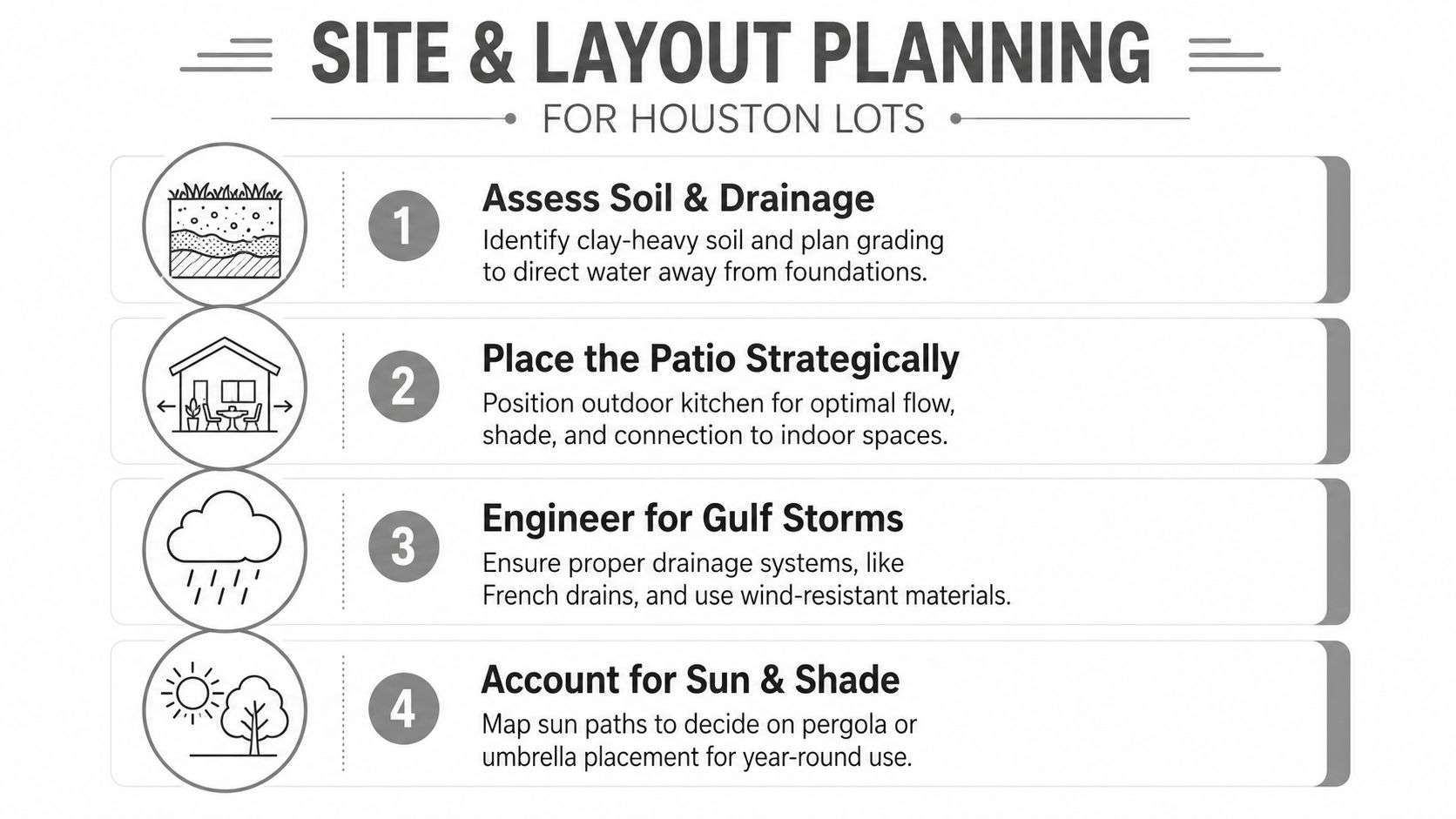
Houston lots make layout a bigger deal than many homeowners expect. Clay-heavy soil, flat grades, and slow drainage can turn a nice patio into a place where water lingers after a storm. Before anyone starts drawing cabinets, the site has to be understood as a drainage surface first and a social space second.
Read the yard before you pick the footprint
Place the cook zone where smoke and heat won't push into the seating area, and shield the grill side from the worst of the late-day sun. Southeast breezes can be useful if the kitchen is positioned correctly, but the airflow needs to be considered with the patio cover, nearby fencing, and the way guests move through the space. The wrong orientation can make the cooking side miserable in summer even if the materials are perfect.
Easements and lot lines matter just as much. Utility easements along the back of a lot can rule out a permanent masonry island or a hard gas run in places that look usable on paper. That's why the lot survey and the easement map should be in hand before design starts. A design that ignores that paperwork often gets redrawn later at a cost nobody wants.
For practical planning, I always want these measurements before a final layout is drawn:
- Lot survey: confirms property lines, setbacks, and easements.
- Drainage path: shows where water goes after a hard rain.
- Proposed footprint: keeps the kitchen from crowding doors or windows.
- Stub-outs: verifies gas, water, and electrical locations.
- Clearances: protects openings and keeps the build code-aware.
Local patio work also has to account for how hardscapes and masonry connect to the ground. That's where an experienced crew that understands hardscape and masonry patio construction in Houston can save the project from avoidable rework.
The other reason layout matters in Houston is storm behavior. A backyard that sheds water well in dry weather can still collect it during a Gulf downpour. A kitchen that's raised, drained, and tied into the rest of the patio correctly will look better longer and cost less to maintain. For broader outdoor living planning, a useful companion resource is this practical outdoor living design guide, especially if the kitchen is part of a larger patio and seating area.
Permits, Codes, and the Floodplain Question
The permit layer is where a lot of Houston homeowners lose time. A small grill island and a utility-connected outdoor kitchen are not the same thing, even if they look similar from the backyard. The permit triggers show up when the scope crosses from decorative to mechanical, plumbing, gas, or floodplain-sensitive work.
The permit trigger isn't one thing
A simple grill island on a slab may be straightforward. The moment the project adds a gas line, water, drain, or sink, the permit picture changes. That's where mechanical, plumbing, and gas approvals enter, and a roofed or attached structure can bring building review with it. Houston's floodplain office says a floodplain development permit is required in addition to any other permit for development in special flood hazard areas, and it notes that outdoor improvements in Zone A, AO, and AE may be treated as non-substantial only if the total cost is below 50% of the structure's appraised value Houston Permitting Center floodplain information.
The floodplain question isn't academic in Houston. If the project becomes substantial, elevation and construction details can get more complicated fast.
That threshold matters because an outdoor kitchen can be part of a larger improvement history, not an isolated item. If the combined work pushes the home over the substantial-improvement line, floodplain rules start to govern how the project is built. That can affect the base, elevation, enclosure details, and whether an elevation certificate enters the conversation. A homeowner who wants a straightforward answer should ask the city early instead of guessing based on the patio alone.
What to verify before you break ground
- Is the lot in a special flood hazard area?
- Will the kitchen be attached to a patio cover or enclosed structure?
- Does the scope include gas, plumbing, electrical, or drainage work?
- Is the home already close to a substantial-improvement threshold?
- Do HOA rules, deed restrictions, or historic overlays add another review layer?
Inspection sequencing also matters. Rough-in work usually needs to be checked before finishes go on, and pressure testing or final signoff happens later. If a builder can't explain that sequence in plain language, the project probably isn't being managed tightly enough.
For homeowners comparing how permits fit into the bigger remodel picture, the city's Houston construction permits overview is a useful local reference point. The key lesson is simple, though. In Houston, a grill island becomes a regulated structure sooner than you might expect.
| Houston Outdoor Kitchen Permits by Project Scope | Permit Required | Code Trigger |
|---|---|---|
| Freestanding grill island, no utilities | Sometimes none beyond local review | No gas, water, or electrical tie-in |
| Sink added | Plumbing permit | Water supply and drain connection |
| Hardwired lighting or outlets | Electrical permit | Any fixed electrical scope |
| Natural gas line | Gas or mechanical permit | Fuel line run from meter or existing supply |
| Attached or roofed structure | Building permit | Structural connection to patio cover or enclosure |
| Special flood hazard area work | Floodplain development permit | Site is in mapped flood hazard area |
Hiring a Houston Outdoor Kitchen Contractor
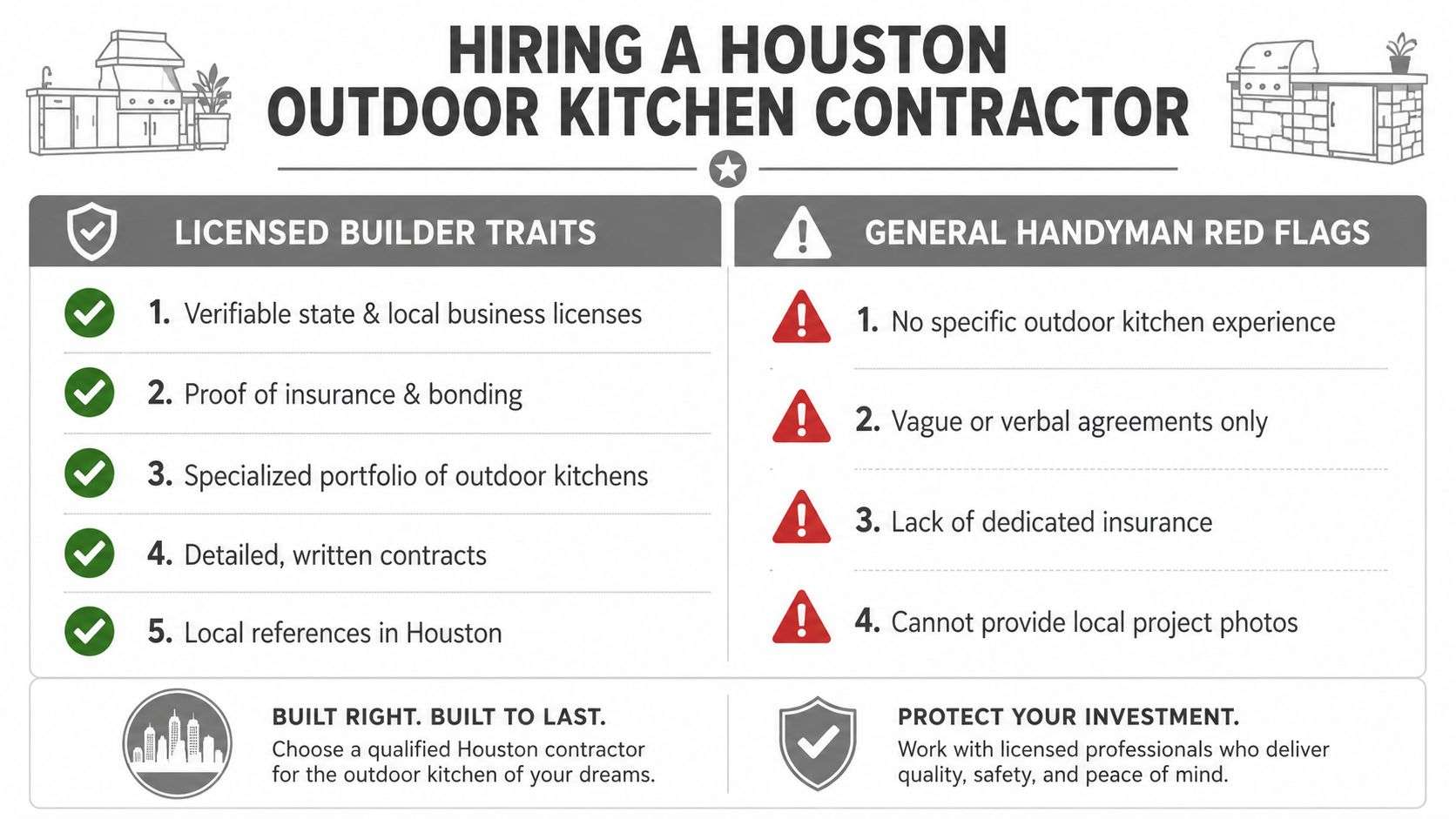
A real outdoor-kitchen builder isn't just a person who can stack block and set a grill. The job needs coordination across structure, utilities, permits, drainage, and finish work, so the contractor has to manage more than one trade at once. In Houston, that difference shows up quickly once a quote is in hand.
What to ask before you sign
Texas doesn't license general contractors at the state level, but plumbing and gas work must be done by licensed trades, and the City of Houston requires contractor registration for permit pulling. That means the first questions should be practical, not flattering. Ask who handles the gas line, who handles plumbing, who pulls the permit, and who is responsible for inspections.
A solid scope should be written in plain language with allowances where selections are still open. Vague one-line estimates usually leave room for change orders later. It also helps to separate manufacturer warranties from the installer's workmanship warranty so you know who stands behind the appliances and who stands behind the build.
Practical rule: if the contractor can't explain what happens when the weather shifts, the scope isn't mature enough yet.
References matter, but they need to be specific. Ask how many Houston outdoor kitchens they've completed in the last 24 months, whether they pull their own permits, and how much of their work is utility-connected versus decorative masonry. Then look at the portfolios with a different lens. You're not just checking style. You're checking whether the builder has repeated experience with floodplain sites, covered patios, and utility coordination.
For homeowners building a budget around the project, the right preparation is as important as the finish selection. A helpful companion piece on budgeting tips for outdoor kitchens can sharpen the cost conversation before bids come in, especially if you're trying to compare quotes that don't include the same scope.
A practical checklist for the first meeting:
- Insurance proof: ask for general liability and workers' comp documentation.
- Written scope: confirm appliances, finishes, utilities, and exclusions.
- Permit plan: ask who files, who schedules, and who meets inspectors.
- Floodplain experience: verify the contractor has handled Houston site conditions.
- Change-order policy: make sure additions are priced before the work changes.
For homeowners who want a single local team rather than coordinating multiple trades separately, H-Towne & Around Remodelers, Inc. can handle outdoor kitchen work as part of broader patio and remodeling scopes, which is often useful when the kitchen is tied to a larger exterior project.
Timelines, ROI, and Long-Term Maintenance
A Houston outdoor kitchen project usually feels slowest before the first shovel hits the ground. Design decisions, utility coordination, and permitting take real time, and the schedule changes depending on whether the project stays simple or crosses into floodplain or structural work. Once construction starts, good crews move faster than homeowners expect, but only after the front-end decisions are settled.
What the calendar usually looks like
Design and quoting often take 2 to 4 weeks. Permitting can take 2 to 6 weeks depending on whether the scope stays outside the floodplain or triggers a floodplain development permit. A typical mid-range custom kitchen often takes 3 to 8 weeks to build, while custom masonry or fully fitted masonry enclosures run longer Houston-focused renovation timing guidance.
| Houston Outdoor Kitchen Timeline at a Glance | Typical Duration | Houston-Specific Notes |
|---|---|---|
| Design and budgeting | 2 to 4 weeks | Finish decisions, utility scope, and site measurements get locked here |
| Permitting | 2 to 6 weeks | Floodplain review can extend the process |
| Construction | 3 to 8 weeks | Masonry, plumbing, gas, and electrical all affect pace |
| Final walkthrough | 1 visit, sometimes more | Punch list items should be closed before seasonal weather worsens |
The smoother scheduling window is usually spring or fall, not peak hurricane season. That's less about comfort and more about avoiding delays when weather interrupts concrete, deliveries, or inspection timing. If the patio already exists and the kitchen is using an established cover, the build can move more predictably than a full outdoor room with new structure and utilities.
ROI and upkeep that actually hold up
Houston resale logic tends to favor outdoor kitchens that look like part of the home, not a bolt-on. The strongest payoff usually comes when the kitchen is integrated with covered patio space and matches the home's exterior palette. That lines up with the broader market data showing resale value can be meaningful when the build is executed correctly Grand View Research report.
Maintenance matters just as much as the original build. In Gulf Coast humidity, I'd keep a simple rhythm:
- Monthly: grill burn-off to clear residue and grease.
- Quarterly: stainless passivation check and wipe-down.
- Annually: stone and grout sealer review.
- Before hurricane season: shut off, secure, and clear loose items.
A well-built outdoor kitchen shouldn't need major appliance replacement right away if it's specified correctly, drained correctly, and cleaned on schedule. The build that lasts is usually the one that treated maintenance as part of the design, not an afterthought.
Key Takeaways and Common Houston Questions
The best Houston outdoor kitchens are built for the Gulf Coast first and for looks second. That means 304 stainless at minimum, 316 stainless where exposure is harsher, sealed joints, smart drainage, and a layout that respects wind, sun, and the way water moves across the yard. It also means asking the permit and floodplain questions before anyone pours a base or runs a gas line.
If you're talking to a contractor this week, keep the conversation focused on four things. Material spec, utility scope, floodplain status, and warranty terms. If the answers stay vague, the project is probably too early for a firm price.
Common Houston questions
Does a basic grill island need a permit?
Sometimes not, if it stays freestanding and has no utilities. The moment gas, water, electrical, or structural tie-ins are added, permits are much more likely.
What does the 50% substantial-improvement rule mean?
If work in a special flood hazard area pushes the home past the city's threshold for substantial improvement, floodplain rules get more serious and can affect elevation and construction requirements Houston Permitting Center floodplain information.
How do I hurricane-prep the space?
Shut off gas, secure loose items, protect cabinet openings, and check that drainage paths aren't blocked before storm season starts.
Is 304 stainless enough near the coast?
It's the minimum practical baseline for Houston. 316 stainless is the safer choice where chloride exposure is higher or the site is closer to salt air Stono Outdoor Living guidance.
How often does it need maintenance?
Monthly cleaning, quarterly stainless care, annual sealing on stone and grout, and a pre-storm check are a realistic rhythm here.
How long should a quality build last before major appliance replacement?
The structure should last much longer than the appliances if the materials, drainage, and fastening details are right. Appliance life depends on use and exposure, but the shell should not be the weak point.
If you're ready to turn a patio into a durable outdoor kitchen Houston homeowners can use through heat, humidity, and storm season, H-Towne & Around Remodelers, Inc. can help with the planning, permits, and build details that keep the project moving. Visit H-Towne & Around Remodelers, Inc. to talk through your patio, your site conditions, and the right scope for your home.