
You're probably in the same spot a lot of Houston homeowners hit. You've spent weeks saving photos of shaker cabinets, warm wood floors, deeper drawers, better lighting, maybe a larger island. Then the practical side kicks in. What's this going to cost, what belongs in the quote, and how do you avoid getting trapped by a number that looks good at first and gets ugly once the walls are open?
That tension is normal. A kitchen remodel is part design project, part construction job, part logistics puzzle. The quote isn't just a price tag. It's the roadmap that tells you what's included, what isn't, where the risk sits, and whether the contractor has thought through the work in a serious way.
National numbers help with context, but they don't tell the whole story in Houston. According to 2026 data from Angi, the average cost of a kitchen remodel in the United States is $26,962, with most homeowners spending between $14,585 and $41,534. Major upscale remodels can reach $164,104 or more according to Angi's kitchen remodel cost guide. That wide range is exactly why kitchen remodeling quotes confuse people. A cosmetic refresh, a practical family remodel, and a full custom rework can all be called a “kitchen renovation,” but they are not the same job.
If you're still early in the planning stage, it helps to pair local budgeting with broader prep work like planning your kitchen remodel in Cumming GA, because good planning habits carry across markets even when local pricing doesn't.
Located in Houston the primary projects that H-Town would like to undertake are; kitchen remodeling, bathroom remodeling, & whole home remodeling.
For homeowners trying to balance scope and financing, it also helps to look at Houston home remodelers with financing options before getting too deep into selections. Budget decisions are easier when you know your payment path up front.
Table of Contents
- The Dream Kitchen and The Dreaded Budget
- Decoding Your Kitchen Remodeling Quote
- Houston Kitchen Remodel Costs A Realistic Breakdown
- How Contractors Calculate Your Remodeling Quote
- Critical Questions to Ask Your Contractor
- How to Compare Kitchen Remodeling Bids Correctly
- Your Next Step Get an Accurate Quote from H-Towne
The Dream Kitchen and The Dreaded Budget
A lot of remodels start at the kitchen table with a simple complaint. The storage doesn't work. The layout jams up whenever two people cook at once. The lighting is dim. The island is too small, or there isn't one at all. In Houston homes, I also see another common issue. The kitchen may look decent, but it doesn't function well for the way the family lives day-to-day.
Then the quote comes in, and the emotional shift is immediate. What felt like a fun upgrade suddenly feels like a major financial decision. That's where homeowners either get more disciplined or make the mistake of chasing the lowest number.
The quote should reduce stress, not create it
A useful quote tells you what you're buying. It should spell out demolition, cabinetry, counters, electrical, plumbing, flooring, finishes, labor, installation, and the pieces that can still move. If the document leaves you guessing, it's not protecting you.
A kitchen remodeling quote should answer questions before construction starts. If it raises more questions than it answers, the quote isn't finished.
This matters even more in a market like Houston, where houses vary a lot. A ranch home in Cypress, a bungalow in The Heights, and a larger home in Katy might all need “a kitchen remodel,” but access, age, code conditions, and layout complexity can be completely different.
A smart homeowner thinks in ranges, not wishful numbers
The biggest budgeting mistakes usually start with a target number that has no relationship to the work. Someone wants custom-looking results on a cosmetic-refresh budget. Or they assume keeping the same footprint means there won't be hidden costs. That's not how kitchens behave once the old finishes come out.
A better approach is to treat the quote like a build plan with financial consequences. The more detail it contains, the less room there is for bad surprises later.
Three habits help right away:
- Define your essential elements: Decide early whether your priority is storage, layout, appliances, finishes, or resale-conscious decisions.
- Separate wants from structural changes: New paint and backsplash live in one category. Moving plumbing and reworking walls live in another.
- Expect some friction in the process: Kitchens touch several trades. Even a well-run project has moving parts.
Homeowners who do this usually feel more in control. They aren't just reacting to a total. They're reading the quote like a decision document, which is exactly what it is.
Decoding Your Kitchen Remodeling Quote
A kitchen quote should read more like a car invoice than a windshield sticker. The sticker gives you one number. The invoice shows the actual machine you're buying, what's included, and what each upgrade costs. Kitchen remodeling quotes work the same way.
If a contractor hands you a single page with a lump sum and a vague line that says “complete kitchen remodel,” you don't have enough information to compare anything. You can't tell whether that price includes disposal, permits, appliance hook-up, trim repairs, or painting. You also can't tell whether the contractor has thought through the work.
Why a one-number estimate is a problem
Homeowners often think a simpler estimate is easier to understand. Usually it's just easier to hide gaps in. A low number can stay low because key items are missing, loosely described, or treated as future change orders.
A professional quote doesn't need to be complicated for the sake of looking formal. It needs enough detail to show where the money goes and where the uncertainty lives.
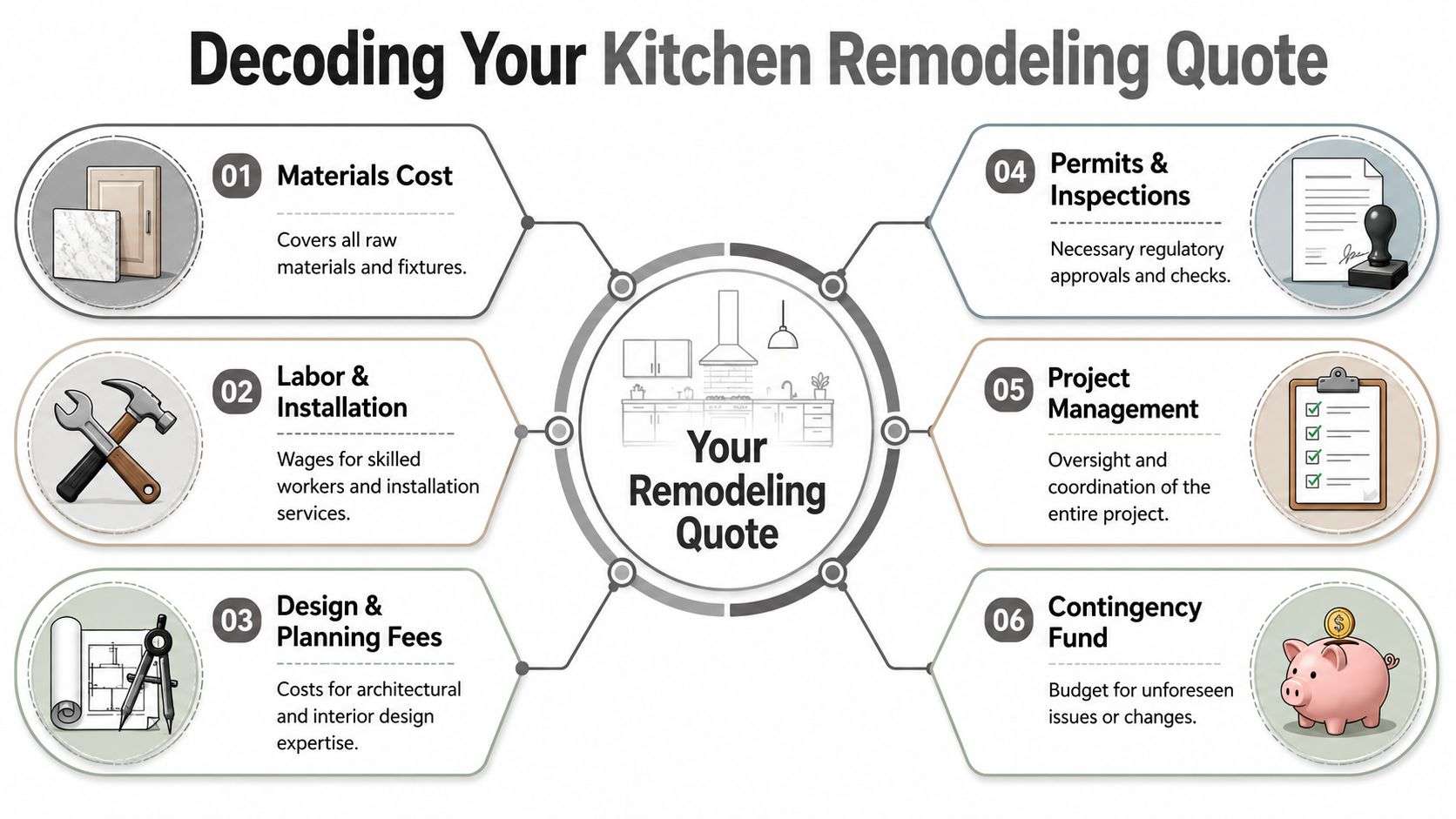
What a professional quote should include
Most solid kitchen remodeling quotes break into clear categories. The exact format varies, but the scope shouldn't.
- Demolition and debris removal: Removal of old cabinets, countertops, flooring, backsplash, and haul-off. If this line is missing, ask who's paying to get the old kitchen out of the house.
- Framing and wall repair: This covers wall changes, patching, drywall, soffits, and repairs after demolition exposes rough conditions.
- Plumbing work: Disconnects, reconnects, fixture placement, new supply or drain work, and any relocation tied to sinks, dishwashers, or gas appliances.
- Electrical work: Recessed lighting, under-cabinet lighting, outlet updates, appliance circuits, switch relocation, and code-related corrections.
- Cabinetry: Stock, semi-custom, or custom. This should identify what's being supplied, not just “new cabinets.”
- Countertops and backsplash: Material, edge profile, cutouts, installation, and backsplash area should be described clearly.
- Flooring and finish work: Floor prep, underlayment if needed, installation, trim, caulk, paint, and touch-up.
- Appliance installation: Delivery coordination, setting, hook-up, and trim adjustments if appliances change size.
- Labor and project management: Skilled trade labor and the coordination required to sequence the work properly.
The items that deserve special attention
Not every line item carries the same risk. A few deserve a closer look because they often create misunderstandings.
| Quote Item | What to check |
|---|---|
| Allowances | Is the allowance realistic for the level of finish you want? |
| Permits | Are permit fees included, excluded, or unknown? |
| Payment schedule | Does it tie to real milestones instead of vague dates? |
| Change orders | Is there a written process for added or revised work? |
| Punch list | Does the quote mention final corrections and completion details? |
Practical rule: If you can't tell whether an item is included, assume it isn't, then ask for the quote to be revised in writing.
Allowances are where many homeowners get caught. The quote may include a budget number for fixtures, tile, or hardware, but if that allowance doesn't match your taste level, the final price climbs later. That doesn't always mean anyone is being deceptive. It does mean you need the quote to match your actual selections or at least the quality tier you expect.
Contingency matters too, especially in kitchens. Once cabinets and drywall come out, contractors may find old repairs, out-of-date wiring, plumbing that needs adjustment, or framing that has to be corrected before finishes can go back in. A quote that pretends those risks don't exist isn't more reassuring. It's less honest.
The best kitchen remodeling quotes are specific without pretending every unknown has already been solved. That balance is what separates a real construction document from a sales sheet.
Houston Kitchen Remodel Costs A Realistic Breakdown
Houston homeowners usually ask one question first. What does a realistic kitchen remodel cost here, not nationally, but here? The answer depends on scope, selections, and how much of the room is being reworked. Still, there are local patterns that help anchor expectations.
In Houston, the typical cost for a mid-range kitchen remodel falls between $45,000 and $65,000, with luxury finishes and layout changes pushing costs to $150,000 or more according to this Houston kitchen remodel pricing overview. That's a more useful baseline for local homeowners than a national average because it reflects what people encounter when they start changing materials, moving utilities, and upgrading finish levels in this market.
For homeowners trying to calibrate expectations with another regional breakdown, understanding South Jersey kitchen renovation expenses is a useful comparison because it shows the same budgeting principle. The line items matter more than the headline number.
If you're still building an early planning budget, this guide to how to estimate home renovation costs helps frame the full project before you commit to a final scope.
What mid-range means in Houston
A mid-range quote in Houston usually buys a meaningful improvement, not just surface-level updates. Think new cabinetry, new counters, updated lighting, flooring, backsplash, and some appliance work. It may also include modest layout refinement if the changes stay controlled.
A minor remodel is different. That job usually protects the existing footprint and limits invasive work. You might keep the sink where it is, avoid major electrical relocation, and choose simpler cabinet and countertop paths.
An upscale remodel changes the rules. Once you start adding layout changes, premium finishes, built-in appliance integration, and heavier customization, the quote can move quickly. The labor becomes more specialized, the lead times get tighter, and the tolerance for mistakes drops.
Sample Houston kitchen remodel budget breakdowns 2026
The table below is a practical planning model, not a one-size-fits-all bid. It shows how budgets often spread across major categories when scope expands from cosmetic to custom.
| Cost Item | Minor Remodel (~$25k) | Mid-Range Remodel (~$60k) | Upscale Remodel (~$150k+) |
|---|---|---|---|
| Demolition and debris removal | $1,500 | $3,500 | $7,500+ |
| Cabinetry | $6,000 | $18,000 | $45,000+ |
| Countertops | $2,500 | $6,500 | $15,000+ |
| Plumbing and electrical | $2,000 | $7,500 | $18,000+ |
| Flooring | $2,000 | $5,000 | $10,000+ |
| Backsplash and wall finishes | $1,000 | $3,000 | $8,000+ |
| Appliance installation | $500 | $1,500 | $4,000+ |
| Painting and trim | $1,500 | $3,000 | $6,500+ |
| Labor and project management | $8,000 | $12,000 | $30,000+ |
These numbers aren't a substitute for field measurements and selections. They are a way to see why two kitchens with the same footprint can price very differently.
Why Houston quotes shift more than homeowners expect
Houston homes create some very specific quoting issues. Moisture exposure, ventilation needs, older wiring in established neighborhoods, foundation movement history, and previous owner work all affect how reliable an initial estimate can be.
Another local factor is labor. Labor costs in Houston kitchen remodeling projects typically account for 25% to 35% of the total project cost according to this Houston renovation cost guide. That means labor efficiency, scheduling, and trade coordination have a direct effect on what lands in your quote.
A few practical trade-offs show up often:
- Keeping the layout stable: This usually protects your budget better than moving major fixtures.
- Changing cabinet quality: Cabinet choices can push the quote fast because they affect material cost, lead time, and installation detail.
- Upgrading finishes all at once: Countertops, hardware, tile, and appliances can each feel manageable on their own. Together, they move the budget tier.
In Houston, the expensive part often isn't the pretty finish. It's the work behind the finish that makes the kitchen function correctly and pass inspection.
When homeowners understand that, they make better quote decisions. They stop treating remodeling bids like shopping tags and start reading them like construction plans.
How Contractors Calculate Your Remodeling Quote
Most homeowners see the final number. Contractors build that number from scope, sequence, and risk. The process is less mysterious than it looks once you know what drives it.
The first pass isn't just measuring the room. It's identifying what has to happen before the first new cabinet goes in. That includes demolition paths, wall conditions, plumbing routes, circuit needs, floor transitions, ventilation, appliance sizes, and whether existing surfaces can stay or need replacement.

The budget starts with scope not square footage alone
Square footage matters, but kitchens aren't priced like carpet. A small kitchen with complicated changes can cost more than a larger kitchen with a disciplined layout and straightforward selections.
Contractors usually build a quote by asking a chain of practical questions. Are you keeping the same footprint? Are you changing cabinet configuration? Does the electrical plan need to expand? Are the appliances changing size or fuel type? Does the hood require new duct routing? The answers affect labor, materials, scheduling, and inspection needs.
Where the money typically goes
One useful benchmark comes from the kitchen and bath industry itself. The National Kitchen & Bath Association provides a benchmark budget distribution: cabinetry typically accounts for 29% of the cost, installation for 17%, and appliances/ventilation for 14% according to the NKBA budget breakdown reference.
That lines up with what homeowners feel during selection meetings. Cabinets anchor the room visually and financially. Installation carries more cost than many people expect because kitchens require multiple trades, careful sequencing, and finish-level precision. Appliances and ventilation also matter more than a lot of first-time remodelers assume, especially when the new layout requires different dimensions, electrical loads, or venting paths.
A contractor's internal quote logic often looks something like this:
- Base construction work includes demo, prep, protection, and rough repairs.
- Core systems work covers plumbing, electrical, ventilation, and any framing changes.
- Finish packages include cabinets, counters, tile, flooring, trim, paint, and hardware.
- Installation and coordination accounts for trade labor, scheduling, supervision, and final completion items.
What changes the quote fast
Some homeowner decisions barely move the budget. Others shift the quote in a hurry.
- Layout revisions: Moving a sink, cooktop, or wall can trigger much more than a fixture relocation.
- Cabinet level: Stock and custom may both look clean in a photo, but they don't hit the quote the same way.
- Appliance strategy: Reusing appliances versus resizing openings for new built-ins creates a very different labor path.
- Finish consistency: One premium selection can be manageable. Multiple premium selections compound quickly.
Good contractors don't just calculate what you asked for. They calculate what it will take to build it correctly.
That's why detailed pre-construction discussions matter so much. The best quote isn't the shortest one. It's the one that accurately translates your decisions into labor, material, and coordination costs before construction starts.
Critical Questions to Ask Your Contractor
Most homeowners know to ask about licensing, insurance, and warranty. Those matter. They're also not enough.
The harder part of a kitchen remodel is operational reliability. Can this contractor manage your project well, on time, with clear communication, while other jobs are running? That's the part many quote comparison articles skip, and it's where a lot of frustration begins.
Questions that expose scheduling risk
Community conversations around remodeling show that homeowners increasingly ask, “How many other projects do you have going on?” and “Where is this on your priority list?” according to this homeowner discussion about contractor workload and delays. Those are smart questions because a kitchen doesn't just need a contractor. It needs sustained attention.
If the contractor is balancing several active jobs, your project can lose momentum even if the original quote looked solid. Materials may not be ordered as early as they should be. Trade scheduling can slip. Small unanswered decisions can sit for days.
Ask these directly:
- How many active projects are you managing at the same time?
- Who will be my day-to-day point of contact once work starts?
- If another job runs behind, what protects my schedule?
- How long until materials will be in?
- What happens if an appliance or cabinet shipment arrives damaged?
A contractor doesn't need to promise a friction-free project. They do need a clear process.
Questions that expose quote gaps
A detailed quote can still hide assumptions. The best way to uncover them is to ask scenario-based questions, not generic ones.
Try questions like these:
- If you open the walls and find outdated wiring, how is that handled?
- What items in this quote are allowances rather than fixed selections?
- What is excluded that homeowners commonly assume is included?
- How do you price change orders, and how quickly are they documented?
- Is cleanup and debris haul-off included from start to finish?
These questions matter because kitchens combine finish work with infrastructure. A quote can look complete while still leaving gray areas around prep, access, temporary protection, or corrections after installation.
Ask the contractor to identify the three parts of your remodel most likely to change cost or timing. If they can't answer that clearly, they probably haven't thought deeply enough about your project.
You also want to hear how decisions are communicated. Some contractors are solid builders but weak communicators. In a kitchen remodel, that creates avoidable stress. Homeowners should know who approves changes, how updates are shared, and when decisions must be made to keep work moving.
A good contractor interview feels less like a sales meeting and more like a working conversation. That's what you want. The quote is only as reliable as the planning discipline behind it.
How to Compare Kitchen Remodeling Bids Correctly
The most expensive kitchen quote isn't automatically the best. The cheapest one is very often the most dangerous.
Homeowners get in trouble when they compare totals without comparing scope. Two bids can be thousands apart and still not be competing on the same work. One may include permits, demo haul-off, finish carpentry, appliance installation, and wall repair. Another may leave several of those items vague or outside the number.
Compare scope before price
Start with a simple rule. Put every bid side by side and look for missing categories before you react to the price.
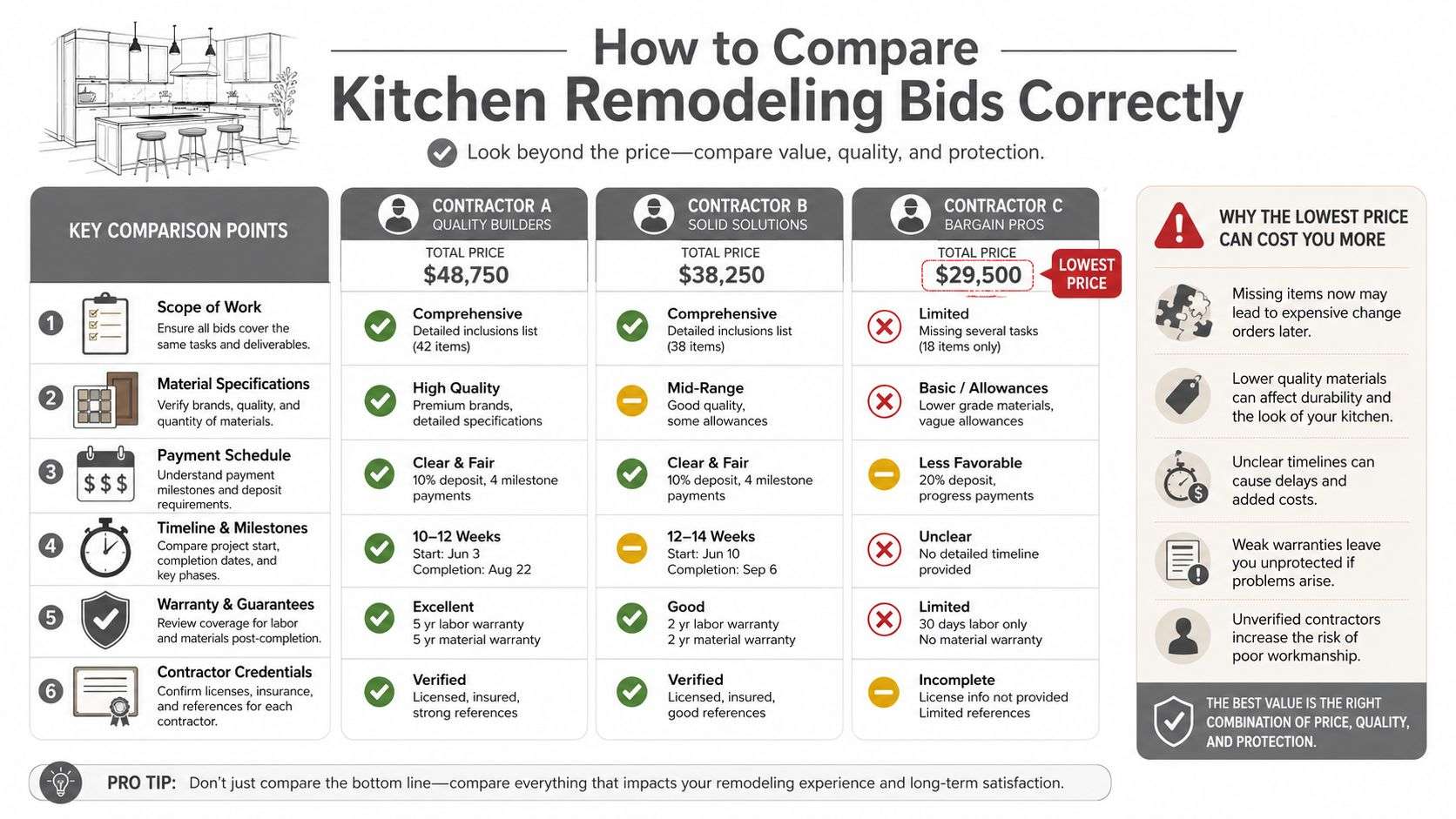
Use a checklist like this:
- Scope language: Does each bid describe the same demolition, installation, and finish tasks?
- Material detail: Are cabinet type, countertop level, tile area, and fixture assumptions spelled out?
- Allowance quality: Are the allowances realistic for what you've discussed, or artificially low?
- Timeline detail: Does the bid mention sequencing, procurement, and milestones in a believable way?
- Protection and closeout: Does it include site protection, cleanup, punch-list work, and final corrections?
If one quote is dramatically lower, don't assume you found a bargain. Assume you found a discrepancy and go hunting for it.
For homeowners comparing local options in nearby communities, it can also help to review what a kitchen remodel contractor in Cypress TX should address in scope, scheduling, and service expectations.
Look hard at the contingency and change-order logic
Homeowners often skip this part until they're already under contract. That's backwards.
Data shows that 10-20% contingency buffers are essential, as unexpected issues like moving a sink or stove can require significant plumbing or electrical system changes not included in initial estimates, potentially doubling costs for that portion of the job according to this kitchen remodel planning article focused on hidden costs.
That doesn't mean every project blows up. It means kitchens contain hidden conditions and scope sensitivity that standard comparison charts often miss.
A smart bid review looks for these warning signs:
| Red Flag | Why it matters |
|---|---|
| Vague descriptions | You can't enforce what isn't defined |
| Very low allowances | The quote may rise as soon as selections are made |
| No contingency discussion | The contractor may be underplaying risk |
| Weak change-order process | Disputes become more likely once work starts |
The right bid usually feels complete, realistic, and a little less exciting than the bargain bid. That's a good sign.
A reliable quote respects the fact that remodeling is real construction, not showroom shopping. It accounts for uncertainty without using uncertainty as an excuse to stay vague. That's what an apples-to-apples comparison really means.
Your Next Step Get an Accurate Quote from H-Towne
If you've read this far, you already know what separates a useful quote from a risky one. The next step is getting a bid built around your actual house, your actual priorities, and the actual conditions that affect cost in Houston.
That process should feel straightforward. It starts with a conversation about scope, goals, layout needs, and finish level. Then comes the field review. Measurements, access, existing conditions, utility locations, and planning details all matter because that's what turns a rough idea into a quote you can trust.
A well-run estimate process should also help you narrow decisions before construction starts. That includes cabinet direction, countertop level, appliance planning, timeline expectations, and any permit-related questions. The more that gets clarified before the contract, the fewer surprises show up later.
Homeowners should expect a complete estimate, clear communication, and honest discussion about trade-offs. If something is still unknown, it should be identified plainly. If an allowance is being used, it should be explained. If there's a schedule risk tied to materials or workload, that should be discussed up front, not after demolition begins.
For kitchen remodeling, bathroom remodeling, or whole home remodeling in the Houston area, the smartest move is to start with a detailed, no-pressure conversation and a quote that treats planning seriously.
If you want a clear, professional estimate from H-Towne & Around Remodelers, Inc., reach out through the website to schedule your complimentary consultation. You'll get help with planning, design direction, permits, and a detailed quote built for the way Houston remodeling projects typically work.