
You may love your Houston home and still feel done with the kitchen, frustrated by an outdated bathroom, or boxed in by a layout that no longer fits your family. That's a common place to be. Moving isn't always the smartest answer when you like your neighborhood, your lot, and your commute.
A remodel can solve the problem without forcing a sale, a move, and a fresh mortgage. The key is making the project financially sensible from the start, not just emotionally appealing. That's where many homeowners get stuck. They know what they want changed, but they're not sure which financing path fits the project, the timeline, and today's borrowing costs.
Your Dream Remodel Is Closer Than You Think
You get home after another Houston downpour, step around the bottleneck in your cramped kitchen, and realize the house still fits your address, your lot, and your life. It just does not fit the way your family uses it anymore. That is usually the point where a remodel stops feeling like a someday idea and starts looking like a practical decision.
Remodeling can also hold value here when the scope is planned well. According to Marwood Construction's Houston renovation guide, a well-executed kitchen remodel in Houston can deliver about 90% ROI, while a bathroom update can return around 86%. Those numbers are not a guarantee, and they should not be treated like one. They do show why many Houston homeowners see remodeling as more than a cosmetic upgrade. Better function, better daily use, and stronger resale appeal often go together.

Why waiting isn't always the cheaper option
Saving up and paying cash can be the right call. It also has a cost when the project keeps getting pushed out.
In Houston, delays often mean more than inconvenience. A failing shower pan can turn into subfloor work. An old kitchen layout can force small temporary fixes that add up without solving the actual problem. After heavy rain, humidity, or a minor storm event, homeowners sometimes move a project up because the house gave them a deadline.
Local remodeling costs vary widely, from straightforward updates to high-end custom work, and many kitchen and bath projects land in a range where financing becomes part of a sensible plan. The better question is not "Can we borrow?" It is "What will this project cost us in total if we do it now versus 12 to 24 months from now?"
That is the framework that matters. Compare the full repayment cost, expected timeline, likely price increases, and the risk of waiting if the project involves worn materials or post-storm repairs. A fast loan with a higher rate can still be the cheaper decision if it prevents further damage or lets you lock in a scope before costs rise again. A lower-cost financing option can be the better choice if the project is elective and you have time to close on it properly.
Practical rule: If the remodel fixes a daily-use problem or prevents a house problem from getting worse, judge the financing by total cost and timing, not by the monthly payment alone.
Financing can be the bridge, not the burden
Good financing gives you enough room to complete the right scope without forcing shortcuts on layout, waterproofing, or materials that matter in Houston homes. Bad financing does the opposite. It makes the payment look manageable while the long-term cost gets ignored.
Before you apply, get clear on your numbers. Lenders will look closely at income, debts, and monthly obligations, so reviewing resources on improving your DTI for home loans can help you figure out whether it makes sense to apply now or clean up your profile first.
It also helps to anchor your budget to actual project examples. Reviewing Houston remodeling portfolio examples by project type gives you a more grounded sense of finish levels, layout changes, and scope before you start comparing loan offers.
Houston home remodelers with financing options can be a good fit. The smart move is choosing financing that matches the job, the condition of the house, and the cost of waiting.
Decoding Your Remodeling Financing Options
A Houston homeowner might need two very different kinds of remodel financing. One is a planned kitchen update after years of putting it off. The other is a fast bathroom or flooring repair after a pipe leak or storm-related damage. The loan that works for one can be a poor fit for the other.
That is why the decision should start with two questions. How fast do you need funds, and what will the money cost over the full repayment period?
Contractor-arranged personal loans
Many Houston remodelers offer financing through lending partners, usually as unsecured home improvement loans. A Houston financing page from HFS Financial's Houston financing overview describes fixed-rate options, no home equity requirement, no prepayment penalties, and a quick approval and funding process.
That speed matters in real projects. If cabinets are on order, materials are rising, or the job involves repairs that should not sit through another heavy rain season, waiting weeks for a slower loan process can cost you more than a slightly higher rate.
The downside is straightforward. Unsecured loans often win on speed and convenience, not always on total borrowing cost. For many mid-sized remodels, that trade-off is acceptable. For larger scopes, it deserves a hard look.
Equity-based borrowing and refinance options
A HELOC can work well for phased projects or jobs where the final scope may shift after demolition. Older Houston homes often reveal wiring, plumbing, or framing issues once walls are open, so flexible access to funds can help. The risk is payment uncertainty if rates change.
A home equity loan is simpler to budget because you receive a lump sum with set payments. That can be a better fit when the scope is defined clearly from the start. The trade-off is that your house secures the debt.
Cash-out refinancing fits a narrower group of homeowners. It makes the most sense when the existing mortgage already needs attention for reasons beyond the remodel. If you currently have a favorable mortgage rate, replacing that loan just to fund a project may be expensive in the long run.
FHA 203(k) loans serve a different purpose. They are better suited to purchase-and-renovate situations or major rehab work than a standard elective remodel. They can solve the right problem, but they also bring more paperwork, approvals, and coordination.
Comparing common remodel financing options
| Financing Type | Best For | Typical Loan Amount | Key Consideration |
|---|---|---|---|
| Contractor-arranged personal loan | Fast kitchen or bathroom remodels, homeowners without usable equity | Varies by lender and borrower profile | Quick funding and fixed payments can help, but compare total repayment cost |
| HELOC | Phased projects, homeowners with equity and comfort with flexible borrowing | Varies | Variable rates can raise payments during the project or after completion |
| Home equity loan | Larger one-time scopes with a defined budget | Varies | Predictable payments, but your home secures the loan |
| Cash-out refinance | Homeowners already evaluating mortgage restructuring | Varies | You are changing the full mortgage structure, not just financing the remodel |
| FHA 203(k) | Purchase-and-renovate or more involved rehab work | Varies | More lender and administrative steps than standard remodel financing |
What to look at before you apply
Start with your monthly budget, not the lender's maximum approval. A payment can look fine on paper and still squeeze the household once insurance, taxes, utilities, and normal home maintenance hit in the same month.
Credit profile and debt load matter here. If you are planning to borrow soon, a practical starting point is learning about improving your DTI for home loans. Even when the loan is not a mortgage product, debt-to-income still affects approval strength, rate options, and whether the payment will feel reasonable after the job is done.
Use a simple filter before signing anything. Compare the rate, fees, payoff flexibility, funding speed, and full repayment amount. In Houston, I would add one more test. Ask whether this financing still makes sense if the project uncovers hidden moisture damage, code updates, or another repair you did not plan for.
The right financing is the option that matches the scope, the urgency, and the real cost of owning a home on the Gulf Coast.
How to Find Reputable Houston Remodelers with Financing
Finding Houston home remodelers with financing options isn't hard. Finding one that offers financing clearly, explains it thoroughly, and effectively executes the work takes more effort.
Start with the company's website
A remodeler that takes financing seriously usually says so plainly. Look for a dedicated financing page, references to lender partnerships, or language that explains whether they offer fixed-payment options, unsecured loans, or project-based financing help.
Don't stop there. Read the rest of the site with the same scrutiny you'd use for a contract. If the company promotes financing heavily but gives almost no detail about project management, insurance, permits, warranty support, or communication, that's a warning sign.
Use this quick filter when reviewing websites:
- Check project relevance: If you need a kitchen remodel, make sure the company shows real kitchen work, not only generic home improvement language.
- Look for scope depth: Bathroom updates, whole-home remodels, additions, and restoration work all involve different skill sets.
- Read how they describe the process: Strong remodelers usually explain consultation, estimating, selections, scheduling, and construction in plain terms.
- Notice whether financing is presented as support, not pressure: A credible company treats financing as one tool, not the entire sales pitch.
Ask direct questions on the first call
The first call tells you a lot. Good remodelers won't get defensive when you ask practical money questions. They should be able to explain whether financing goes through a third-party lender, whether funds go to you or to the contractor, and when project payments are expected.
Ask questions like these:
- Do you offer financing directly or through a lending partner?
- Is the financing better suited for kitchens, bathrooms, or larger whole-home projects?
- How does your payment schedule line up with the lender's disbursement process?
- Can I use financing for change orders if the scope evolves?
- Who handles permit coordination and project documentation if the lender needs paperwork?
Build a shortlist, then compare the right things
At this stage, don't compare only price. Compare responsiveness, clarity, project fit, and whether the company sounds comfortable discussing real trade-offs. A remodeler who can explain both construction scope and payment structure is usually easier to work with once the job starts.
One practical example in the Houston market is H-Towne & Around Remodelers, Inc., which handles kitchen remodeling, bathroom remodeling, whole-home renovations, additions, and restoration work, and also offers financing support through its process. That's useful for homeowners who want one company involved in both project planning and the financing conversation, instead of stitching those pieces together themselves.
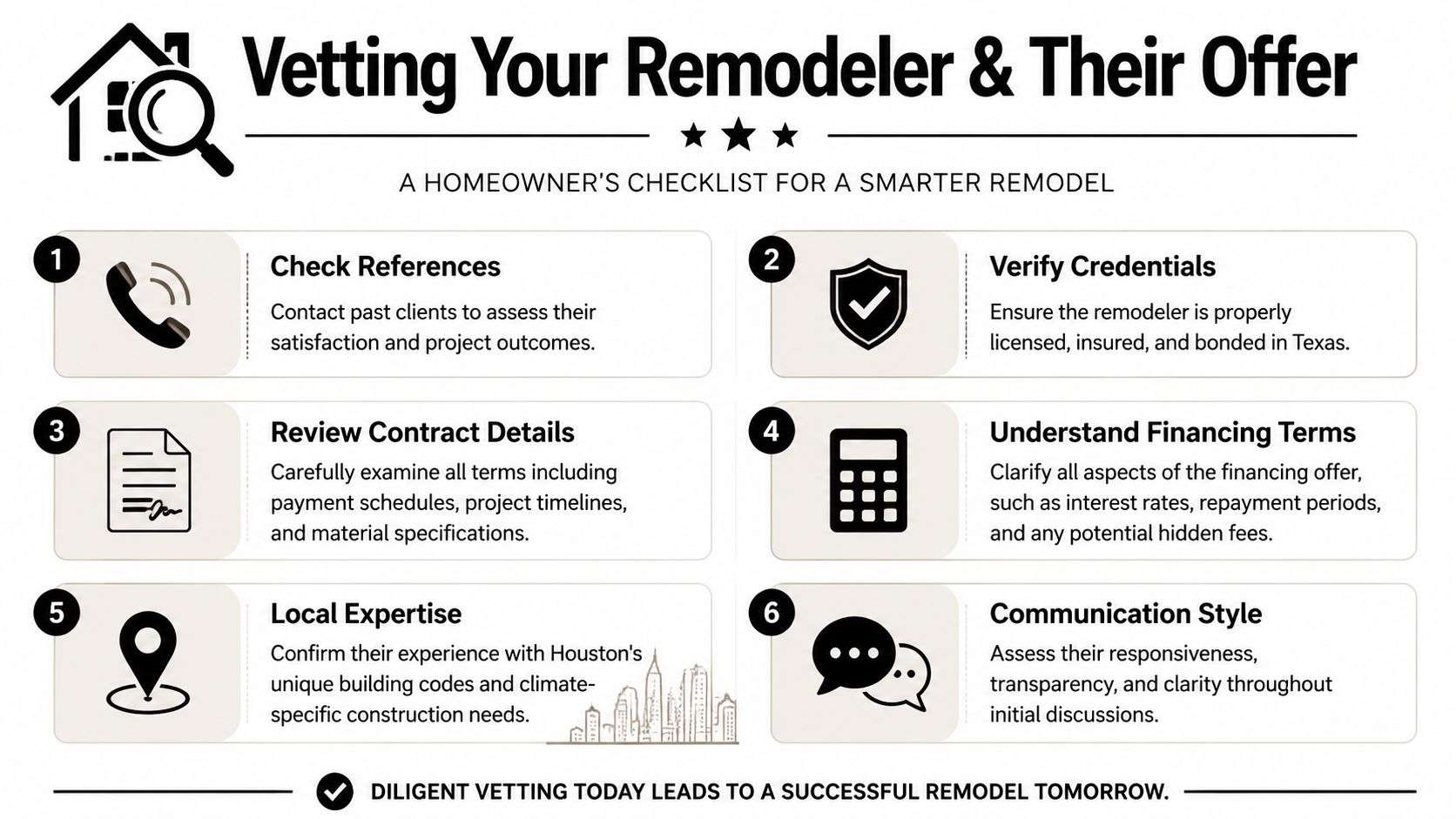
Vetting the Offer and the Remodeler
A financing offer can look attractive and still be the wrong deal. A remodeler can show strong photos and still be the wrong contractor. You need to evaluate both sides at the same time.
Low payment doesn't mean low cost
Many homeowners fixate on the monthly number first. That's understandable, but it's not enough. The key question is how much the project costs after interest, fees, and the full repayment term are accounted for.
The rate environment matters here. According to All American Tile & Remodeling's financing page, the federal funds rate held around 4.25% to 4.50% through May 2026, which means consumer borrowing has remained relatively expensive compared with the ultra-low-rate period. If a remodeler talks only about “easy monthly payments” and avoids total cost, treat that as incomplete information.
Ask this plainly: “What will I pay over the full life of this loan if I keep it to term?”
The financing questions that matter
Bring these questions to every financing discussion:
- What is the full repayment amount? Monthly payment alone can hide a costly long-term structure.
- Is the rate fixed or variable? Fixed payments are easier to plan around.
- Are there origination charges or lender fees? If there are costs built into the loan, you want them identified early.
- Are there prepayment penalties? Some homeowners expect to pay the loan down faster after a bonus, sale, or refinance.
- How is the money released? Funds that go directly to the homeowner create one kind of control. Stage-based disbursements create another.
- Will this place a lien on the property? You should know exactly what secures the debt.
Vet the remodeler with the same intensity
Financing can help you start a project. It won't protect you from poor craftsmanship, weak communication, or incomplete scope planning.
Review the company itself in a practical way:
- Insurance first: Ask for proof of general liability coverage and ask how worker coverage is handled.
- Permits and inspections: For structural, electrical, plumbing, and major layout work, ask who pulls permits and who schedules inspections.
- References with substance: Ask for recent clients with projects similar to yours, not just any happy customer.
- Warranty clarity: Get the workmanship warranty terms in writing.
- Contract detail: The contract should define materials, allowances, payment timing, and how change orders are approved.
If part of your remodel includes storm-related exterior work, it also helps to understand the inspection side. A resource like your guide to roof inspections can help homeowners ask better questions when roofing, water intrusion, or insurance-related damage overlaps with a renovation project.
A strong review set also matters. Reading recent homeowner testimonials can reveal whether a remodeler communicates well, stays organized, and handles problems professionally after the contract is signed.
A good remodeler won't rush you past the uncomfortable questions. They'll answer them clearly because they expect informed clients to ask.
Financing a Remodel in the Texas Gulf Coast Climate
Houston remodeling isn't only about finishes and floor plans. Weather changes the financing conversation in ways many general financing pages ignore.
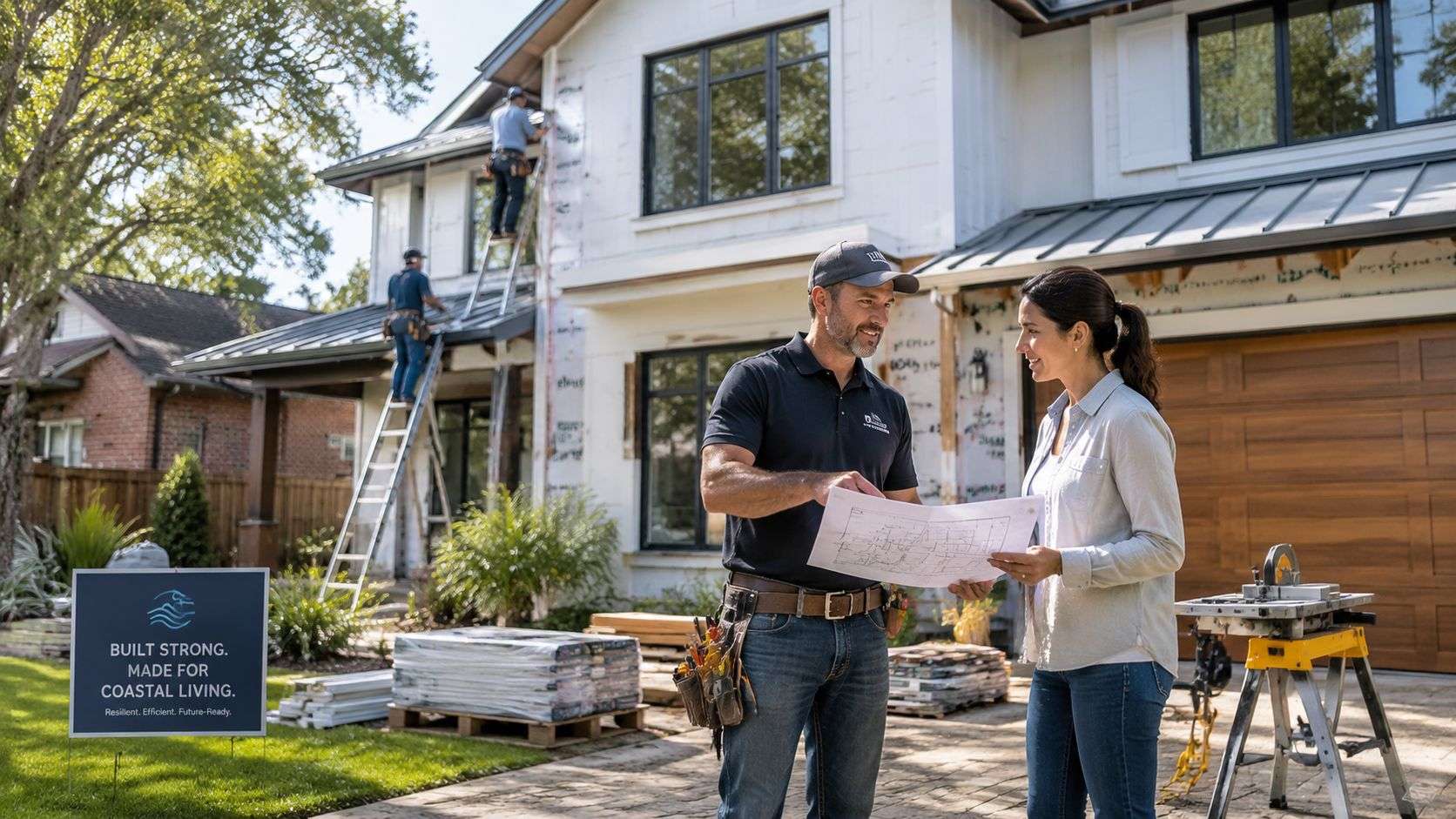
Storm recovery changes the financing problem
For a planned kitchen remodel, the usual question is how to pay for the job. For storm, flood, or fire restoration, the bigger question is often how to cover the gap between insurance money and the actual scope required to rebuild properly.
According to A Beautiful Floor's financing discussion, the U.S. has averaged 18 weather and climate disasters costing at least $1 billion each year over the 2019 to 2023 period, and that matters in a Gulf Coast market where homeowners regularly deal with flood and wind-loss events. In real projects, the issue isn't just whether financing is available. It's whether financing can bridge the deductible, scope changes, code-related upgrades, emergency work, and the time lag before insurance funds fully arrive.
Where homeowners get tripped up
Insurance claims and remodel financing don't always line up neatly. You may receive approval for repair work but decide to upgrade materials, change the layout, or bring a space to a better finish level while the house is already under construction. That added scope usually isn't covered the same way.
Common pressure points include:
- Deductibles: Homeowners need to understand what they must pay themselves and how that interacts with financing.
- Code-required work: Rebuild requirements may exceed the original condition of the home.
- Timing gaps: Emergency mitigation and reconstruction often start before all claim funds are in hand.
- Betterment decisions: Once walls are open, many owners choose to improve the space rather than only restore it.
If your project starts with an insurance claim, ask the remodeler whether the financing is intended as short-term bridge money, long-term project financing, or a mix of both.
Local project planning matters more after damage
Houston-area restoration projects often involve permit questions, documentation for insurers, and scope revisions after demolition reveals hidden conditions. That's why local experience matters. A company that understands the overlap between restoration, permitting, and reconstruction financing can save homeowners from serious confusion.
If your project falls into that category, review a contractor's dedicated storm and flood damage restoration services before signing anything. You want to know whether they handle only repair work, or whether they can also manage the upgrade and remodel side once the emergency phase is over.
Financing should match the type of emergency
Not every damage-related project should be financed the same way. A fast-moving repair with a narrow insurance gap is different from a larger reconstruction that turns into a kitchen remodel, bathroom rebuild, or whole-home renovation. The financing structure needs to match the timeline and the amount of uncertainty.
That's why generic “we offer financing” language isn't enough in Houston. Homeowners here need specifics. Can the financing cover non-covered upgrades? Can it be used while waiting on claim proceeds? Does the contractor understand how claim-related work and elective remodel upgrades should be separated on paper? Those answers matter just as much as the interest rate.
Start Your Houston Remodel with Confidence
The smartest remodel financing decision usually isn't the fastest approval or the lowest advertised payment. It's the option that fits your project scope, your home, and your household budget without creating avoidable stress later.
For Houston homeowners, that means thinking in layers. First, choose the right type of financing for the job. Next, pressure-test the actual offer. Then make sure the remodeler can deliver the work, manage the process, and handle local realities such as permits, inspections, and storm-related complications when they apply.
Keep the decision grounded
Before you sign anything, make sure you can answer these questions with confidence:
- Does this financing fit the project, or am I stretching the project to fit the financing?
- Do I understand the full cost, not just the monthly payment?
- Is the remodeler equipped for my specific scope, whether that's a kitchen, bathroom, whole-home renovation, or restoration job?
- Have I reviewed insurance, references, contract terms, and the workflow for payments and change orders?
That's the framework that keeps a remodel from becoming a financial headache.
Good projects start with clear numbers and clear scope
Homeowners usually feel better once the project stops being vague. A clear scope, realistic allowances, and a financing path that makes sense can turn a stalled idea into a manageable plan. That's especially true for kitchens and bathrooms, where smart design choices can improve daily life immediately while still supporting long-term value.
Houston home remodelers with financing options can absolutely help you move forward. Just make sure you're hiring one that treats financing as part of responsible planning, not as a shortcut around careful decision-making.
If you're planning a kitchen remodel, bathroom renovation, whole-home update, or restoration project and want to discuss both the construction scope and the financing side clearly, H-Towne & Around Remodelers, Inc. offers complimentary estimates for Houston-area homeowners. A direct conversation can help you compare options, define the right scope, and decide whether financing supports the project in a way that makes financial sense for your home.