
Most kitchen remodels near Jersey Village land between $45,000 and $85,000, and many homeowners recover about 70% to 80% of that cost at resale. That means the smartest project usually isn't the one with the most demolition. It's the one that improves how the kitchen works every day while keeping budget and future value in balance.
If you're reading this, your kitchen probably has one or two problems that have turned into ten. The cabinets don't hold what you need. The layout traps whoever is cooking. The lighting is poor at the counters and too harsh everywhere else. Maybe the finishes are dated, but more often the bigger issue is that the room doesn't function well anymore.
That's common in Jersey Village. Homes here have good bones, established neighborhoods, and owners who'd rather improve what they have than move just to get a better kitchen. A remodel in this area isn't just about style. It's about building a kitchen that works better, lasts in Houston humidity, and doesn't create maintenance headaches two summers from now.
Table of Contents
- Your Guide to Kitchen Remodeling in Jersey Village
- The Remodeling Journey Process and Timeline
- Decoding the Costs of a Jersey Village Kitchen Remodel
- Local Codes and Permits Staying Compliant in Harris County
- Design and Materials for Houston Climate and Your Lifestyle
- Choosing Your Remodeling Partner From Vetting to Warranty
Your Guide to Kitchen Remodeling in Jersey Village
A lot of Jersey Village kitchens weren't designed for how families use them now. People want wider walk paths, better prep space, stronger task lighting, easier cleanup, and storage that keeps counters clear. If your current kitchen makes simple things harder than they should be, remodeling starts to look less like a luxury and more like a practical fix.
That decision also fits the local market. Jersey Village has a median age of 38.53 and average household expenditures of $109,876 per year, which points to an established homeowner base that can support substantial home upgrades instead of only patchwork repairs, according to the Jersey Village demographics profile. In plain terms, this is the kind of community where owners often invest in long-term improvements that make the house work better and protect value.
The strongest remodels start with function, not finishes. Before talking about cabinet colors or backsplash tile, answer the harder questions.
- Workflow first: Where do groceries land when they come in? Where do small appliances live? Can two people move through the room without bumping into each other?
- Storage reality: Do you need deeper drawers, a pantry wall, better corner access, or fewer upper cabinets and smarter lower storage?
- Daily wear: Will the materials stand up to spills, humidity, cooking grease, and constant wiping?
- Resale sanity: Are you upgrading for your family, or are you planning to sell in the near future?
A kitchen can look expensive and still perform badly. Good remodeling fixes friction first.
Kitchen remodeling near Jersey Village TX works best when the plan respects both the house and the climate. Some homes can handle a bigger rework of the layout. Others get a better result by keeping plumbing and major walls in place and spending on cabinetry, surfaces, ventilation, and lighting. Knowing the difference is where good planning pays off.
The Remodeling Journey Process and Timeline
The hardest part for many homeowners isn't choosing finishes. It's not knowing what happens next. A kitchen remodel feels more manageable when you understand the order of work and the decisions that matter at each stage.
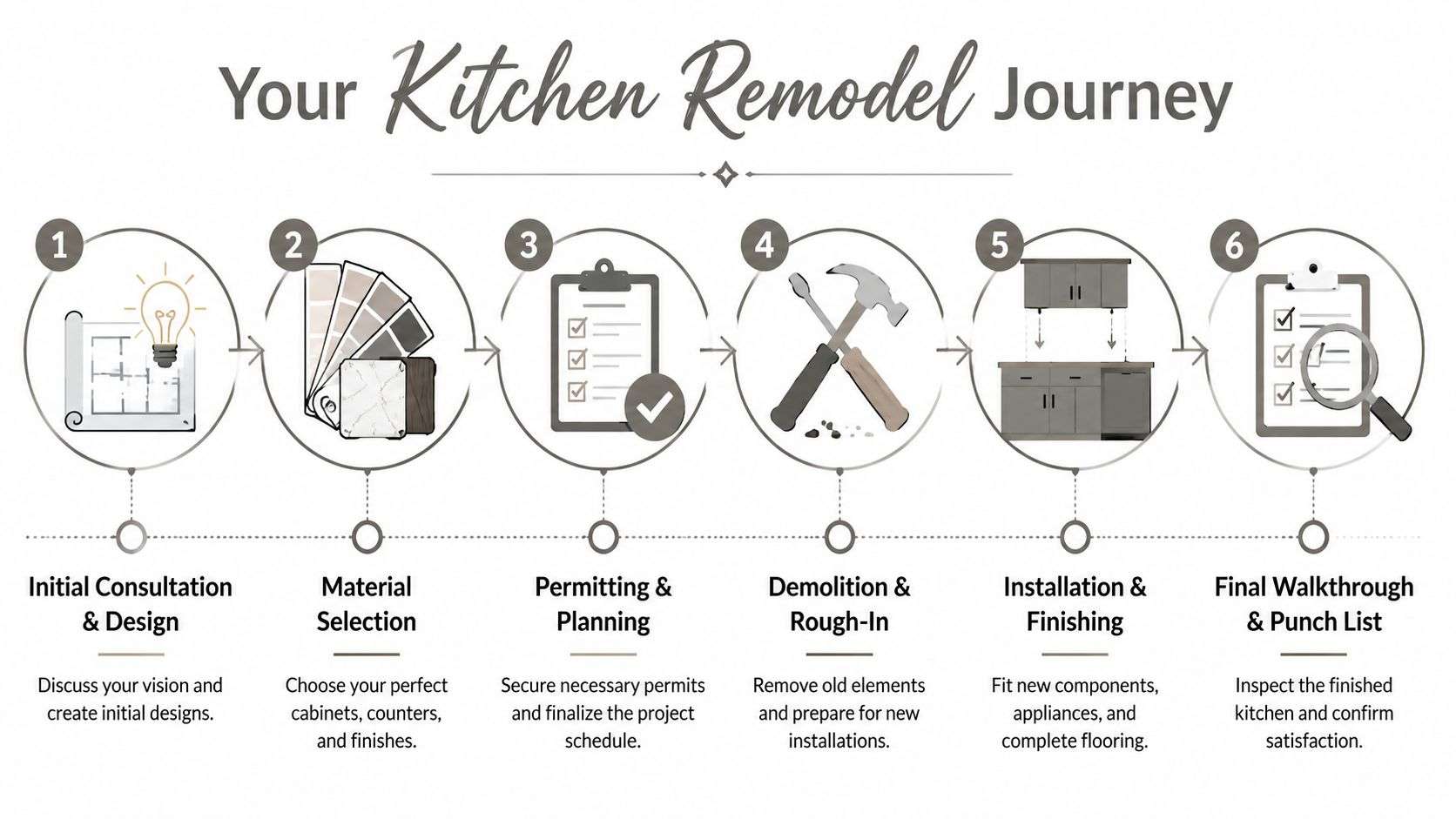
If you want a fuller phase-by-phase overview, this step-by-step kitchen remodel guide is a useful companion while you compare bids and scopes.
What happens before construction starts
The first stage is design and field verification. Measurements have to be exact. Appliance specs need to be confirmed early. If the refrigerator depth, vent hood requirements, or sink base width are guessed at, the project can stall later when cabinets or counters arrive.
Material selection happens earlier than many owners expect. Cabinets, countertops, flooring, hardware, plumbing fixtures, and lighting all affect one another. A simple example is floor thickness. Change that and you may need to adjust appliance clearances, dishwasher fit, and transitions into nearby rooms.
Then comes permit planning and scheduling. That part often feels slow because much of the work is on paper. But at this stage, costly mistakes are avoided. Finalizing the layout, ordering long-lead items, and aligning trades before demolition keeps the project from turning into a stop-and-start jobsite.
Practical rule: Don't schedule demolition until the design is settled and key materials are ordered.
What happens once the work begins
Demolition is fast compared with everything around it. The primary work begins after the old cabinets, counters, and finishes are out. Once walls are open, the team can inspect framing, confirm dimensions, and make any approved adjustments to plumbing, electrical, or ventilation.
Rough-in is the technical core of the project. Electricians place circuits and device locations. Plumbers set supply and drain lines. If the kitchen layout changes, the hidden infrastructure is rebuilt to match the new plan during this stage. Issues from poor past installations also tend to emerge during this phase.
Installation follows in a sequence that matters:
- Cabinets go in first so everything else has a fixed reference point.
- Countertops follow after final cabinet placement is confirmed.
- Backsplashes, fixtures, and trim are installed once surfaces are set.
- Appliances and punch-list details come near the end.
For the homeowner, the biggest practical issue is living through the disruption. Set up a temporary coffee station, microwave area, and dishwashing plan before demolition starts. Families who do that usually handle the in-between period far better than those trying to improvise during construction.
A final walkthrough closes the loop. Doors should align properly, drawers should glide cleanly, outlets should work where expected, and every finish item should be checked against the contract. That last pass matters because a good kitchen isn't just finished. It's tuned.
Decoding the Costs of a Jersey Village Kitchen Remodel
A kitchen budget usually gets off track the same way. A homeowner starts with cabinets and countertops, then the actual cost appears after opening walls, correcting old wiring, improving ventilation, or replacing materials that will not hold up well in Houston humidity. The smarter way to price a remodel is to separate appearance choices from infrastructure choices.
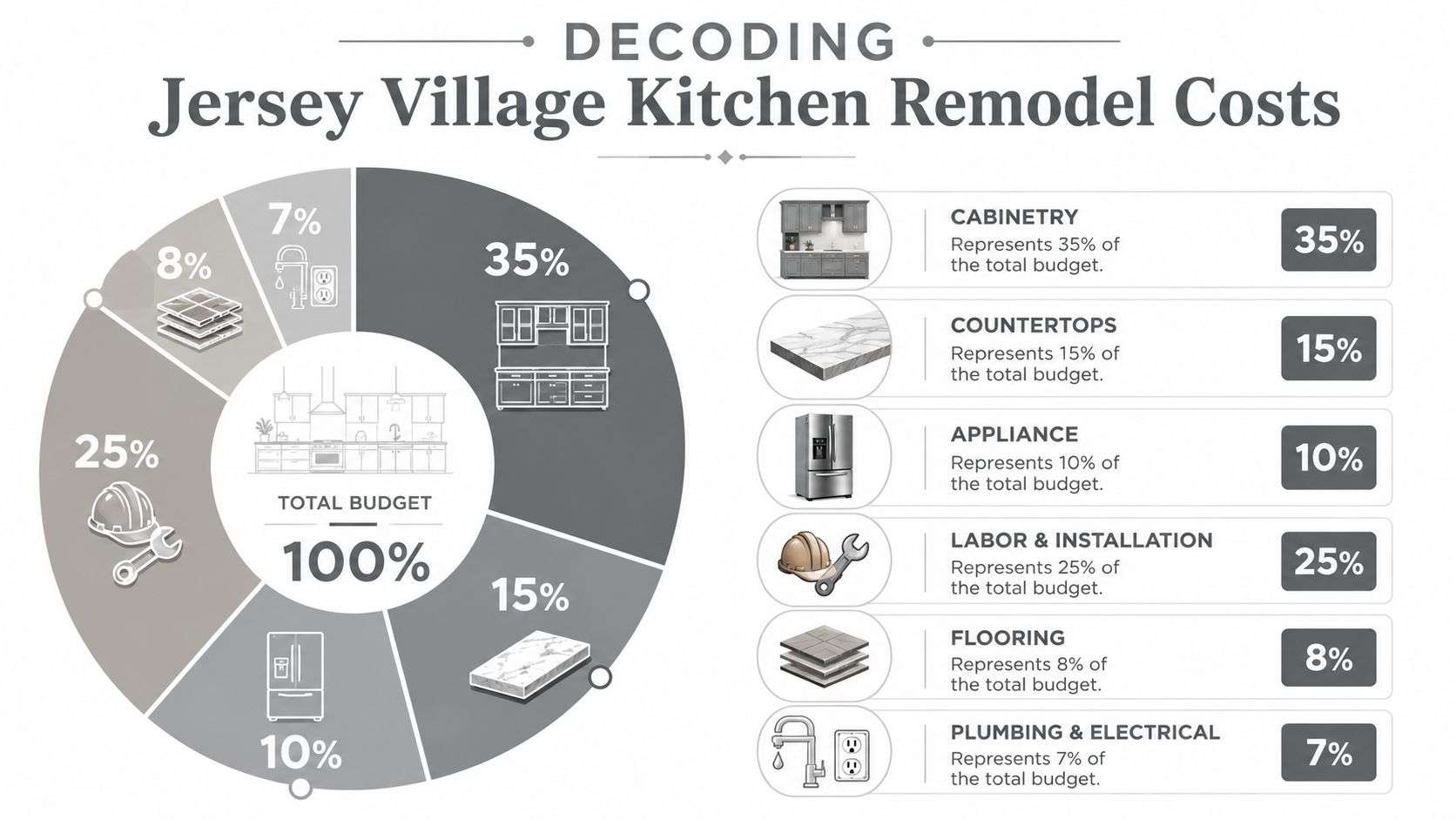
For homeowners trying to turn rough ideas into real numbers, this home renovation cost estimating guide is a practical starting point before you ask for formal bids.
What pushes a kitchen budget up or down
The biggest cost driver is scope. Keeping the sink, range, and refrigerator in roughly the same locations usually protects the budget because plumbing, electrical, gas, and venting stay closer to existing conditions. Once the layout shifts across the room, labor rises fast.
Older homes around Jersey Village can add another layer of cost. We often find circuits that need updating, undersized exhaust setups, wall damage hidden behind old cabinets, or floor surfaces that are no longer flat enough for a clean cabinet install. None of that is glamorous, but it affects how the kitchen performs long after the project is done.
Three decisions usually have the strongest effect on price:
| Decision area | Lower-cost direction | Higher-cost direction |
|---|---|---|
| Layout | Keep the existing footprint | Move plumbing, electrical, gas, or walls |
| Cabinet scope | Use standard sizes and improve storage inside the plan | Full custom sizes and major reconfiguration |
| Material selection | Choose durable midrange products that handle heat and humidity well | Select premium finishes, specialty details, and higher-maintenance surfaces |
A cosmetic update and a full remodel solve different problems. If the room works well and looks tired, surface replacements may be enough. If the kitchen traps heat, lacks storage, has poor lighting, or shows moisture wear around windows and sink walls, a deeper remodel usually makes more sense.
Compare bids carefully. A lower number often means fewer corrections behind the walls, thinner material allowances, or less attention to ventilation and moisture resistance.
Where spending usually pays off
In this climate, I would rather see money go into durability than into one more decorative upgrade. Kitchens near Jersey Village deal with heavy AC use, seasonal humidity, and long cooking cycles that put moisture and grease into the air. Materials and systems need to stand up to that.
Spending usually makes sense in these areas:
- Cabinet construction and finishes: Plywood boxes, quality hardware, and finishes that tolerate moisture hold up better than cheaper options that swell or peel.
- Ventilation: A properly sized hood and correct duct routing help control grease, humidity, and heat that can wear out paint, cabinets, and drywall.
- Countertops and splash areas: Low-maintenance surfaces with tight seams and good moisture resistance reduce staining, swelling, and edge failure.
- Lighting and electrical access: Better task lighting and enough outlets improve daily use more than many decorative upgrades do.
- Storage upgrades: Deep drawers, pull-outs, and pantry organization make the kitchen work better without forcing a full footprint change.
Where owners often overspend is on finishes that photograph well but do not wear well. Delicate cabinet coatings, trendy open shelving near cooking zones, or materials that absorb moisture can create maintenance problems in a Houston-area kitchen. A good budget puts function first, then builds the look around materials that can handle real use.
Local Codes and Permits Staying Compliant in Harris County
Permit talk isn't exciting, but it affects safety, resale, and insurance far more than most homeowners realize. A kitchen remodel can cross from cosmetic work into code-regulated work quickly. The moment you start moving plumbing, changing wiring, altering walls, or modifying ventilation, compliance matters.
The cleanest approach is simple. Decide early whether your remodel is only finish replacement or a true reconstruction of part of the house. That determines how much review the project needs and how carefully drawings, field notes, and trade coordination have to be handled.
Work that usually needs permit review
Cosmetic updates often stay simpler. Swapping like-for-like finishes such as cabinet hardware, paint, or surface materials is very different from changing the structure or systems behind the walls.
Permit review is commonly part of the conversation when the project includes:
- Electrical changes: Adding circuits, relocating outlets, updating lighting locations, or changing appliance connections.
- Plumbing changes: Moving sinks, modifying drain or supply lines, or relocating dishwashers and ice-maker feeds.
- Wall modifications: Removing or altering walls, widening openings, or changing framing.
- Mechanical updates: Adjusting exhaust routing or making ventilation changes tied to the kitchen layout.
For many owners, the easiest path is to work with a remodeler who handles that paperwork and inspection coordination as part of the job. This Houston construction permits overview is a helpful primer if you want to understand the process before construction begins.
Why skipping permits creates bigger problems later
Unpermitted work has a way of showing up at the worst time. It can complicate a sale, raise questions during inspections, or force a buyer to ask for repairs or credits. It can also leave you in a weak position if there's ever a claim involving electrical, plumbing, or fire damage.
If a project changes life-safety systems or hidden infrastructure, paperwork is part of the job, not a nuisance added on top of it.
A permit isn't a guarantee of craftsmanship. But it does create accountability around code minimums, inspections, and the documented scope of work. That matters in kitchens because so much of the important work ends up hidden behind drywall, cabinets, and finishes.
Design and Materials for Houston Climate and Your Lifestyle
A kitchen in this part of Texas has to survive more than dinner prep. It has to deal with humidity, repeated temperature swings, moisture from cooking, and the wear that comes from constant cleaning. Style still matters, but durability should drive more of the decision-making than many showroom displays suggest.

A national Houzz survey for 2026 found that 47% of renovating homeowners are adding pantry cabinets, and the same planning mindset applies locally because Houston-area kitchens also need material choices that resist swelling, mold risk, and premature wear in humid conditions, as noted in this Houzz 2026 kitchen remodeling trends article.
Choose materials that handle moisture well
Not every attractive material belongs in a Gulf Coast kitchen. Some finishes look great at installation and become a maintenance problem once steam, spills, and seasonal humidity start working on them.
Good material decisions usually look like this:
- Cabinet construction: Prioritize stable cabinet boxes, quality finishes, and door styles that won't fight you on cleaning. If you're comparing species and construction details, this 2026 guide to kitchen cabinets is useful for understanding wood differences before you commit.
- Counter surfaces: Favor surfaces that are practical for your cooking habits and easy to maintain around water, oils, and daily wipe-downs.
- Flooring: Pick a floor that can tolerate tracked-in moisture, frequent cleaning, and movement between kitchen and adjacent rooms without becoming slippery or fussy.
- Ventilation: Treat the hood as a performance item, not just a decorative one. Better air movement helps finishes last.
Some choices consistently cause trouble. Cabinets with low-grade finishes near dishwashers and sinks can show wear early. Flooring that doesn't tolerate moisture can cup, swell, or telegraph damage at seams. Highly delicate surfaces can turn basic kitchen use into constant maintenance.
In Houston, “durable” doesn't mean industrial-looking. It means the finish still looks good after steam, splashes, and real family use.
Build storage around how your household actually lives
Storage is where design and function meet. The best-looking kitchen still feels chaotic if cereal boxes live on the counter and cookware is piled into one deep black hole of a base cabinet.
Pantry additions are popular for a reason. They solve the everyday frustration of not knowing where things go. But pantry space only works if it's planned around the household, not copied from a photo.
Consider these practical upgrades:
- Tall pantry cabinets: Better for dry goods, small appliances, and bulk storage when a walk-in pantry isn't available.
- Deep drawers near the range: Easier for pots, pans, lids, and utensils than low shelves behind doors.
- Trash and recycling pull-outs: They free up floor space and reduce traffic conflicts around prep zones.
- Landing zones: Give the refrigerator, oven, and sink enough nearby counter space to be useful.
Kitchen remodeling near Jersey Village TX should reflect how you cook, clean, host, and move through the room. A family that cooks nightly needs different storage than a household that mainly wants a clean entertaining kitchen. A resilient design starts by telling the truth about how the space gets used.
Choosing Your Remodeling Partner From Vetting to Warranty
A kitchen remodel gets real the morning your cabinets are out, the sink is disconnected, and someone has to make a sound call about a wet wall, an out-of-level floor, or a vent path that is not where the plan assumed. That is when contractor selection matters most. Jersey Village homeowners have good options in this market, but choices only help if you know how to screen them.

The warning signs usually show up before work starts. A vague proposal, soft answers on permits, and unclear allowances for cabinets, tile, or plumbing fixtures usually lead to change orders that feel avoidable later. In this area, I also pay attention to how a contractor talks about moisture, ventilation, and material acclimation. Houston heat and humidity expose weak planning fast.
What to verify before you sign anything
Start with licensing, insurance, and basic business legitimacy. Then go further. A contractor should be able to explain who is pulling permits if required, who is scheduling inspections, and how electrical, plumbing, drywall, cabinetry, and countertops will be sequenced so the job does not stall for days at a time.
Use a practical screening list:
- Insurance and business status: Confirm the company is properly insured and actively operating as a residential remodeler.
- Written scope: Make sure demolition, installation, exclusions, and owner-supplied items are clearly listed.
- Trade management: Ask who coordinates electricians, plumbers, countertop templating, and inspections.
- Material planning: Find out how long-lead items are tracked and what happens if a cabinet or appliance arrives damaged.
- Communication process: Ask who updates you, how often, and where decisions get documented.
- Relevant past work: Review kitchens with a similar age, layout, and construction type to your home.
Good contractors answer hard questions plainly.
Ask what happens if subfloor rot shows up around the sink run. Ask how they protect adjacent rooms from dust and how they handle cabinet installation during humid stretches when materials need to acclimate indoors. Ask whether they build extra time into the schedule for inspections, countertop fabrication, and punch-list corrections. You are not looking for polished wording. You are looking for a process that holds up under pressure.
What a solid contract and warranty should cover
A contract should describe the actual job in enough detail that both sides can point to the same document when questions come up. “Kitchen remodel” is too broad to protect anyone. The written agreement should spell out cabinet installation, countertop scope, appliance responsibilities, plumbing fixture installation, backsplash limits, paint coverage, and payment stages tied to clear progress points.
Watch for these contract features:
| Contract item | Why it matters |
|---|---|
| Detailed inclusions | Reduces disputes about what was assumed versus what was priced |
| Allowance language | Clarifies the budget for items like fixtures, tile, or hardware before selections change |
| Change-order process | Sets a written method for handling hidden damage, owner revisions, or code-driven updates |
| Schedule terms | Helps set realistic expectations for lead times, inspections, and weather-related delays |
| Punch-list closeout | Defines how final touch-ups and corrections get completed |
| Warranty terms | Explains what is covered after completion and how service requests are submitted |
Warranty terms deserve a close read. In a Houston-area kitchen, failures often show up where moisture and movement meet. Caulk joints separate. Wood trim shifts. A plumbing connection drips inside a sink base. A finish starts to telegraph uneven framing or drywall repairs after the house cycles through heat and humidity. The warranty should say what is covered, how long coverage lasts, and what the service process looks like once the final payment is made.
H-Towne & Around Remodelers, Inc. is one local company homeowners may consider for kitchens and other residential remodeling work. Whether you choose that firm or another qualified team, the standard should stay the same. Choose a contractor who can explain the scope clearly, document it in writing, and build a kitchen that still performs well after one Houston summer.
The right remodel partner explains the job clearly before demolition starts, then handles surprises with documentation, not guesswork.
If you are narrowing the field, ask each finalist to walk you through your project as if construction starts next week. The better candidate will talk through site protection, permit steps, inspections, long-lead materials, hidden conditions, finish tolerances, and final warranty service without hesitation. That level of clarity usually separates a controlled remodel from an expensive mess.