
If you're staring at worn laminate, chipped edges, or a kitchen layout that still works but no longer feels worth showing off, you're in the same spot a lot of Cypress homeowners hit before a remodel starts. The countertop usually gets blamed first because it's the surface you touch every day, but in real projects it's often the signal that the whole room needs a better plan. New tops can sharpen the look of the kitchen fast, but they also affect sink placement, backsplash height, cabinet condition, lighting decisions, and how the room handles moisture over time.
That matters in Cypress. Homes here see humid air, busy family use, and in some cases water damage that turns a simple surface swap into a deeper repair. A countertop choice that looks good in a showroom can become the wrong choice if the cabinets underneath have swelling, the sink base took on water, or the project really belongs inside a full kitchen or bath remodel instead of a one-line item.
Table of Contents
- Why Cypress Homeowners Are Upgrading Their Countertops
- Choosing the Right Countertop Material for the Houston Climate
- Budgeting Your Cypress Countertop Project What to Expect
- The Countertop Installation Process From Measure to Finish
- How to Prepare Your Home for a Smooth Installation
- Warranty Insurance and Finding a Trusted Installer
- Cypress Countertop Questions and Your Next Steps
Why Cypress Homeowners Are Upgrading Their Countertops
A typical Cypress call starts the same way. The kitchen still works, but the counters show their age every day. Burn marks near the cooktop, swelling around the sink, chipped laminate edges, old cutout sizes that limit fixture choices, or a color that keeps the whole room stuck in the early 2000s. In bathrooms, builder-grade tops often reach the point where they look worn even when they are clean.
Countertops get attention because homeowners use them hard and see them constantly. They affect prep space, cleaning time, sink options, and how the rest of the room reads. Replace the top, and suddenly the cabinet doors, backsplash, faucet, and wall color either make sense or need to be updated too. That is why countertop replacement in Cypress often grows into a wider kitchen or bath remodel.
A lot of these projects are driven by condition, not style.
- Function has slipped: The layout may need more usable landing space, a better sink setup, or edges that clean up easier in a busy family kitchen.
- The cabinets are worth saving: If the boxes are still level and solid, new counters can improve the room without paying for a full tear-out.
- The home may be sold in the next few years: Countertops are one of the changes buyers notice fast, especially when paired with other high-ROI upgrades for sellers.
- Moisture damage changed the scope: In Cypress, countertop replacement often follows a plumbing leak, repeated sink splash exposure, or a larger water event. After that, the primary question is not whether the top looks bad. It is whether the substrate, sink base, backsplash area, and adjacent finishes are still sound.
That last point matters more here than many national articles admit. Humidity usually does not ruin a stone slab by itself, but it does expose weak spots around seams, caulk lines, sink rims, and cabinet tops. After flood or leak work, a new countertop can be the visible finish on top of a repair that also includes cabinet drying, vanity replacement, plumbing updates, or backsplash removal.
I tell homeowners the same thing on site. A countertop swap works well when the cabinets are dry, level, and worth keeping. It goes sideways when someone tries to lay a nicer surface over swollen particleboard or a sink base that never fully recovered from water exposure.
If you are still weighing looks against maintenance and day-to-day use, this guide on how to choose kitchen countertops for your home helps narrow the options before you commit to a full remodel scope.
Choosing the Right Countertop Material for the Houston Climate
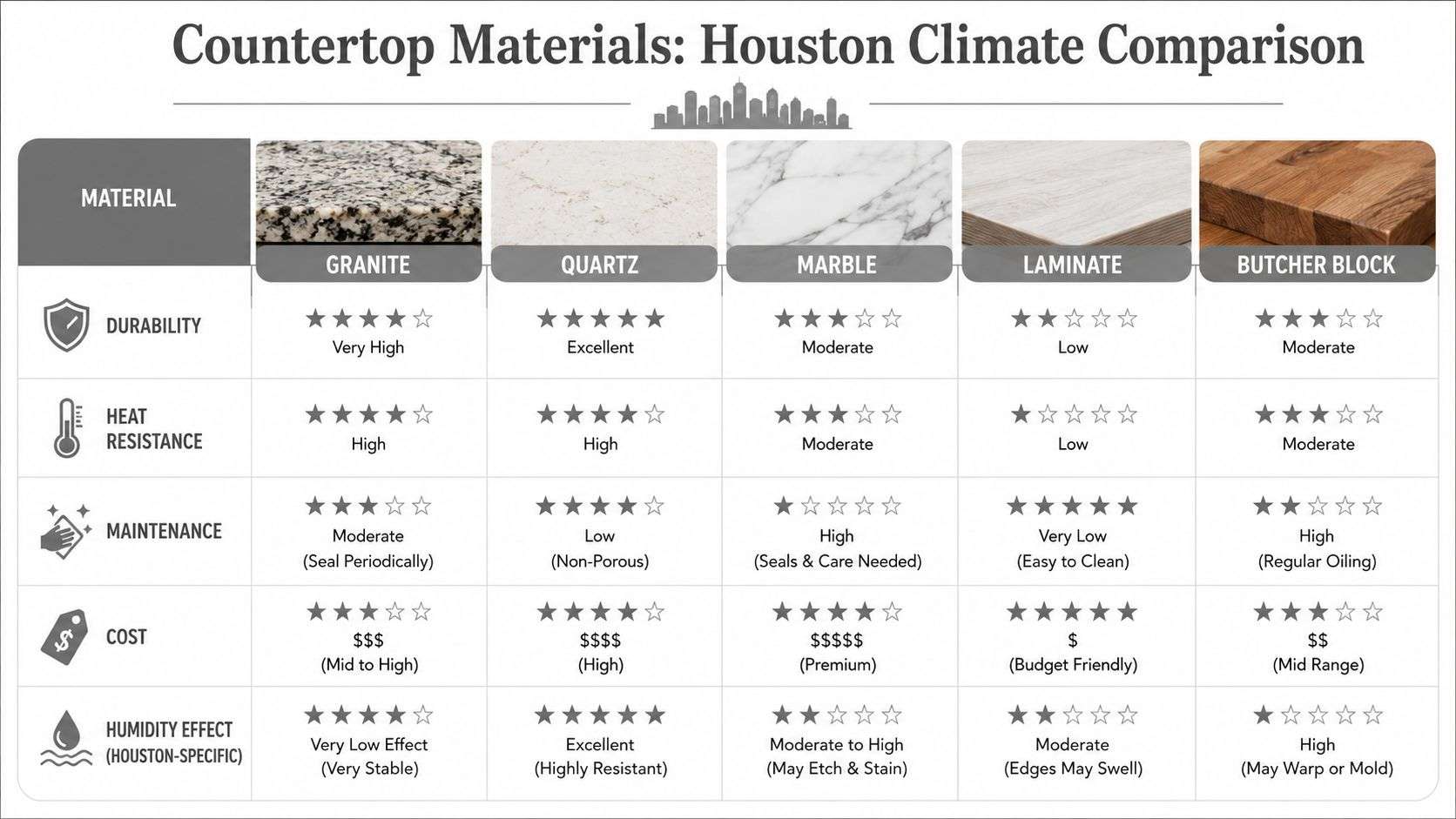
Most countertop advice is too generic for this area. Cypress homeowners don't just need a pretty surface. They need one that holds up to humidity, routine kitchen mess, occasional plumbing leaks, and in some homes, countertop replacement comes after a bigger moisture event. That's an underserved part of local guidance, especially because countertop replacement here is often part of broader water-damage repair rather than a simple style update.
What humidity changes
Humidity doesn't usually ruin the stone itself. It exposes weak points around it. Think sink rims, seams, backsplash joints, cabinet tops, and substrate conditions. That's why moisture resistance isn't just about the slab surface. It's about the whole assembly.
For homeowners weighing options, this practical guide on how to choose kitchen countertops is useful if you're still narrowing down style and function together.
Practical rule: In Cypress, the best countertop isn't always the one with the hardest surface. It's the one that matches the room's moisture exposure, maintenance tolerance, and cabinet condition.
Material comparison for real Cypress use
| Material | What works well | What causes trouble | Best fit in Cypress |
|---|---|---|---|
| Quartz | Non-porous feel, consistent appearance, easy daily cleanup | Less forgiving if cabinets below are out of level or damaged | Strong choice for busy kitchens and post-repair remodels where low maintenance matters |
| Granite | Natural variation, strong visual depth, good durability in regular use | Needs more maintenance attention than homeowners sometimes expect | Good for kitchens where owners want natural stone and will keep up with care |
| Marble | High-end look, softer and classic appearance | Shows wear more easily in active family kitchens | Better for lower-abuse areas, bathroom tops, or homeowners comfortable with patina |
| Laminate | Budget-friendly and fast to understand visually | Moisture intrusion at seams and edges can become a problem if water gets underneath | Fine for dry areas and tighter budgets, weaker choice where leaks or flood history are concerns |
| Butcher block | Warm look, softer feel, works in certain design styles | Moisture and maintenance discipline matter a lot | Best used selectively, not blindly, in humid environments |
The local gap in material guidance is real. Existing Cypress-area content rarely answers whether quartz, granite, or laminate is the better choice after Texas Gulf Coast moisture exposure, even though that's a real homeowner concern in this market, as noted in local countertop coverage discussing Cypress material options.
A few straight calls from the field:
- Quartz usually makes the easiest long-term sense for homeowners who want a cleaner maintenance routine and less worry around everyday kitchen moisture.
- Granite works well when the install is done right and the homeowner accepts upkeep instead of expecting a zero-maintenance stone.
- Marble is usually a design-first decision, not a practical-first one.
- Laminate can still fit the job, especially in secondary spaces, but it's a weaker answer if the home has dealt with leaks, swelling, or flood repair.
- Butcher block needs commitment. In a humid climate, neglect shows up faster.
If the home has had water intrusion, don't choose by sample board alone. Check the cabinet boxes, sink base, drywall behind the backsplash line, and flooring transitions. A premium slab over compromised cabinetry is money spent in the wrong order.
Budgeting Your Cypress Countertop Project What to Expect
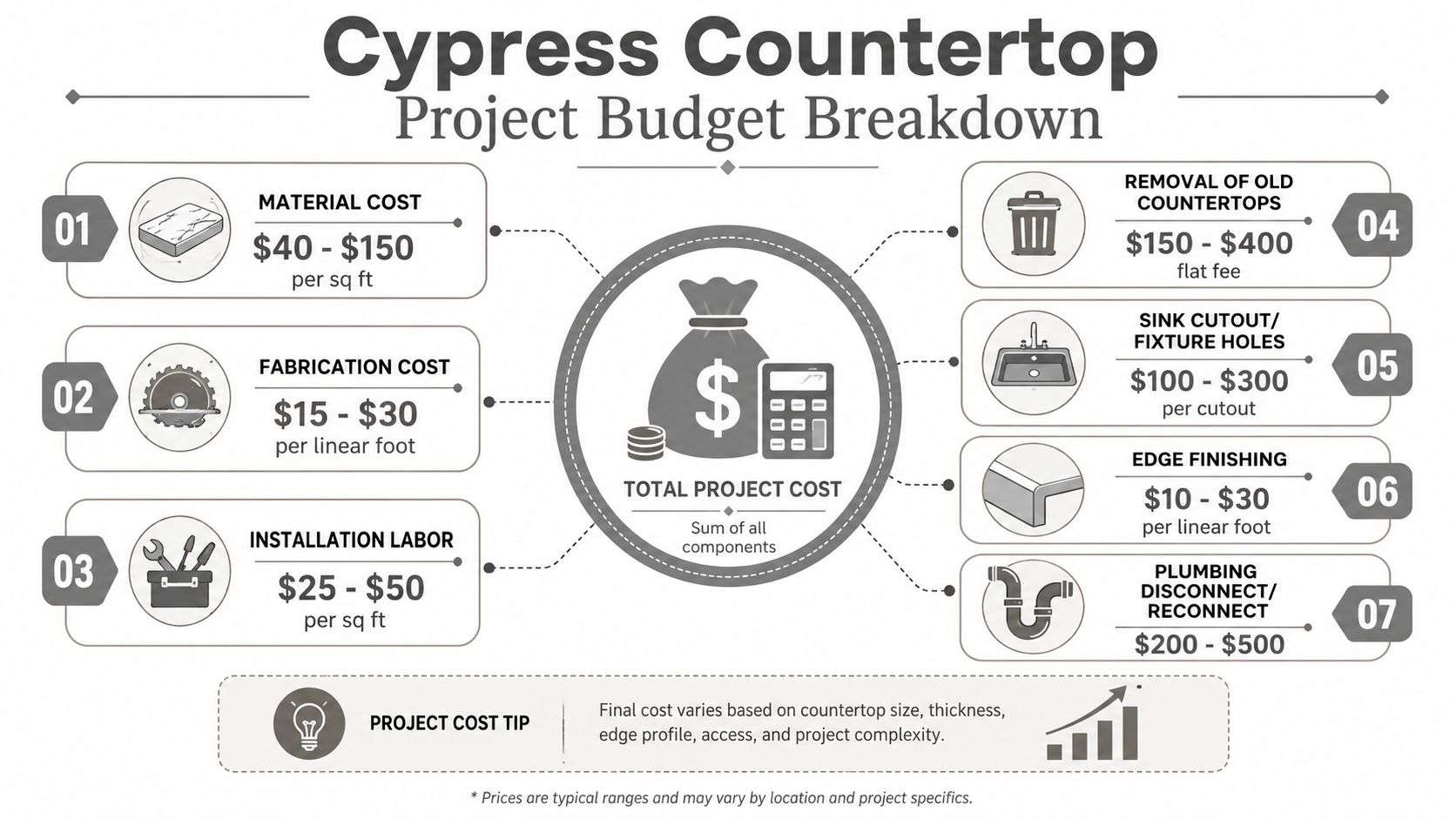
A lot of Cypress countertop budgets go sideways for the same reason. The homeowner prices the slab, then discovers the full scope of work includes fabrication, sink and cooktop cutouts, old top removal, edge work, plumbing reconnects, and cabinet prep if the boxes are out of level or have taken on moisture.
That last part matters more in Cypress than people expect.
Homes here deal with humidity year-round, and some projects start after a leak, dishwasher failure, sink base rot, or flood cleanup. In those cases, the countertop is only the visible layer. If the cabinet rail is swollen or the sink base floor is soft, installing a new top before fixing the structure below it is a fast way to waste money.
Why local pricing swings so much
The biggest price drivers are material, square footage, and layout complexity. A simple vanity top with one sink cutout prices very differently from a kitchen with an angled run, island, cooktop opening, full-height splash, and seam planning around windows or corners.
Labor moves the number too. These are the line items that usually change the final total:
- Demolition and disposal: Removal is quicker when the old tops are laminate and the cabinets are being replaced. It takes more care when existing cabinet boxes must stay intact.
- Cabinet repair or leveling: Uneven runs, swollen particle board, and loose sink bases need correction before stone goes in.
- Edge profile: Straight or eased edges are usually less expensive than more detailed profiles.
- Cutouts and drilling: Undermount sinks, cooktops, faucet holes, soap dispensers, and water filtration taps all add labor.
- Backsplash work: A short matching splash is one budget. Full wall coverage is another.
- Plumbing reconnection: Disconnecting and reinstalling fixtures often gets missed in early estimates.
Material choice also changes how much risk sits in the budget. Quartz often gives Cypress homeowners a more predictable maintenance picture in kitchens and baths. Natural stone can perform well, but if the client expects zero upkeep, the long-term cost discussion is incomplete. Laminate lowers the entry price, but it is less forgiving if the room has a history of swelling, leaks, or repeated moisture exposure.
If the countertop is part of a larger kitchen or bath update, it helps to price it with the rest of the scope instead of treating it as an isolated purchase. Homeowners comparing phases and payment timing often review Houston home remodelers with financing options before they lock in the countertop alone.
Where budgets usually go off track
The common mistake is skipping condition checks. Homeowners choose the surface first, then learn the cabinet run is out of level, the sink cabinet has water damage, or the plumbing needs to move for a new sink configuration.
That is where surprise costs start.
A better budgeting plan starts with a few direct questions:
- Are the existing cabinets structurally sound? Cosmetic wear is one thing. Soft boxes, swelling, and separation at the rails are another.
- Is this a simple finish upgrade or part of water-damage repair? That changes both material choice and prep work.
- Are you reusing the sink, faucet, and backsplash? Reuse can save money, but only if sizes, hole locations, and condition still line up.
- Will other trades be involved? Plumbing, electrical, drywall, and tile work can push the actual project cost above the countertop estimate.
In practice, the smartest budget includes a contingency for the unglamorous work. Cabinet leveling, substrate correction, and moisture-related repairs do not change the look of the finished kitchen in a photo. They do decide whether the new countertop stays supported, sits flat, and holds up for years.
The Countertop Installation Process From Measure to Finish
Countertop installation looks simple at the end because most of the precision work happened before the slab entered the house. The sequence matters. Skip steps, rush fabrication, or force a bad fit, and that's when seams, overhangs, sink alignment, and corner details start to go wrong.
The general benchmark is clear. From templating to completion, the industry standard is about 10 to 15 business days, with fabrication often taking 7 to 10 business days and the on-site installation usually finishing in 4 to 8 hours, which puts many projects in the 2 to 3 week range from measurement to usable surface, according to this overview of the countertop installation timeline.
What happens before install day
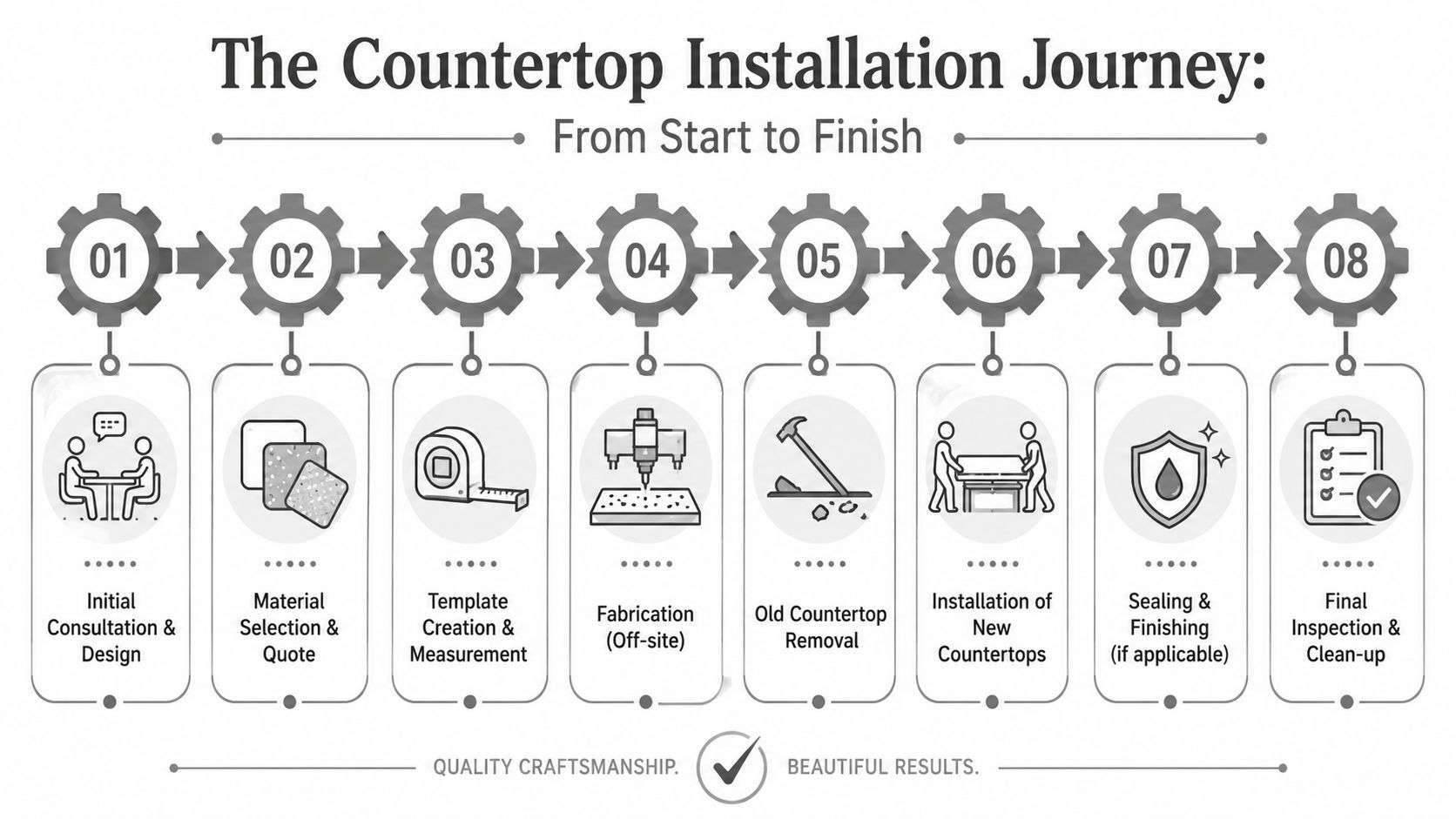
Most good projects move through a predictable chain.
Consultation and layout review
In this step, the homeowner's goals get translated into actual dimensions, sink decisions, edge details, and backsplash scope.Material selection
The slab choice affects look, maintenance, seam placement, and sometimes how forgiving the install will be.Template creation
This is one of the most important steps. Accurate templates account for wall conditions, cabinet runs, sink locations, appliance fit, and overhangs.Fabrication
Off-site work includes cutting, polishing, shaping openings, and preparing seam areas. This isn't dead time. It's where precision gets built into the job.
The timeline feels long only if you think installation begins when the truck arrives. In reality, installation begins at measurement.
What happens on install day and right after
Install day is fast compared with fabrication, but it's not casual work. Crews are moving heavy material, dry-fitting pieces, checking level, aligning seams, securing tops, and finishing edges and sink details. In many homes, the visible work wraps up the same day. Larger or more intricate layouts can take longer.
A well-run install usually includes:
- Dry placement first: Pieces get positioned and checked before final securing.
- Seam alignment: Good seams don't happen by luck. They come from prep, fit, and patience.
- Sink and corner sealing: These areas need careful finishing because water finds weak details fast.
- Clean-up and final walkthrough: Homeowners should understand what can be used right away and what needs cure time.
After installation, some parts of the kitchen may still be temporarily out of service. Sink and backsplash connections typically follow after the required set and cure periods. That's why family scheduling matters. If you're planning around school nights, work-from-home days, or a holiday week, build in downtime instead of assuming the room will be fully operational the minute the slabs are set.
How to Prepare Your Home for a Smooth Installation
A smooth countertop install depends as much on preparation as craftsmanship. Heavy pieces have to move through the house safely. Crews need room to work. And if the sink area isn't ready, the day can slow down for reasons that had nothing to do with the slab.
One local detail matters more than most homeowners expect. Installers in Cypress often use clear silicone for sink rims and corners, and that material needs a 24-hour set time before plumbing reconnection so the seal stays permanent and leak-free. Pre-disconnecting plumbing 48 hours prior helps avoid delays.
The homeowner checklist that prevents delays
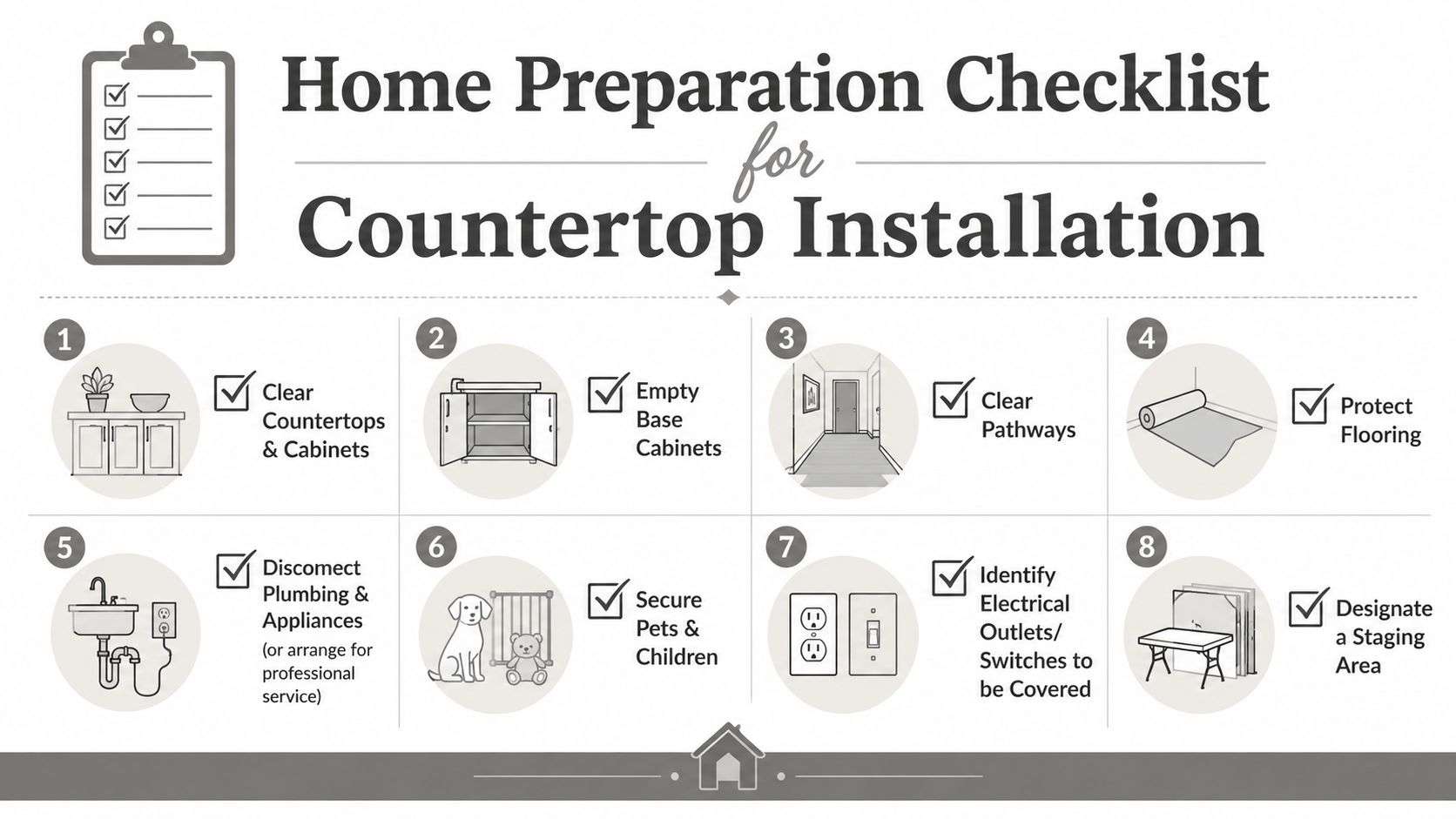
- Clear the countertops completely: Not just the toaster and coffee maker. Remove everything so crews don't have to work around breakables.
- Empty the base cabinets near sink areas: Installers and plumbers may need access from below.
- Open a clean path from entry to kitchen or bath: Slabs are heavy and awkward to maneuver around furniture, rugs, and decor.
- Protect pets and keep children out of the work zone: The safest house on install day is the one with less foot traffic.
- Confirm disconnect responsibilities in advance: Know who is handling plumbing and any appliance disconnection before the crew arrives.
- Set up a temporary kitchen if needed: A folding table, microwave, and coffee setup can make the downtime easier.
- Identify anything that stays: If you plan to reuse the sink, faucet, or backsplash area, point that out before removal starts.
- Choose a staging area: Crews may need a spot for tools, packaging, or removed material.
Small delays usually come from access, not fabrication. A blocked walkway, full sink base, or last-minute plumbing question can throw off the whole day.
If flooring is newly finished or easy to dent, say that early. Good crews plan protection, but homeowners should still point out the surfaces they're worried about most.
Warranty Insurance and Finding a Trusted Installer
Countertops look permanent once they're in. The risk shows up later if the fit was rushed, the sink seal fails, the seam opens, or a crew damages the house and isn't properly covered. That's why insurance and workmanship warranty matter just as much as the slab itself.
A trustworthy installer should be able to explain what they cover, what the material manufacturer covers, and who handles problems if something goes wrong during installation. Those are basic questions, not awkward ones.
What to verify before you sign
Start with the essentials.
- Licensed and insured status: You want proof, not a verbal assurance.
- A clear scope of work: Removal, cutouts, sink details, backsplash scope, and cleanup should all be spelled out.
- A local track record: Ask to see kitchens or baths similar to yours, especially if your project includes moisture-related repairs.
- A process for change orders: If hidden cabinet damage appears after demolition, there should be a documented path forward.
If you want a neutral checklist for screening contractors, Handvetted's guide to vetting pros is a solid place to review the basics before signing with anyone.
For homeowners specifically planning a larger kitchen update around their counters, this page on a kitchen remodel contractor in Cypress TX gives a useful sense of how countertop work fits into a broader remodel rather than standing alone.
What a strong warranty actually covers
Material warranty and workmanship warranty are not the same thing. A slab manufacturer may address issues tied to the product itself. The installer's workmanship warranty should address the fit, seams, attachment, and finish quality of the installation work.
Top-tier installers in the Houston-Cypress area often provide a 15-year craftsmanship warranty. That's a meaningful standard because it shows the installer expects the fabrication and installation process to hold up over time.
H-Towne & Around Remodelers, Inc. is one licensed, insured option for homeowners who need countertop installation tied into kitchen remodeling, bathroom remodeling, or storm and flood repair work.
Cypress Countertop Questions and Your Next Steps
A few practical questions usually come up late in the process, right when homeowners are almost ready to move.
Common questions from Cypress homeowners
Can I replace the countertop without replacing the cabinets?
Yes, if the cabinets are level, dry, structurally sound, and worth keeping. If they have swelling, movement, or water damage, replacing only the top can create a short-term fix.
Can I reuse my existing sink?
Sometimes. Reuse makes sense when the sink is in good condition and the new cutout plan supports it. If you're already updating the faucet, sink base, or plumbing layout, replacement is often cleaner.
Do I need a permit for a simple countertop swap?
That depends on the scope. A basic surface replacement may not trigger the same requirements as a larger kitchen remodel with electrical, plumbing, or layout changes. Ask before work starts.
Which material is easiest to live with?
For many busy families, the easiest answer is the material that asks the least of them day to day and fits the room's moisture exposure. The right choice is usually the one that matches your habits, not the showroom lighting.
Should I do countertops before or after other remodeling work?
Usually after the cabinet plan is finalized and before final backsplash completion. If flooring, cabinets, or wall repairs are still moving, the countertop schedule should follow the build sequence.
A good next step is to stop thinking only in terms of stone samples and start with the room conditions. Check cabinet health, decide whether this is a cosmetic refresh or a larger remodel, and then choose the material that fits the way your home is used.
If you're planning countertop installation in Cypress TX as part of a kitchen, bathroom, or whole-home update, H-Towne & Around Remodelers, Inc. offers complimentary estimates and can help you evaluate whether your project should stay a surface replacement or roll into a larger remodel plan.