
Most Cypress kitchen remodels land in the $35,000 to $85,000+ range, with broader Houston-area projects commonly falling between $30,000 and $150,000 based on scope and finish level. In real life, that usually means a kitchen project takes several weeks to a few months once design choices, permits, demolition, and installation all start moving.
If you're reading this, there's a good chance your kitchen still works, but it doesn't work well. The cabinets may be tired, the lighting may be poor, and the layout may force everyone into the same corner at the same time. That's where a lot of Cypress homeowners get stuck. They want a better kitchen, but they don't want to walk into a project that doubles in cost because of one or two design decisions.
Affordable kitchen remodeling in Cypress TX isn't about chasing the cheapest bid. It's about choosing the right scope, the right materials, and the right contractor structure so your money goes into changes you'll live with every day.
Your Guide to Kitchen Remodeling in Cypress
A kitchen remodel usually starts with irritation, not inspiration. Drawers don't close right. The old fluorescent box light makes the room feel dated. Counter space disappears the minute someone sets down groceries. By the time most homeowners call a remodeler, they're not looking for a showroom kitchen. They're looking for a room that feels easier to use.
That matters in Cypress because remodeling isn't just a style decision. In the Houston, The Woodlands, Sugar Land metro area, the median owner-occupied housing value was $281,900 in the 2019 to 2023 American Community Survey, and the area also had 2,166,832 housing units with 1,820,704 occupied housing units, which shows the scale of the local housing market where remodeling decisions compete with the cost and hassle of moving (Houston market remodeling context).
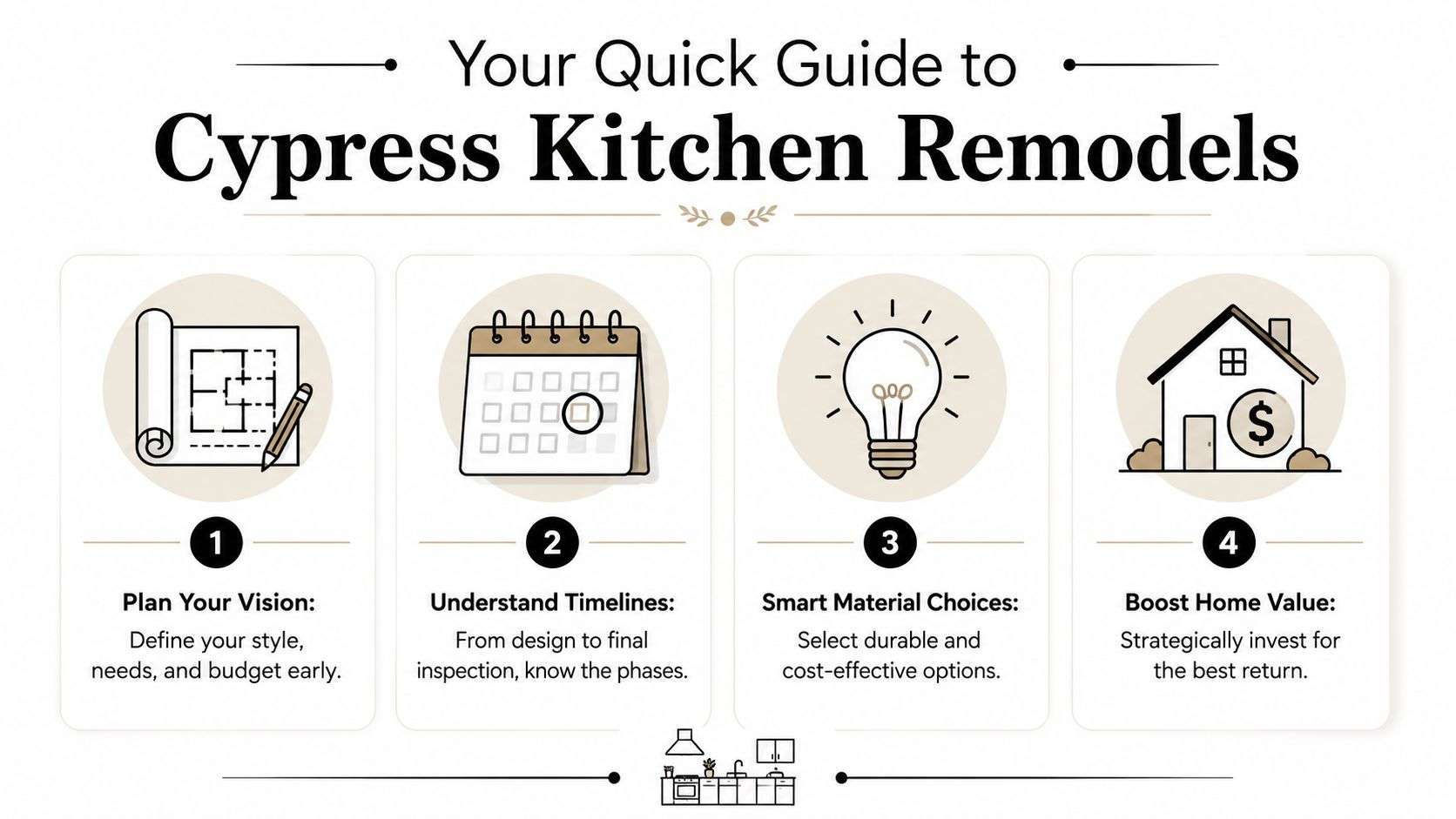
A quick local reality check
| Key planning point | What it means for a Cypress homeowner |
|---|---|
| Budget range | Most projects people ask about are not “budget” in the bargain sense. They're budget-conscious mid-range remodels with carefully controlled scope. |
| Timeline | Even a straightforward remodel takes coordination across selections, ordering, demolition, installation, and final punch work. |
| Best savings lever | Keeping the footprint intact usually protects the budget better than downgrading every finish. |
| Value mindset | A good remodel should improve daily function first, then appearance, then resale appeal. |
The homeowners who stay happiest with the result usually make three decisions early:
- They define what must change: poor storage, bad lighting, worn cabinets, damaged tops.
- They separate wants from expensive wants: a bigger island and moving plumbing aren't the same kind of upgrade.
- They budget around scope, not mood: “Affordable” is a planning strategy, not a style category.
Practical rule: If your kitchen feels dated but the basic workflow still works, you may not need a full gut remodel to get a meaningful upgrade.
What affordable usually looks like
In Cypress, the most workable approach is often a focused remodel. That means improving the visible, high-use surfaces and fixing the weak points without tearing the room apart. Cabinet refinishing, updated counters, better task lighting, durable flooring, and cleaner trim work can change the whole room if the bones are still good.
The biggest mistake I see is assuming affordability comes from picking cheaper materials after the design is already too complex. It usually works the other way around. Start with a disciplined plan, then spend where it shows.
Decoding Kitchen Remodel Costs in Cypress TX
Homeowners usually ask one question first. “What's this really going to cost?” The honest answer depends less on style words like basic or luxury and more on what you're changing behind the walls.
For a 2025 Houston-area kitchen remodel, a common range is $30,000 to $150,000, with many Cypress-specific projects clustering around $35,000 to $85,000+. Labor often uses 30% to 35% of the total budget, so on a $60,000 project, labor may account for roughly $18,000 to $21,000 before materials, permits, or contingency costs are added (Houston and Cypress kitchen cost ranges).
Where budget pressure usually comes from
Labor is where many homeowners underestimate the project. They focus on cabinet door styles and countertop samples, but the cost swings often happen because of what the crew has to do to install those choices. If the project needs demolition, framing adjustment, electrical updates, plumbing changes, drywall repair, trim, paint, and multiple return trips for finish work, labor adds up fast.
That's why it helps to compare your plan by scope, not by inspiration photo.
Cypress kitchen remodel budget tiers
| Budget Tier | Estimated Cost Range | Common Scope of Work |
|---|---|---|
| Focused update | $25,000 to $45,000 | Surface-driven improvements, cabinet repainting or selective replacement, new counters, lighting, backsplash, flooring, and fixture swaps while keeping the existing layout |
| Mid-range remodel | $45,000 to $85,000 | New cabinets and countertops, flooring, lighting, appliance coordination, finish upgrades, and a more complete refresh within the current footprint |
| Large-scope remodel | $85,000+ | Full gut renovation, layout changes, utility moves, structural work, premium finish packages, and more involved permit and inspection activity |
A useful companion if you want another broad look at the cost to remodel a kitchen is this breakdown from Home Project Services. It's helpful for comparing national-style budgeting language against what local scope decisions mean on actual projects.
What “affordable” does and doesn't mean
Affordable doesn't mean unrealistic. It doesn't mean full custom cabinetry, relocated appliances, and structural changes at a cosmetic-update price. It means building a project that spends money where it changes function and durability.
It also doesn't mean every line item should be cut. Cheap paint over failing cabinet boxes is not value. Low-grade flooring in a busy family kitchen is not savings if it has to be replaced early. Smart budgeting puts pressure on the expensive scope decisions first, then balances finish quality.
A kitchen budget gets easier to manage when the plan answers one question clearly: what are we keeping exactly as it is?
A better way to read estimates
When you get bids, don't look only at the total. Look for these scope triggers inside the estimate:
- Cabinet approach: repaint, reface, stock replacement, or custom build
- Countertop installation details: tear-out, template timing, sink cutouts, edge selections
- Electrical scope: added lighting, relocated outlets, panel-related concerns
- Plumbing scope: fixture replacement versus line relocation
- Wall and framing work: soffit removal, island changes, pass-throughs, wall removal
Two estimates can look similar at first glance and be priced very differently because one implicitly includes layout movement and the other doesn't.
Smart Strategies for an Affordable Kitchen Remodel
A Cypress homeowner starts with a simple goal. Freshen the kitchen, keep the budget under control, and avoid turning a four-week job into a two-month disruption. The projects that stay affordable usually make disciplined scope choices early, before selections and demolition start pulling the price upward.
The biggest budget swing is not the faucet finish or backsplash pattern. It is how much of the kitchen you decide to disturb.
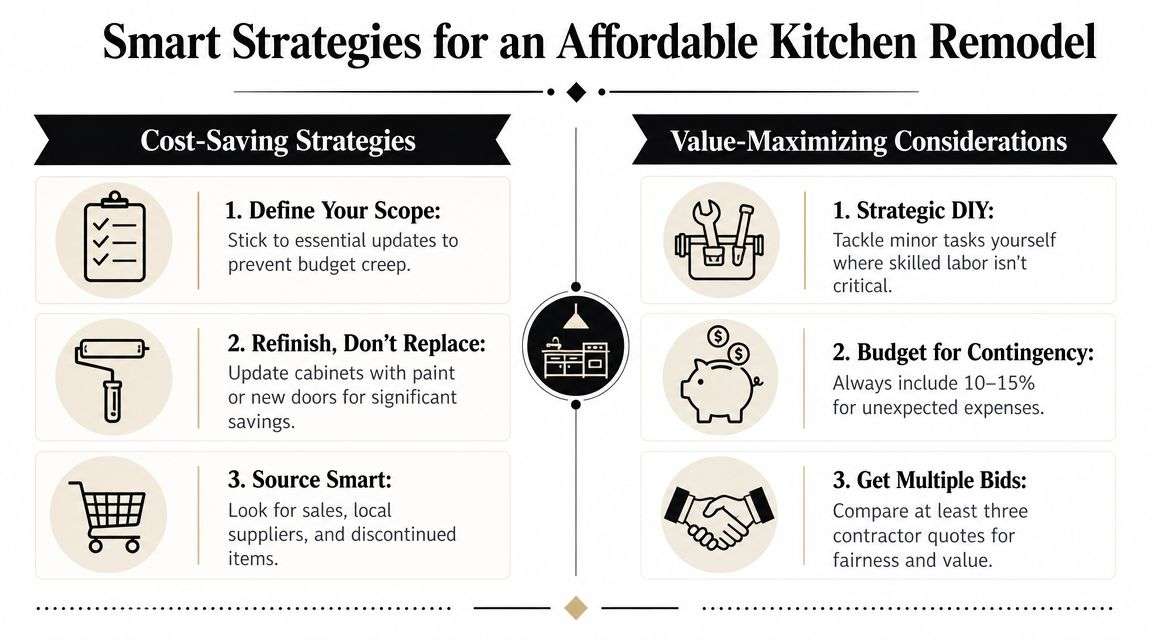
Keep the layout if the kitchen already functions
In Cypress remodels, the fastest way to control cost is to keep the sink, range, and refrigerator in place unless the current layout causes daily problems. A layout change sounds manageable on paper, but it usually adds several trades at once. Plumbing has to move. Electrical often needs new outlet locations or circuit changes. Venting may need to be reworked. Then patching, flooring, drywall, and paint follow behind it.
That is why affordable remodeling is really a scope decision first.
If the room works reasonably well now, spend on surfaces and storage improvements before you spend on relocation work.
Put money where you touch the kitchen every day
Some upgrades give a strong return in daily use without forcing a full rebuild. Cabinet repainting or refacing can make sense if the boxes are level, solid, and worth saving. New counters can change the whole look of the room without requiring custom cabinetry. Lighting updates often improve the kitchen more than homeowners expect, especially over prep areas and sinks.
Flooring needs a harder look. In busy Cypress households with kids, pets, or frequent backyard traffic, the cheapest material is often the one that wears out first. Luxury vinyl plank and porcelain tile usually hold up better than bargain flooring that looks good for a year and then starts showing edge wear or water damage.
Know where low bids usually get thin
A low kitchen price is not automatically a good kitchen price. I pay attention to what was left out.
Cabinet work is a common example. One contractor may price repainting with proper prep, sanding, primer, and hardware reinstallation. Another may price a faster paint job that looks fine at handoff and starts chipping early. Countertop pricing can hide similar differences, especially around tear-out, sink cutouts, edge details, and who handles plumbing disconnect and reconnect.
The same applies to trim, drywall repair, and finish work. Those details decide whether the kitchen feels finished or patched together.
Demolition can save money, or create expensive cleanup
Homeowner demo only works when the limits are clear and the disposal plan is realistic. Removing loose shelving or old fixtures is one thing. Tearing into cabinets, tile, or soffits without understanding what is behind them can damage walls, flooring you planned to keep, or utility lines that were never meant to be exposed that way.
If you are weighing when to hire removal pros, that guide is useful because kitchen tear-out affects more than debris hauling. It affects sequencing, wall condition, and how quickly the rebuild can start.
For bigger budget planning, this guide on remodeling a home on a budget does a good job showing how phased work can keep a project realistic.
Trade-offs that usually make sense in Cypress kitchens
These choices tend to protect budget without making the kitchen feel cheap:
- Keep cabinet boxes if they are structurally sound. Repainting or refacing often beats full replacement on cost.
- Choose one feature to stand out. Counters, a backsplash, or pendants can carry the design without upgrading every finish.
- Use standard sizes where possible. Custom widths, custom depths, and specialty inserts add up fast.
- Replace fixtures without relocating them. You get a visible update without opening the door to utility rerouting.
- Phase secondary work. If the budget is tight, complete the core kitchen now and save under-cabinet lighting, built-ins, or wall treatments for later.
The goal is not to make every line item as cheap as possible. The goal is to spend on the parts that improve function, hold up to use, and avoid expensive rework later.
Navigating Permits and Timelines in Harris County
Permits become part of the conversation the moment a kitchen remodel stops being cosmetic. If you're replacing like for like, permit issues are often limited. If you're moving plumbing, adding or relocating electrical, changing ventilation, or removing part of a wall, permit review becomes much more likely.
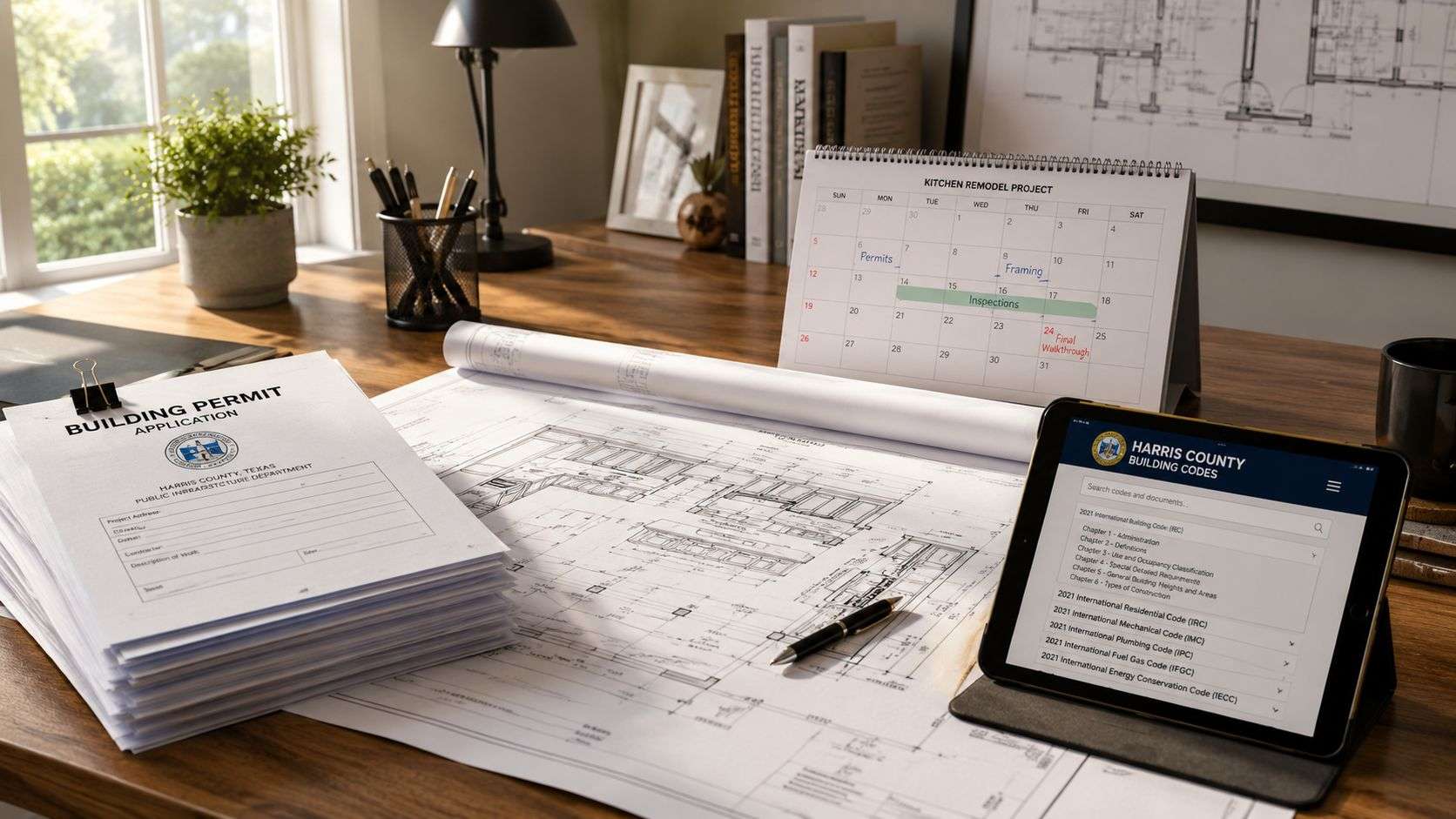
Work that commonly triggers permit review
In practical terms, kitchen work usually moves into permit territory when it affects safety systems, utilities, or structure.
That often includes:
- Electrical changes: adding circuits, relocating outlets, changing wiring paths, or expanding lighting beyond simple fixture swaps
- Plumbing changes: moving sinks, rerouting drains, or altering water supply locations
- Mechanical updates: venting changes tied to range hoods or similar systems
- Structural work: removing walls, widening openings, or modifying framing
If your project touches any of those, don't guess. A contractor should explain what must be filed, who pulls the permit, and what inspections are expected. Homeowners who want a better picture of that process can review this local guide to Houston construction permits.
What the timeline usually feels like
A kitchen remodel rarely feels linear from the homeowner side, even when the contractor has a clear schedule. There are selection decisions, lead times, site prep, rough work, installation sequencing, and final touch-ups. Countertops can't be templated until cabinets are in place. Appliances need to land at the right point. Paint and trim work often happen in more than one pass.
A realistic timeline usually breaks into phases:
| Phase | What happens |
|---|---|
| Planning and selections | Layout review, scope decisions, material picks, estimate refinement |
| Permitting and ordering | Permit preparation where needed, product ordering, schedule coordination |
| Demolition and rough work | Tear-out, framing adjustments, rough electrical, plumbing, and prep |
| Installation and finish work | Cabinets, counters, flooring, backsplash, paint, fixtures, appliances, punch list |
The fastest kitchen remodel is usually the one with fewer mid-project changes, not the one with the most aggressive promised start date.
What delays projects most often
Most timeline problems come from avoidable decisions:
- Late material selections
- Backordered specialty items
- Change orders after demolition
- Unclear responsibility for permit handling
- Uncoordinated trades waiting on one another
If you want the project to move smoothly, finalize as much as possible before demo starts. In kitchens, indecision is expensive because almost every trade depends on what the previous trade finished.
How to Choose the Right Cypress Remodeling Contractor
A Cypress homeowner gets three kitchen bids. One is far lower than the others. On paper, it looks like the obvious choice. Then the questions start. Who is pulling permits if electrical work changes? Who orders cabinets and checks them for damage? Who is coordinating countertop templating, appliance delivery, and final punch work? That gap between a low number and a real plan is where budgets usually slip.
The right contractor does more than quote a price. The right contractor shows you which scope decisions are driving cost, which parts of the kitchen can stay as-is, and where complexity will add labor, delay, or permit requirements. In this market, that matters most on jobs that go beyond surface updates. Once you involve layout changes, new circuits, plumbing moves, or custom lead-time items, poor coordination gets expensive fast.
What to verify before you sign
Start with the estimate and contract, not the photo gallery.
A polished portfolio can show style. It does not show whether the company writes clean scopes, prices change orders clearly, or keeps trades aligned once demolition begins. Ask for documentation and read it.
Check these items closely:
- Insurance and business details: Confirm current liability coverage and who the legal contracting party is.
- Written scope of work: The proposal should spell out demolition, prep, installation, finish work, and exclusions.
- Allowance structure: If cabinets, tile, lighting, or fixtures are listed as allowances, ask what happens if your selections run over.
- Permit responsibility: The contract should state who files, who meets inspectors, and which work is expected to require approval.
- Daily project oversight: Ask who is managing crews, answering site questions, and approving field changes.
- Warranty terms: Get the workmanship warranty in writing, along with any manufacturer coverage on products.
If you are comparing firms, reviewing the services on this kitchen remodel contractor in Cypress TX page can give you a practical baseline for what a full-scope remodeler typically handles.
Why the cheapest bid often changes mid-project
Low bids usually come in one of two forms. The contractor is intentionally underpricing to get the job, or the scope is thin and missing real work.
In kitchens, the missing work is often predictable. Drywall repair after demo. Floor prep under new materials. Disposal fees. Trim adjustments after cabinet installation. Disconnect and reconnect steps for plumbing or appliances. Permit handling. These are not rare extras. They are common parts of the job.
A stronger estimate usually feels more specific because it identifies assumptions before work starts. That gives you a fairer way to compare proposals. If one bidder includes painting, hardware installation, haul-off, and final fixture hookup while another leaves those vague, the lower number is not truly lower. It is less complete.
Ask every contractor one direct question: What is most likely to become an extra charge in my kitchen, and why?
The answer tells you a lot. An experienced remodeler can point to actual risk areas quickly. Rotten subfloor. Out-of-level walls. Electrical updates in older sections of the home. Cabinet changes that affect flooring transitions. Vague answers usually mean vague pricing.
Reviews matter, but read them like a homeowner, not a marketer
Star ratings help, but the written comments matter more. Look for repeat mentions of communication, cleanliness, schedule control, and how the company handled problems after work began. A contractor with recent, detailed reviews gives you a clearer picture than one with only a few short comments.
It also helps to understand how review patterns are built. Some companies actively ask past clients for feedback and some do not. That alone does not make the reviews less useful. If you want context on how companies get more reviews for local businesses, that guide explains why some firms have a more visible review trail than others.
Questions worth asking in the first meeting
Use the consultation to test judgment.
Ask questions tied to budget decisions, not just design preferences:
- Which part of my scope is adding the most labor cost?
- What can stay in place to control the budget without hurting function?
- If I want to move one major item, sink, range, or refrigerator, which creates the biggest ripple effect?
- Which selections need to be finalized before demolition?
- How do you price and approve change orders?
- Who will be my point of contact once work starts?
Those answers should be direct and specific to your kitchen. If the contractor cannot explain trade-offs clearly before the contract, that usually does not improve during construction.
H-Towne & Around Remodelers, Inc. is one example of a licensed, insured Houston-area remodeler that handles kitchen remodeling and related residential renovation work in Cypress and nearby communities. The takeaway is not the brand name. The takeaway is the process standard you should expect from any contractor you consider: documented coverage, clear scope, defined permit responsibility, and one accountable person managing the job.
From Vision to Reality What to Expect Next
A typical Cypress kitchen transformation doesn't need a dramatic TV-style reveal to be successful. It usually starts with a family that's tired of living around the room's limitations. The cabinets are worn but still structurally usable. The countertops are dated. The floor has seen too many years of spills, pets, and daily traffic. Everyone agrees the kitchen needs help, but no one wants to blow the budget on changes that won't improve everyday use.
So the plan gets tighter.
A realistic before-and-after path
Instead of moving walls, the homeowner keeps the footprint. Instead of relocating the sink and range, those stay put. The project focuses on the items that change the room the most in daily life: cabinet refinishing or replacement within the same layout, new countertops, flooring that can handle traffic, better lighting, and cleaner finishes throughout.
That kind of remodel usually feels bigger than it sounds because kitchens respond quickly to visible improvements. Better storage access, a brighter work surface, durable flooring, and updated fixtures can make the whole house feel more current even when the actual layout stayed the same.
What a good outcome really looks like
The best result is rarely “we spent as little as possible.” It's “we spent intentionally and didn't pay for complexity we didn't need.”
A strong remodel should leave you with:
- A kitchen that works better every day
- Finishes that match your actual use, not just a showroom photo
- A budget that reflects deliberate choices
- A process that didn't spiral because of poor planning
The homeowners who feel best at the end are usually the ones who made peace with trade-offs early. They chose one or two high-impact upgrades, protected the layout where possible, and worked from a written plan instead of making decisions room by room once demolition began.
The next move
If your kitchen feels outdated, inefficient, or just harder to live with than it should be, start with scope before style. Decide what must improve, what can stay, and what would create cost without enough payoff. That's the core of affordable kitchen remodeling in Cypress TX.
Then get a detailed estimate from a contractor who can explain the trade-offs clearly, not just hand over a single total.
If you're ready to talk through your kitchen realistically, H-Towne & Around Remodelers, Inc. offers complimentary estimates for homeowners in Cypress and the Greater Houston area. A useful first conversation should cover your existing layout, where your budget is most likely to go, which upgrades are worth prioritizing, and what it would take to move from ideas to a buildable plan.