
If you already have a covered porch or patio, screening it in Houston usually costs $1,200 to $2,800, with a 2026 local average of $2,761. If you're building a full screened-in porch from the ground up, you're looking at a much larger project that averages $37,454 to $55,368 in Houston for 2026.
That gap matters because a lot of homeowners start out asking for “a screened porch” when they're really choosing between two very different jobs. One is an enclosure upgrade. The other is full construction with structure, roof, foundation, and all the details that go with building in Houston's wet, shifting, storm-prone conditions.
Before you call screened-in porch contractors Houston homeowners recommend, get your expectations straight on cost, scope, and what kind of build will hold up here.
Quick Guide
Project type Typical Houston cost What it usually means Screen an existing porch $1,200 to $2,800 Adding screen to a porch or covered area you already have Local average for screening existing porch in 2026 $2,761 A practical benchmark for budgeting Full new screened-in porch build $37,454 to $55,368 average in 2026 New construction with foundation, roof, framing, and electrical Project timing: Timelines vary based on design, permitting, weather, inspections, and site conditions. In Houston, delays usually come from rain, muddy access, permit turnaround, and change orders.
Critical note: In Gulf Coast conditions, a pretty porch isn't enough. Storm-resistant framing, drainage planning, and material choices that handle humidity and pests are what determine whether the space still looks good after a few hard seasons.
Enjoying Your Houston Yard Without the Bugs and Sunburn
Most Houston families want the same thing from the backyard. They want a place to sit outside in the evening, watch the kids play, drink coffee in the morning, or host people without getting eaten alive by mosquitoes.
Then reality arrives. The air is heavy, the bugs are relentless, and the sun can make an uncovered patio miserable long before lunch. A screened porch solves a real Houston problem because it transforms outdoor space into usable living space instead of a part of the house you avoid for half the year.
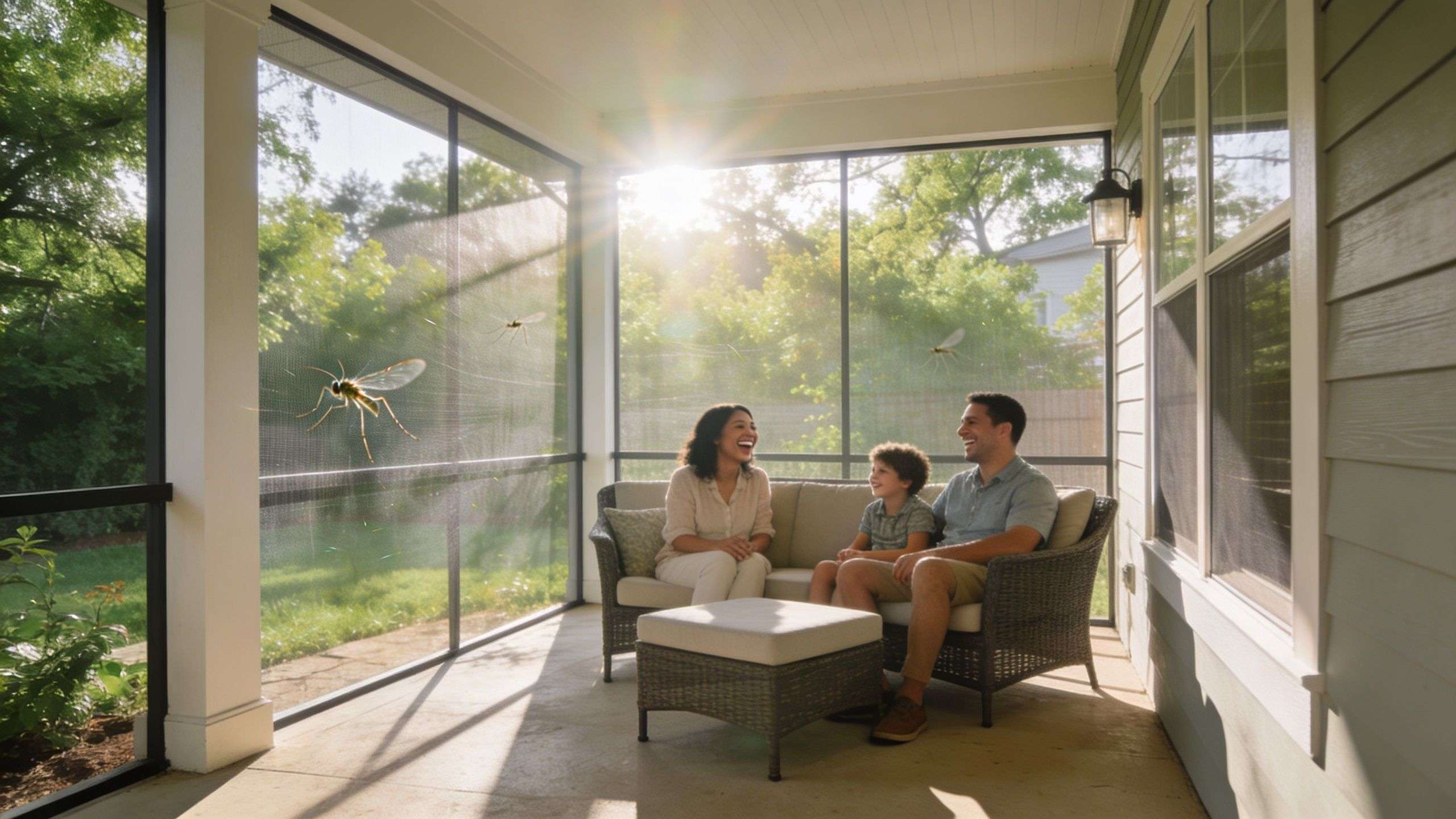
Why screened porches make sense in Houston
A good screened porch does three jobs at once. It keeps insects out, cuts direct sun, and gives you a buffer between the house and the weather. In this climate, that's not a luxury. It's the difference between a space you use and a space you sweep.
For many homes, the simplest route is enclosing something that already exists. In Houston, the cost to screen an existing porch typically ranges from $1,200 to $2,800, with a 2026 local average of $2,761, according to Angi's porch screening cost guide. That price point is why a lot of homeowners start with an existing covered porch, patio, or deck rather than jumping straight into new construction.
What works and what doesn't
Some porch projects feel great for a month and then become maintenance headaches. Others keep working year after year because the contractor made the right early decisions.
What works in Houston:
- A roofed area with real shade: Screen alone won't fix heat gain if the roof design leaves the space baking in afternoon sun.
- Frames and fasteners chosen for moisture exposure: Humidity punishes cheap materials fast.
- A layout that supports airflow: A screened porch should still feel breezy, not boxed in.
- Clean transitions at the slab, door, and roofline: Gaps are where bugs, water, and callbacks start.
What doesn't:
- Treating it like a decorative add-on: In Houston, this is an exterior structure exposed to heat, rain, and storm pressure.
- Using indoor-grade finishes outside: Paint peels, trim swells, and joints open up.
- Skipping maintenance planning: Even a well-built porch needs routine attention.
- Hiring a contractor who only talks about appearance: Looks matter, but performance matters first.
A screened porch should feel easy to own. If every rainstorm gives you a new concern, the design missed something important.
The best projects start with an honest answer to one question. Are you improving a structure you already have, or are you building a new room outside? That answer controls everything from budget to permit path to how carefully your contractor needs to think about drainage, framing, and storm exposure.
Decoding Houston Screened-In Porch Costs and ROI
A Houston homeowner gets one quote for a few thousand dollars and another for five figures, then assumes one contractor is overcharging. In practice, those bids are often for two different projects. Screening an existing covered patio is one job. Building a new screened porch that can survive Houston humidity, shifting soil, and storm exposure is another.
That scope difference drives almost every price swing.
Three cost tiers Houston homeowners should separate
The cleanest way to budget a porch is to sort the project into one of three buckets first. If you skip that step, the numbers are useless.
| Project scope | Houston pricing benchmark | Main cost drivers |
|---|---|---|
| Screen an existing porch | $1,200 to $2,800 | Existing condition, materials, repairs, access |
| Porch enclosure work by square foot | $4.65 to $18.60 per square foot | Complexity, roof style, site work, materials |
| New screened porch build | $37,454 to $55,368 average in 2026 | Foundation, framing, roofing, electrical, size |
Those ranges only make sense if the underlying structure is clear. A basic rescreen or light enclosure can stay relatively modest. A true new build climbs fast because you are paying for the parts homeowners do not always see first, such as footings, framing connections, roofing tie-ins, and electrical.
In Houston, I tell clients to be careful with low numbers that only cover the visible shell. If the bid does not address drainage, attachment points, or movement in the slab, the savings can disappear after the first hard season of rain.
Where the budget usually moves
Ask every contractor to break the estimate into structural work, enclosure work, and finishes. That is the fastest way to spot whether you are paying for real durability or just nicer trim.
Budget pressure usually shows up in these areas:
- Foundation and site prep: Houston clay soils, drainage problems, and settling can turn a simple porch footprint into corrective work before the build even starts.
- Roof integration: Tying a new porch roof into the house without creating leak points takes labor, planning, and sometimes framing changes.
- Screen system and framing material: Basic screen panels cost less up front, but stronger framing and better corrosion resistance usually hold up better in Gulf Coast conditions.
- Electrical and comfort upgrades: Fans, outlets, lighting, and rough-ins for future heaters or shades are cheaper to install during construction than after.
- Exterior matching work: Brick, siding, soffit, fascia, and roofing details often separate a porch that looks added on from one that looks original to the house.
If you want another budgeting reference point before collecting bids, Rescreen Rescue's screened porch budget is a useful comparison because it helps homeowners think through scope before they sit down with a contractor.
Cost trade-offs that matter in Houston
Some upgrades raise the price for good reason.
A better roof connection, stronger fasteners, aluminum framing, or improved drainage details may not be the flashy part of the project, but those are often the choices that keep a porch serviceable after years of wet air, wind-driven rain, and summer heat. Cheap screen work can look fine on day one and still fail early if the frame racks, the door twists, or water starts sitting where it should drain.
That is why the lowest quote is rarely the best value here.
What kind of return you can expect
A screened porch usually pays back best when it feels like a permanent part of the home and solves a real Houston problem. Shade, bug control, and protected outdoor living all matter to buyers. So does build quality.
Return drops when the porch feels temporary, traps heat, shows movement, or has obvious shortcuts at the roofline and slab edge. Buyers notice that stuff. Inspectors do too.
For homeowners weighing this project against a larger renovation plan, it helps to compare it with other upgrades through a broader Houston home remodeling services overview. A porch can be a smart investment, but the best decision depends on the condition of the house, how long you plan to stay, and whether the project is being built for appearance or for long-term performance in Houston weather.
Designing a Porch That Can Handle Houston Weather
In Houston, porch design is a durability decision disguised as a style decision. You can pick the prettiest screen system on the market and still end up with a poor result if the frame, drainage, and attachment details aren't right for Gulf Coast weather.
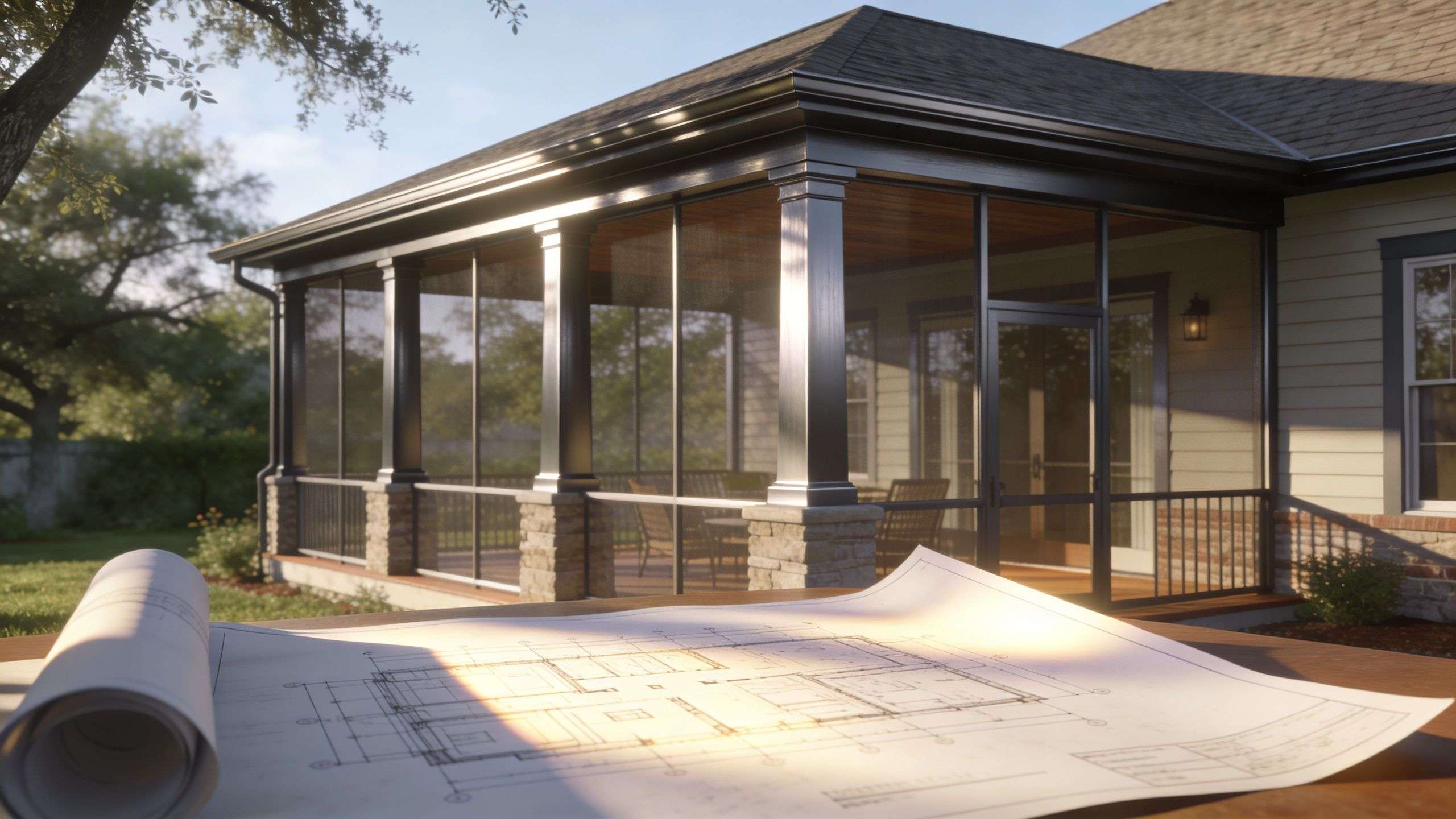
Material choices that hold up better
Screen selection matters, but it shouldn't be the only material conversation. Houston homeowners usually focus first on visibility and bug control. Contractors should be thinking just as hard about corrosion, movement, and how the enclosure behaves during long humid stretches.
A few practical rules:
- Fiberglass screen: Common and workable for many standard projects. It can be a sensible choice when budget matters and the frame system is well built.
- Aluminum screen or aluminum framing: Often makes more sense where moisture exposure is constant and long-term corrosion resistance matters.
- Solar or privacy screen products: Helpful when sun load is the primary problem, not just mosquitoes.
- Pet-resistant mesh: Worth discussing if dogs scratch at lower panels or doors get heavy use.
If you're comparing screen types and want a consumer-friendly breakdown before selecting a product, Choosing the right porch screen gives a useful overview of how different mesh options behave in real outdoor use.
The framing question matters more than many bids admit
The frame carries the project. In Houston, wood can work well when it's detailed and protected properly. Aluminum also has real advantages where humidity and rain exposure are constant. The wrong frame isn't always obvious on day one. It becomes obvious after swelling, loose joints, corrosion, or repeated service calls.
Smart contractors also pay attention to transitions. The places where a screen wall meets masonry, siding, soffit, slab edge, or roofing are where failures usually start. If those details look rushed on the drawings or in the estimate, expect trouble later.
Practical rule: Ask where water goes before you ask what color the trim will be. Drainage and attachment details decide whether the porch ages well.
Building past minimum code
Many Houston contractors meet the 2021 Houston Construction Code, but few publicly focus on going beyond the minimum for real storm resilience. Houston Porch's discussion of code and resilience gaps points out a meaningful knowledge gap around storm-hardened screening, reinforced framing for Category 4 to 5 events, and retrofitting existing porches to survive the next major hurricane.
That gap is real in the field. A contractor can be competent at clean finish work and still be weak on storm thinking. Those are not the same skill set.
What better resilience-minded builders usually address:
- Reinforced frame connections: Not just screen panels, but how the whole enclosure ties into the main structure.
- Fastener selection for exposed conditions: Hardware choice matters in wet, high-humidity environments.
- Roof runoff management: Gutters, drainage direction, and splash control can protect both porch and foundation.
- Retrofitting strategy for existing patios: Older covered patios often need more than screen to perform well under wind and rain.
Homeowners planning outdoor living work should also look at a contractor's broader exterior experience. Porch and patio construction in this climate is part structural work, part weather management, and part finish carpentry. Reviewing firms that specialize in porches and patios in Houston can help you see whether they think through those layers or just sell appearances.
The best screened-in porch contractors Houston has aren't just building a pleasant place to sit. They're building a structure that can take heat, wind, water, insects, and movement without turning into a maintenance trap.
Your Vetting Checklist for Houston Porch Contractors
A contractor walks your yard for ten minutes, glances at the patio cover, and emails a price before dinner. In Houston, that kind of speed usually means somebody skipped the hard parts. The hard parts are the ones that matter here: soil movement, roof tie-in details, drainage, insect pressure, and materials that hold up in heat and humidity.
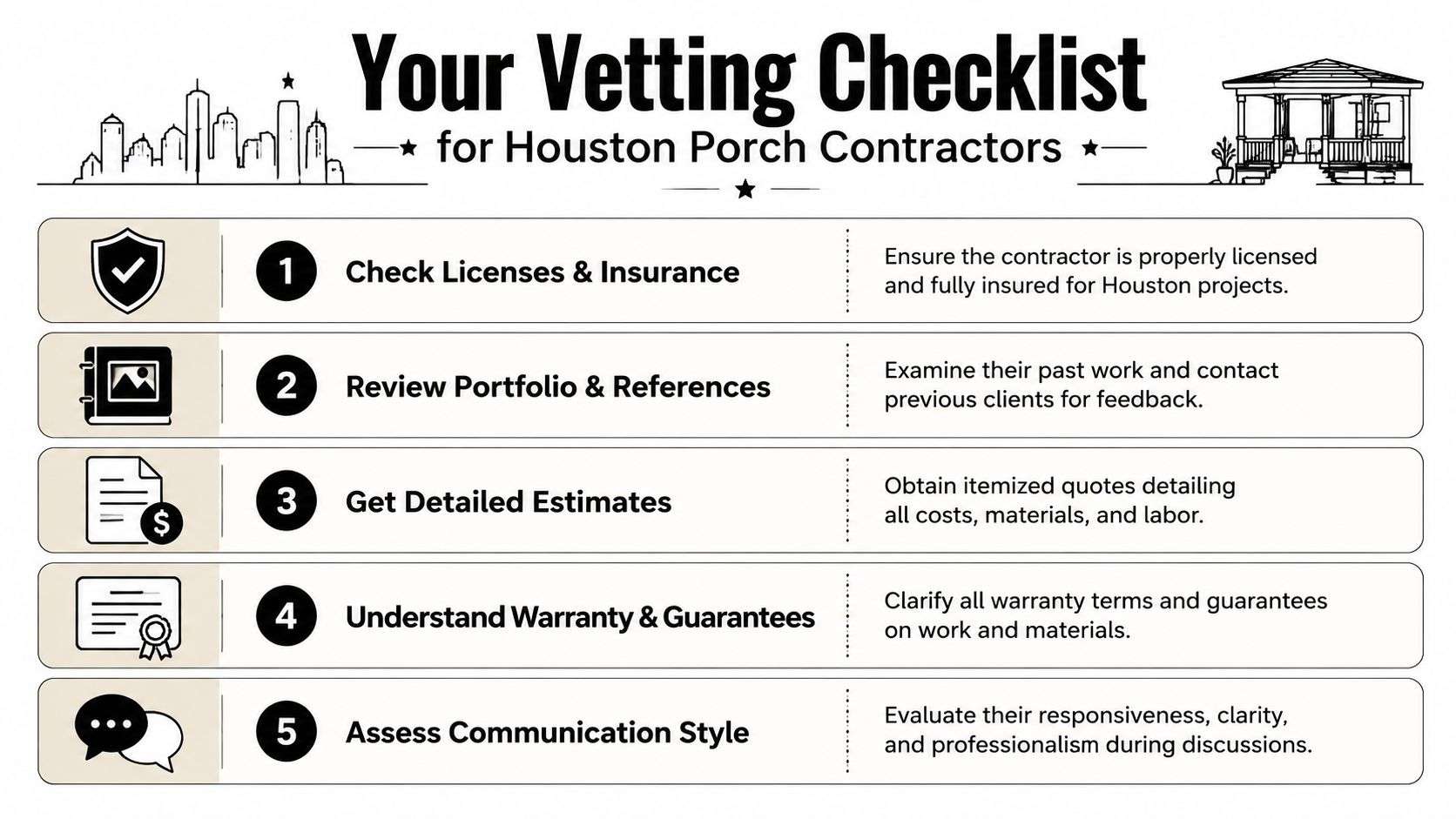
Start with business basics and field experience
Verify that the contractor carries liability insurance and workers' comp or can clearly explain how labor is covered. Ask for current documentation. If there is property damage or an injury on site, you want that settled on paper before the first truck arrives.
Then look at actual local work. Houston porch projects need more than clean trim and nice stain color. Check the photos for how the porch meets the house, how water sheds off the roof, whether the screen framing looks rigid, and whether the enclosure looks like part of the home instead of an add-on. Bonus points if they can show jobs that are a few years old, not just fresh installs taken the day they finished.
Ask questions that expose how they think
Good contractors do not just measure and price. They inspect. They ask how the yard drains in a heavy rain, whether the existing slab has movement, where afternoon sun hits hardest, and how much wind and rain the porch takes during a storm.
A few questions pull that out fast:
- How do you check the existing slab, footings, or patio cover before pricing?
- Who handles permits, drawings, and inspections?
- What screen system, framing material, fasteners, and trim products are included in the estimate?
- How do you build for Houston humidity, termites, and corrosion exposure?
- What is your plan if you open up the structure and find rot, movement, or poor prior work?
- How are change orders approved and priced?
- What does the warranty cover, and what is excluded?
If the answers stay vague, expect surprises later.
One thing I watch closely is whether a contractor can explain trade-offs without turning the conversation into a sales pitch. Aluminum may cut maintenance, but it is not the answer for every opening size or design. Wood can look better on some homes, but it demands better moisture management and more upkeep in this climate. A solid contractor says that plainly.
Be careful with any bid that sounds cheap because it assumes the existing slab, roof, and columns are all fine without much inspection. That is where porch budgets get blown up in Houston.
Read the estimate like a scope sheet
A good estimate should tell you exactly what is being built, what is being reused, and what is excluded. If you cannot tell what materials are included or who is responsible for permits and cleanup, the document is too loose.
Look for these specifics:
| What to review | Why it matters |
|---|---|
| Material specifications | Keeps screen type, framing, trim, and hardware from getting swapped later |
| Structural assumptions | Shows whether the price depends on the existing slab or roof passing inspection |
| Permit responsibility | Prevents delays and blame-shifting if the city asks for revisions |
| Drainage and water management | Confirms runoff, gutters, splash control, and grading were considered |
| Change order procedure | Keeps added work documented before costs grow |
| Payment schedule | Ties money to progress instead of vague promises |
| Cleanup and punch list language | Sets expectations for closeout and final corrections |
Communication matters too. You are hiring a company that will be in and around your home for weeks, sometimes longer if weather or permit revisions slow things down. If they dodge calls, answer questions loosely, or keep rewriting the scope before a contract is signed, expect more of the same once construction starts.
The right screened-in porch contractors Houston homeowners hire usually have one trait in common. They make the job feel clearer, not easier than it really is. Clear answers, realistic timelines, and written detail are what you want. Confidence without specifics is expensive.
Navigating the Construction Process From Start to Finish
Once you sign the contract, the emotional rhythm of the job matters almost as much as the workmanship. Most homeowners do fine when they know what's coming. They get frustrated when they expect steady visible progress every day and the project doesn't move that way.
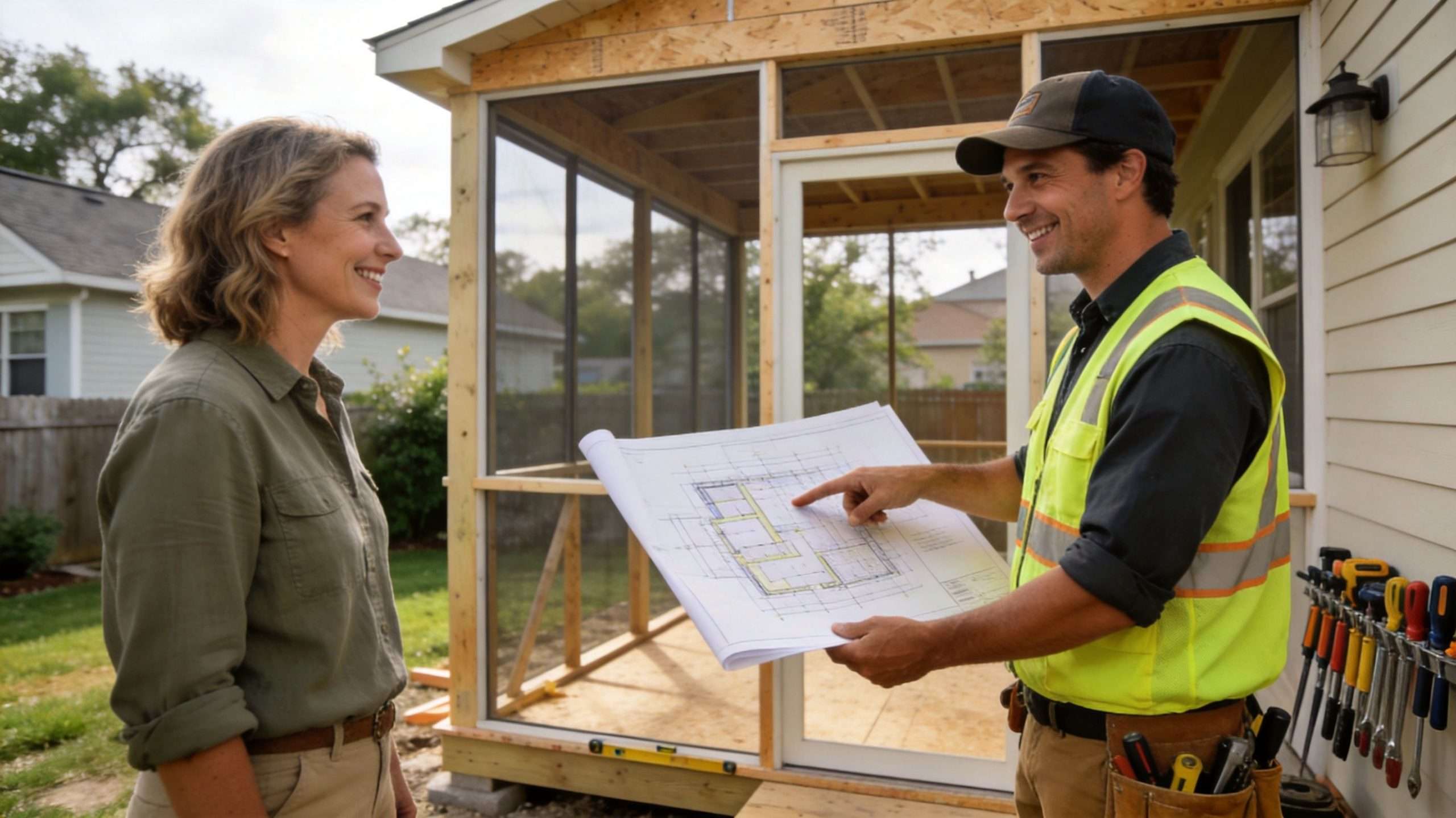
The project usually moves in stages
The first stage is paperwork and final selections. That includes drawings, permit submission, material choices, and confirming scope. Homeowners often think construction starts when they sign. In reality, the actual start is when approvals, ordering, and scheduling line up.
Then the property gets noisy. If it's a new build, you may see excavation, framing, roofing, and utility rough-in before the porch looks like anything finished. If it's an enclosure project, demolition and correction work can expose hidden problems in an existing slab, beam, or roof connection.
A few ways to make the process easier on yourself:
- Move furniture and valuables early: Don't wait for the crew to work around patio clutter.
- Secure pets and kids from the work zone: Exterior jobs still involve sharp tools, materials, and open access points.
- Ask who your daily contact is: One clear point of communication prevents confusion.
- Expect weather pauses: Houston rain can turn a clean schedule into a muddy mess quickly.
The closeout matters more than people think
The final walkthrough isn't just about appearance. It's where you test doors, look for screen damage, review caulking, confirm drainage, and make sure punch list items are documented before the last payment is made.
After completion, the porch needs regular care. Michael Nash Design Build's maintenance guidance notes that in a subtropical climate like Houston's, failing to address small tears, weekly debris removal, and door sweep maintenance can lead to pest problems and maintenance costs rising by over 200 percent within 18 to 24 months.
Small issues stay small only if you handle them quickly. A tiny tear in screen, a dragging door, or debris packed in a corner can become a much bigger nuisance in Houston humidity.
The homeowners who enjoy their porches the longest usually do one simple thing well. They treat the space like part of the house. They inspect it, clean it, and fix little problems before a storm season or a long wet stretch turns them into expensive repairs.
Build Your Porch and Transform Your Home with H-Towne
A screened porch is a smart project when it's built for Houston instead of copied from another climate. That means paying attention to moisture, movement, drainage, sun exposure, pest pressure, and storm season. It also means choosing a contractor who understands that exterior remodeling on the Gulf Coast is never just about finishes.
H-Towne & Around Remodelers, Inc. fits that standard. The company brings the kind of practical construction background Houston homeowners need for porch and patio work, especially when a project calls for careful planning, permit coordination, and resilient building practices. If you want to see the level of workmanship and design range that supports that kind of work, review the company's local remodeling portfolio.
What makes that especially useful is that porch building isn't treated as an isolated service. It sits inside a broader remodeling practice that includes room additions, storm restoration, and full-scale residential renovation. That kind of range matters because many porch projects connect back to larger home decisions. A homeowner starts with outdoor living, then realizes the back door, kitchen layout, or family room flow also needs attention.
That's where H-Towne is especially well positioned. While the company can absolutely deliver a durable screened porch, the deeper strength is in kitchen remodeling, bathroom remodeling, and whole-home remodeling. Those are the projects where planning, craftsmanship, coordination, and long-term value really show.
If your original idea was “screen in the patio,” but the underlying need is to improve how your home lives day to day, it's worth having that larger conversation. Sometimes the best investment isn't only outside. It's the way the whole house works together.
If you're ready to talk through a screened porch, a kitchen upgrade, a bathroom renovation, or a full home remodel, contact H-Towne & Around Remodelers, Inc.. They serve Houston-area homeowners with complimentary estimates, practical guidance, and the kind of hands-on project management that helps good ideas turn into well-built spaces.