
If you're shopping granite countertops in Tomball, TX, expect a typical installed range of $55 to $110 per square foot in the local market, and you're looking at a material that still sits firmly in the mainstream, with one industry estimate valuing the global granite countertops market at US$41,847.9 million in 2024 and projecting US$70,905.7 million by 2033, plus a 6.1% CAGR over 2025 to 2033 and a separate U.S. estimate of $2.1 billion by 2027 with 4.1% CAGR from 2022 to 2027, while granite accounted for 25% of all kitchen countertop installations in the U.S. in 2023 (granite market estimates and U.S. installation share).
If you're standing in a Tomball kitchen right now with old laminate, a short backsplash, and a tape measure on the counter, that's the takeaway. Granite isn't a fringe choice. It's still one of the standard materials homeowners pick when they want a top that looks custom and holds up under actual use.
Located in Houston the primary projects that H-Town would like to undertake are; kitchen remodeling, bathroom remodeling, & whole home remodeling
Around Tomball, the decision usually starts the same way. A homeowner in 77375 or 77377 starts with one question that sounds simple and turns out not to be. Is granite still worth it here, with humidity, storm season, shifting slab trends, and all the talk about quartz?
It can be, but only if you choose the right slab, the right finish, and a fabricator who understands what Gulf Coast houses do over time. In this area, countertops don't live in a showroom. They live next to steam from dishwashers, damp air around sinks, kids dropping cups on island corners, and cabinet runs that aren't always perfectly level.
Table of Contents
- Why Tomball Homeowners Are Choosing Granite Right Now
- What Granite Actually Is and Why It Lasts
- Granite vs Quartz and Other Countertop Choices
- Selecting and Installing Granite in Tomball
- Polished Honed and Leathered Finishes Compared
- Caring for Granite in Houston Humidity
- 2025-2026 Granite Style Trends in Texas Homes
- Working With H-Towne and Planning Your Project
Why Tomball Homeowners Are Choosing Granite Right Now
A lot of kitchen projects in Tomball start with a familiar scene. The homeowner is standing near an aging cooktop cutout, looking at worn laminate edges, trying to decide whether to patch one more issue or finally replace the tops with stone. For many families, granite lands in the sweet spot between appearance, durability, and budget.
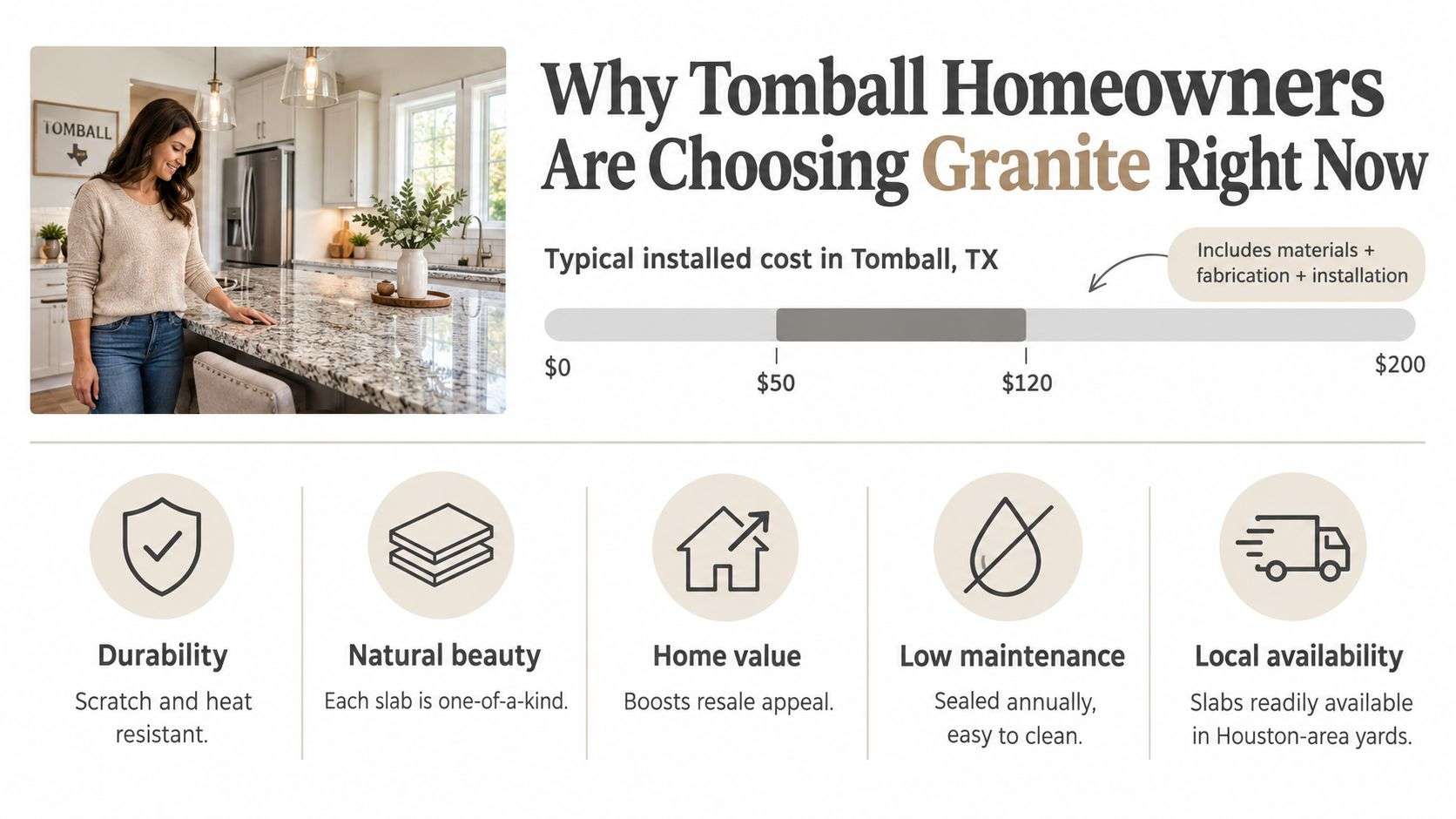
What makes granite attractive in Tomball
The first reason is simple. It still feels like a meaningful upgrade without forcing every kitchen into the same flat, engineered look. Homeowners who want movement, depth, and natural variation usually respond to granite faster than they do to more uniform surfaces.
The second reason is practical. Granite has history on its side. It wasn't always common in homes because cutting and transport used to be difficult and expensive, but broader residential adoption accelerated in the 1970s and 1980s after diamond cutting tools and improved processing made slabs more accessible. One industry history even notes that in 1987, when granite countertops first reached the general public in a bigger way, only two colors were available. By the 1990s, supply expansion from countries including Brazil, India, and China helped make granite a standard premium kitchen option (history of granite countertops).
Granite has been around long enough that nobody's still asking whether it belongs in a kitchen. The real question is whether the slab and finish fit the way your house runs every day.
Why now feels different locally
Homeowners in the Tomball and Cypress area are also asking better questions than they used to. Instead of only looking at color, they want to know how a countertop behaves after months of humidity, whether it needs frequent sealing, and what happens if a storm event forces part of the kitchen to be rebuilt.
That shift matters because a lot of local search results still lean on design photos instead of answering Gulf Coast questions. The bigger maintenance issue here isn't whether granite is durable in the abstract. It's whether the slab you're considering is dense enough, sealed properly, and installed with enough support to handle a real Texas kitchen over the long haul.
What Granite Actually Is and Why It Lasts
Granite is a natural igneous stone. In plain kitchen language, that means it formed under intense heat and pressure and cooled into a dense mass of interlocking minerals. That structure is why it handles daily wear well and why no two slabs look exactly alike.
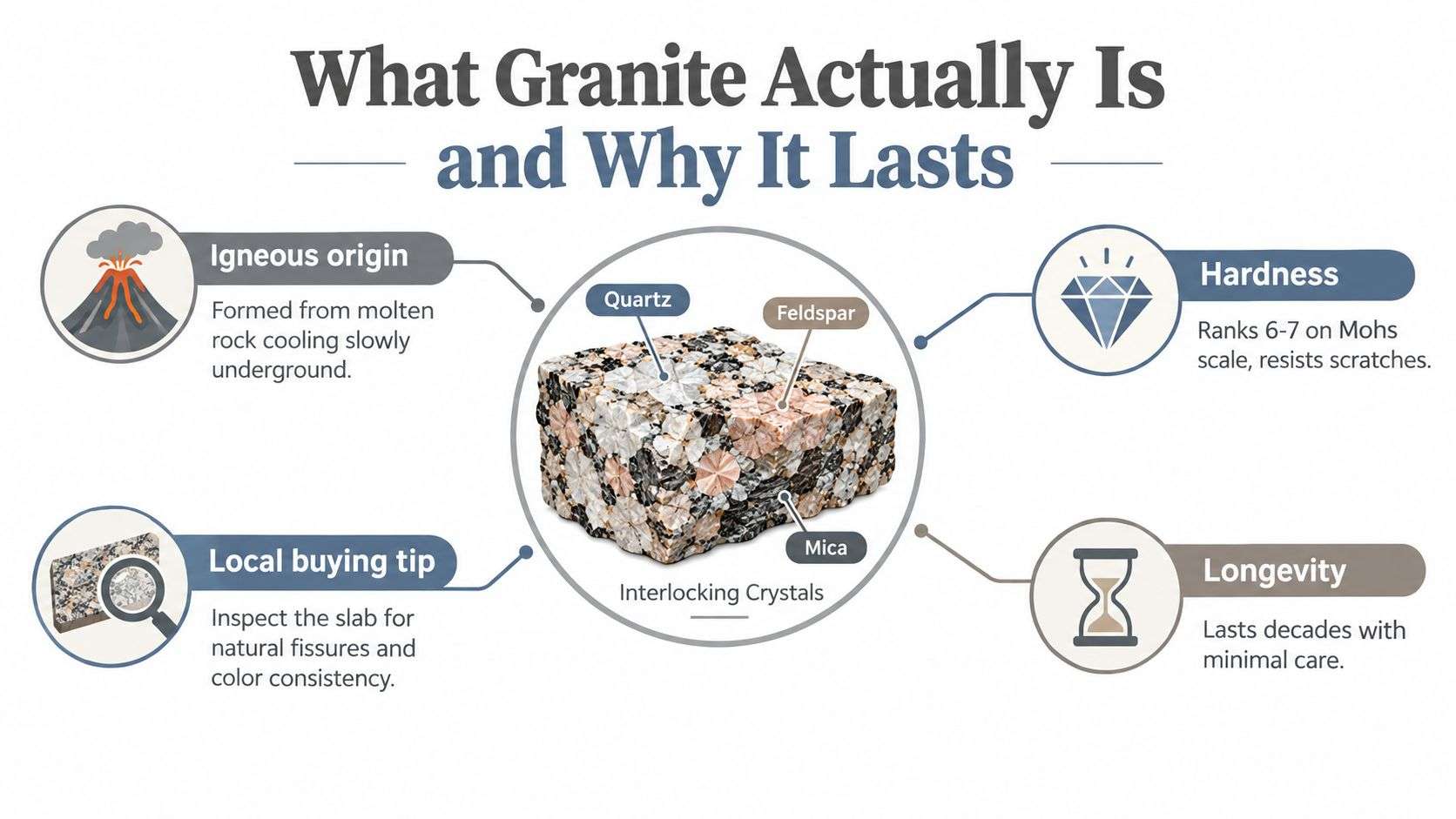
What you'll hear in the slab yard
When buyers walk a yard in the Houston area, they usually run into labels that sound more technical than they really are.
- Level groupings usually sort slabs by rarity, movement, color demand, and import profile, not by structural quality alone.
- Classic patterns tend to have familiar, repeatable looks that work in a lot of kitchens.
- Exotic slabs usually bring stronger movement, bolder veining, or unusual color blends that read more custom.
You'll also hear color names that have become common shorthand in the trade. Some homeowners want warm and familiar. Others want dark, quieter stone with less visual noise. The key is not the name on the tag. The key is the actual slab in front of you, because natural stone varies lot to lot.
Why thickness and density matter
In most Tomball kitchens, 3 cm granite is the preferred choice because it doesn't need a plywood build-up under the slab. That helps when cabinet runs in older homes aren't perfectly true and you need cleaner fabrication and fewer transition problems at sinks, cooktops, and appliance panels.
Granite also lasts because many varieties are very low-porosity natural stone, with commercial examples often reported around 0.4% to 1.5% porosity. For a homeowner, the useful field test isn't a lab chart. It's the water-drop check. If water darkens the stone in about 2 to 5 minutes, the slab is absorbing enough that it likely needs stronger sealing attention. If water beads beyond 10 to 15 minutes, the slab is dense enough that sealing may be optional or needed less often. On more absorbent material, maintenance may be annual. On denser slabs, intervals can stretch to every 2 to 3 years (stone porosity, water-drop timing, and sealing intervals).
Practical rule: Don't buy granite based only on color. Test how the actual slab absorbs water before you assume it'll be easy to live with in a humid Tomball kitchen.
Granite vs Quartz and Other Countertop Choices
Most homeowners narrowing down granite countertops in Tomball, TX aren't comparing ten materials. They're usually choosing between granite and quartz, then maybe adding a wood accent on an island or a small serving area.
The better way to compare them is by how they behave in a local kitchen. Not just how they look under slab-yard lights. If you want a broader planning framework before locking in material, this guide on how to choose kitchen countertops is a good companion read.
Local trade-offs that matter more than brochures
Granite earns its place when the homeowner cooks often, wants a natural slab, and doesn't mind periodic sealing. Quartz usually wins with families who want a more uniform look and the least maintenance routine possible. Wood works best as an accent, not the whole work surface, especially in a humid kitchen.
One local truth that gets missed is heat behavior. Granite is generally the more forgiving choice for someone who regularly moves hot cookware straight off the range. Wood obviously can't play that role, and many families feel more relaxed with granite around heat than they do with resin-based surfaces.
Granite vs Quartz vs Wood Accents in a Tomball Kitchen
| Factor | Granite | Quartz | Wood Accent |
|---|---|---|---|
| Look | Natural movement and one-of-a-kind patterning | More uniform and controlled appearance | Warm accent, softer visual texture |
| Humidity response | Works well if the slab is properly sealed and maintained | Non-porous surface, no sealing routine | More sensitive to moisture movement |
| Heat tolerance | Strong choice for busy cooking kitchens | Homeowners tend to be more cautious with direct heat | Not suited for hot cookware |
| Seam visibility | Depends heavily on slab pattern and layout | Often easier to control visually on quieter designs | Usually used in smaller sections |
| Maintenance | Needs periodic sealing based on slab absorbency | Lower routine upkeep | Needs regular care and protection |
| Best fit | Homeowners who want natural stone character | Families prioritizing easier maintenance | Mixed-material kitchens and accent areas |
My practical recommendation
If you want the most natural look and you use your kitchen hard, granite is still one of the best-balanced choices in this market.
If your top priority is avoiding a sealing routine, quartz usually makes more sense. Wood belongs in the conversation as a design accent, not as the main workhorse surface in most Tomball homes.
Selecting and Installing Granite in Tomball
A good granite job feels simple to the homeowner. It rarely is. The clean result depends on a sequence that has to be done in the right order, with no guessing at the cabinet level, sink layout, or seam plan.
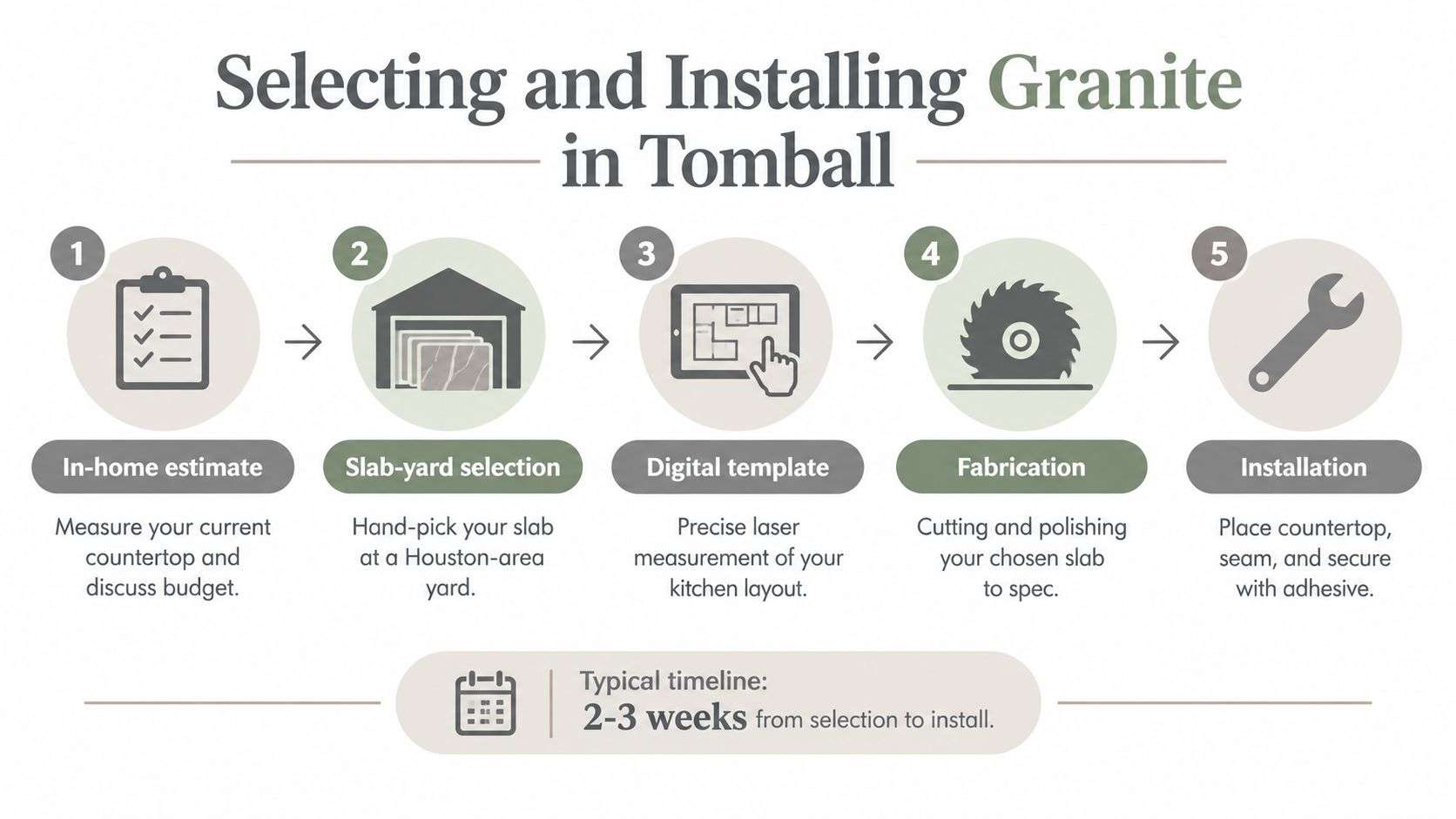
The job starts before the slab is cut
The first visit is usually an in-home measure and scope check. That's where the crew figures out whether the project is a straightforward top swap or whether the homeowner is also changing sinks, backsplashes, plumbing locations, lighting, or cabinet layout. If you're organizing a larger remodel at the same time, Virtual Tour Easy's renovation checklist is useful because it helps keep demolition, selections, and trade scheduling from getting out of order.
After that comes slab selection, then digital templating. That template matters more than most homeowners realize. It picks up wall variation, corner conditions, sink centering, appliance clearances, and where a seam can hide best without landing in a weak or ugly spot. For nearby project context, this page on countertop installation in Cypress, TX reflects the same general flow used across northwest Houston.
Permits and scope changes
A plain countertop replacement is often treated very differently from a true remodel. In Houston guidance, cosmetic-only kitchen or bathroom work such as cabinet replacement, tiling, painting, or countertop repairs is generally outside permit requirements, but touching plumbing, electrical, or structural elements changes the picture (Houston remodel permit overview).
For projects that do require permits, the official process is not one simple upload. The Houston Permitting Center says residential remodel applicants need an iPermits login, a building permit application, payment of plan-review fees, and then plan upload after an email invitation (Houston iPermits remodel workflow). In plain terms, if your project goes beyond a top swap, plan for paperwork.
What the crew should get right on install day
Install day is where fabrication quality shows up fast. Cabinets need to be level enough to support the slab evenly. Sink areas and spans need support in the right places. Overhangs need to be planned before the slab is carried in, not after.
Industry guidance commonly targets 1/16 inch (1.5 mm) stone-to-stone joints, and overhangs generally need reinforcement once they exceed about 6 inches for 2 cm material or 10 inches for 3 cm material (natural stone countertop joint and support guidance). That's not cosmetic trivia. Hairline cracks usually show up first at seams, sink cutouts, and unsupported cantilever points.
A homeowner walkthrough before the crew leaves should include:
- Seam check: Look for tight joints, minimal lippage, and color-matched fill.
- Sink alignment: Confirm the sink sits centered and the reveal is consistent.
- Edge review: Run your hand lightly along exposed edges for chips or rough polish.
- Support points: Ask where brackets or reinforcement were added on overhangs.
- Plumber finish-out: Make sure reconnects happen after the slab is properly set and cured.
On a good install, the seams don't call attention to themselves, the sink reveal looks intentional, and nothing flexes when weight goes on an overhang.
Polished Honed and Leathered Finishes Compared
Finish choice changes how granite feels in the room just as much as color does. In Tomball kitchens, the finish also changes how fingerprints, water marks, and everyday use show up.
What each finish does best
Polished granite gives you the shiny, reflective look that comes to mind first. It brings out color depth and movement clearly. In many kitchens, it also gives the strongest stain resistance feel because the surface presents tighter and slicker after finishing. The downside is that smudges around prep zones and range areas show faster.
Honed granite has a softer matte look. It works well in transitional kitchens that don't want a formal shine. It usually hides fingerprints better than polished, but homeowners need to understand that a matte surface can show darkening differently when it gets wet or when sealer is fresh.
Leathered granite adds texture. It often reads warmer, more current, and less flat under overhead lighting. In busy family kitchens, it's one of the easiest finishes to live with because it tends to disguise water spotting and day-to-day marks well.
Granite Finish Comparison for Tomball Kitchens
| Finish | Look | Maintenance | Best For |
|---|---|---|---|
| Polished | Glossy, reflective, vivid color movement | Easier wipe-down, but shows fingerprints faster | Traditional kitchens and homeowners who want brightness |
| Honed | Smooth matte, quieter appearance | Needs more attention to sealing and moisture habits | Transitional spaces and softer visual palettes |
| Leathered | Textured, deeper character, lower glare | Practical for daily use and forgiving visually | Busy kitchens and homeowners wanting a more custom feel |
Edge profile and lighting matter too
A finish doesn't stand alone. Pair it with the wrong edge and the kitchen can feel dated fast. Simpler eased or slim eased edges tend to age better in Tomball homes than ornate profiles that collect grime and visually thicken the top.
Lighting also changes everything. A polished black or dark brown slab under direct cans can look dramatic in the slab yard and too reflective once installed. Honed and leathered finishes usually soften that effect.
Caring for Granite in Houston Humidity
Granite care in this area isn't hard, but it does need to be honest. Gulf Coast humidity changes how water sits on the surface, how quickly sealers cure, and how obvious darkening becomes around sinks and cooktops.
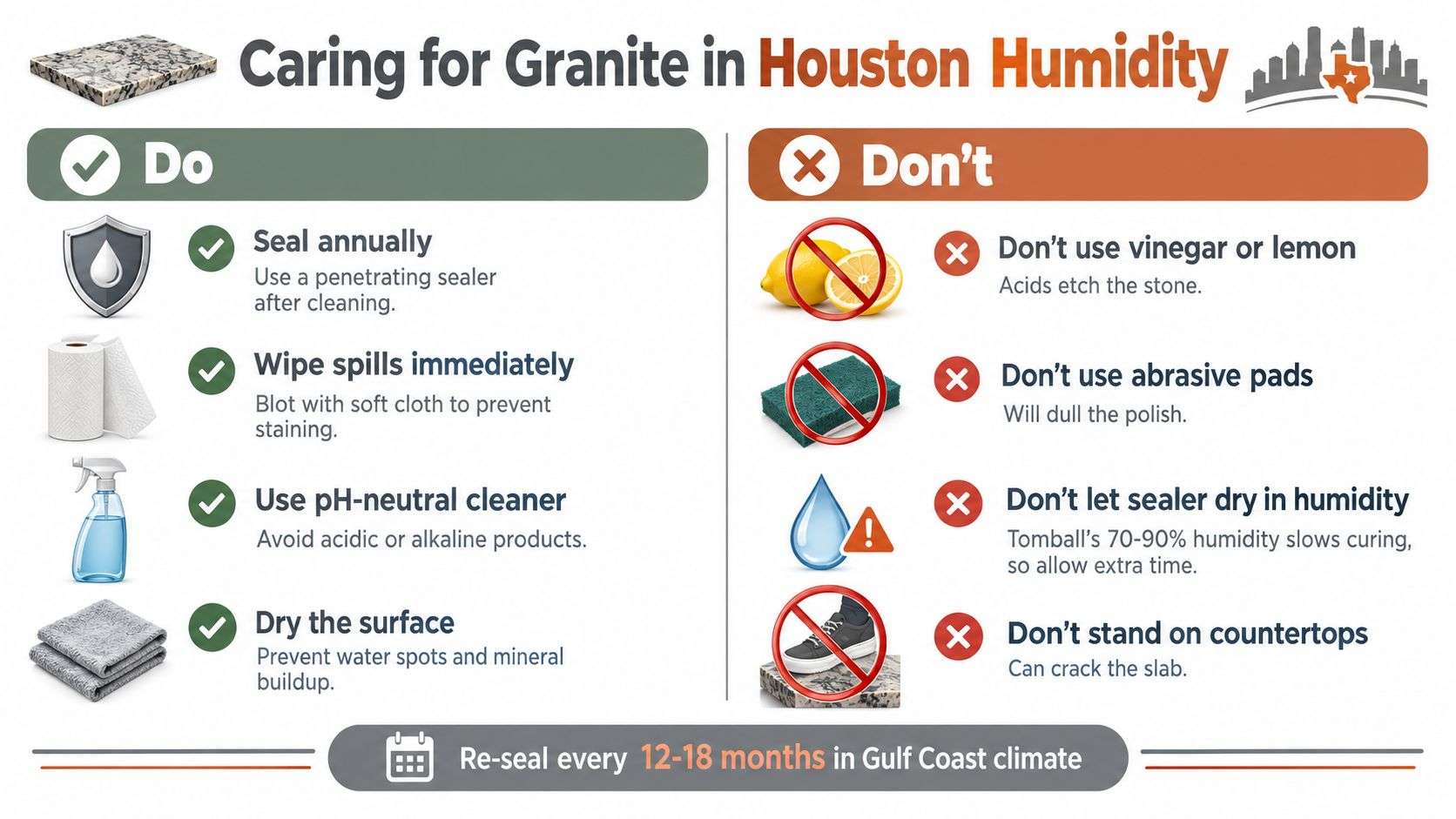
The routine that works better here
The best maintenance routine starts with observation, not a fixed calendar. Check absorbency with the water-bead test on a cleaned, dry area. If water darkens the surface quickly, the top is asking for attention. If it beads for a long stretch, you can usually back off and avoid over-sealing.
For regular cleaning, keep it simple.
- Use a pH-neutral cleaner: Gentle stone-safe products are a better choice than acidic sprays.
- Wipe and dry sink areas: Standing water is what exposes weak sealing fastest.
- Blot spills instead of grinding them in: Especially with coffee, cooking oils, tomato sauces, and wine.
- Use cutting boards anyway: Granite resists wear well, but your knives won't love direct stone contact.
What doesn't work
Vinegar, lemon-heavy cleaners, and abrasive pads cause more trouble than they solve. On some modern slabs with surface resins or treatments, harsh cleaners can leave the finish looking uneven or hazy. That's what many homeowners mistake for a stain when it's really a finish issue.
If acidic foods sit overnight on dark stone, you can also see a whitish film or dull spot that reads as haze under the light. The fix depends on whether you're dealing with residue, sealer failure, or surface finish change. Scrubbing harder usually makes it worse.
Keep the test simple. Water on a dry counter tells you more about sealing needs than a guess based on how long it's been since install.
Storm season and closed-up houses
One Gulf Coast issue generic countertop articles skip is what happens when the house sits closed up during a storm outage or post-flood drying. Moisture hangs in the air longer. Cabinet interiors stay damp. Sink bases can wick smell and humidity upward toward the underside of the top.
If a kitchen has flood exposure, inspect more than the slab face. Check sink mounts, caulk lines, cabinet tops, and any seam near appliance cutouts. Granite often survives events that ruin cabinets and substrate. The surrounding assembly is usually the weaker point.
2025-2026 Granite Style Trends in Texas Homes
Granite isn't dated. Certain granite looks are dated. That's the distinction homeowners should care about.
The shift showing up in Texas kitchens is away from busy, shiny, heavy-looking installs and toward cleaner fabrication with warmer stone. The trend coverage that matters most points to honed or leathered finishes, mixed-material kitchens, matte surfaces, warmer earthy tones, slimmer edges, and waterfall or mixed-surface islands as growing design directions in 2025 and 2026 (Texas countertop trend coverage for 2025 and 2026). That lines up with what works visually in a lot of Tomball homes, especially where cabinet colors have moved away from stark gray.
What looks current now
The granite jobs that feel fresh usually share a few traits:
- Softer movement: Slabs with controlled veining or quieter pattern shifts.
- Warmer undertones: Cream, taupe, soft brown, and earthy mixed neutrals.
- Slimmer visual mass: Cleaner edges and less decorative profiling.
- Mixed materials: Stone on the perimeter, wood or a contrasting surface on a furniture-style island.
If you're trying to coordinate that with the rest of the house, these furniture style ideas for homeowners can help translate countertop choices into a broader room palette without forcing everything to match.
Where granite still wins on style and function
Granite still has an edge in places where homeowners want a one-of-a-kind slab, a more natural look outdoors, or a farmhouse sink run that benefits from continuous stone character instead of a flatter manufactured appearance.
The looks I see fade fastest are overdone speckled patterns paired with busy backsplashes and heavy edge treatments that make the top look thicker than it needs to. The other short-lived choice is chasing an ultra-trendy slab that fights the rest of the house. In Tomball, the kitchens that age best usually feel settled, not loud.
Working With H-Towne and Planning Your Project
When homeowners ask for quotes on granite countertops in Tomball, TX, the part they usually want most is clarity. Not a vague square-foot number. A real breakdown of what's included, what could change, and whether the job is just a countertop swap or a larger remodel in disguise.
A solid planning process starts with a short phone conversation, then an in-home measure, then a written estimate that separates slab selection, fabrication, edge work, sink and cooktop cutouts, tear-out, and install labor. If you're comparing scopes from different contractors, it's worth reviewing what should appear in remodeling quotes before you sign anything. This overview on kitchen remodeling quotes is helpful for that.
Where budget confusion usually starts
The biggest quote problems happen when one side assumes the project is cosmetic and the other side is really pricing a remodel. The moment a homeowner wants to relocate plumbing, move electrical, alter cabinet structure, or change room layout, permits and trade coordination enter the picture.
Houston permit guidance treats bathroom utility changes the same way. Cosmetic bathroom updates can stay outside permit requirements, but relocating fixtures, drain lines, or plumbing changes requires a permit (Houston bathroom permit distinctions). For larger room remodel scopes, permit-cost references commonly show combined approvals rather than one flat permit, with example totals around $447.06 for a kitchen remodel and $336.00 for a bathroom remodel because building, electrical, and plumbing approvals can stack (Houston remodel permit fee examples).
What smart homeowners pin down early
Before work starts, get these points settled in writing:
- Scope boundaries: Is this just tops, or does it include backsplash, sink, plumbing reconnect, and wall repair?
- Seam responsibility: Ask where seams are planned and who approves final placement.
- Material details: Confirm slab thickness, finish, edge profile, sink type, and backsplash height.
- Warranty language: Know what applies to the stone itself and what applies to workmanship like seams, setting, and mounting.
- Schedule triggers: Understand what delays template, fabrication, or install. Cabinets, tile, flooring, and appliance timing all affect the countertop date.
A well-run project feels predictable because the details were handled early, not because the work is simple. That's especially true in older Tomball homes where walls move, floors drift, and cabinet runs need correction before a stone top ever comes through the door.
H-Towne & Around Remodelers, Inc. handles kitchen remodeling, bathroom remodeling, whole-home renovations, and countertop projects across the Houston area with the kind of planning Gulf Coast homes require. If you're weighing granite against other options, need help sorting out installation scope, or want a remodel team that understands humidity, storm repair, and real-world kitchen use, visit H-Towne & Around Remodelers, Inc. to schedule the next step.