
Let's get right to the number one question every Houston homeowner asks: "How much is this going to cost me?"
For a standard, well-built room addition in the Houston area, you should plan to invest between $45,000 and $90,000. It's a bit like buying a new truck—the base model gets the job done, but if you want the premium King Ranch trim with all the bells and whistles, the price tag is going to climb. High-end finishes or complex plumbing for a new bathroom will do the same for your addition.
Your Quick Guide to Houston Room Addition Costs
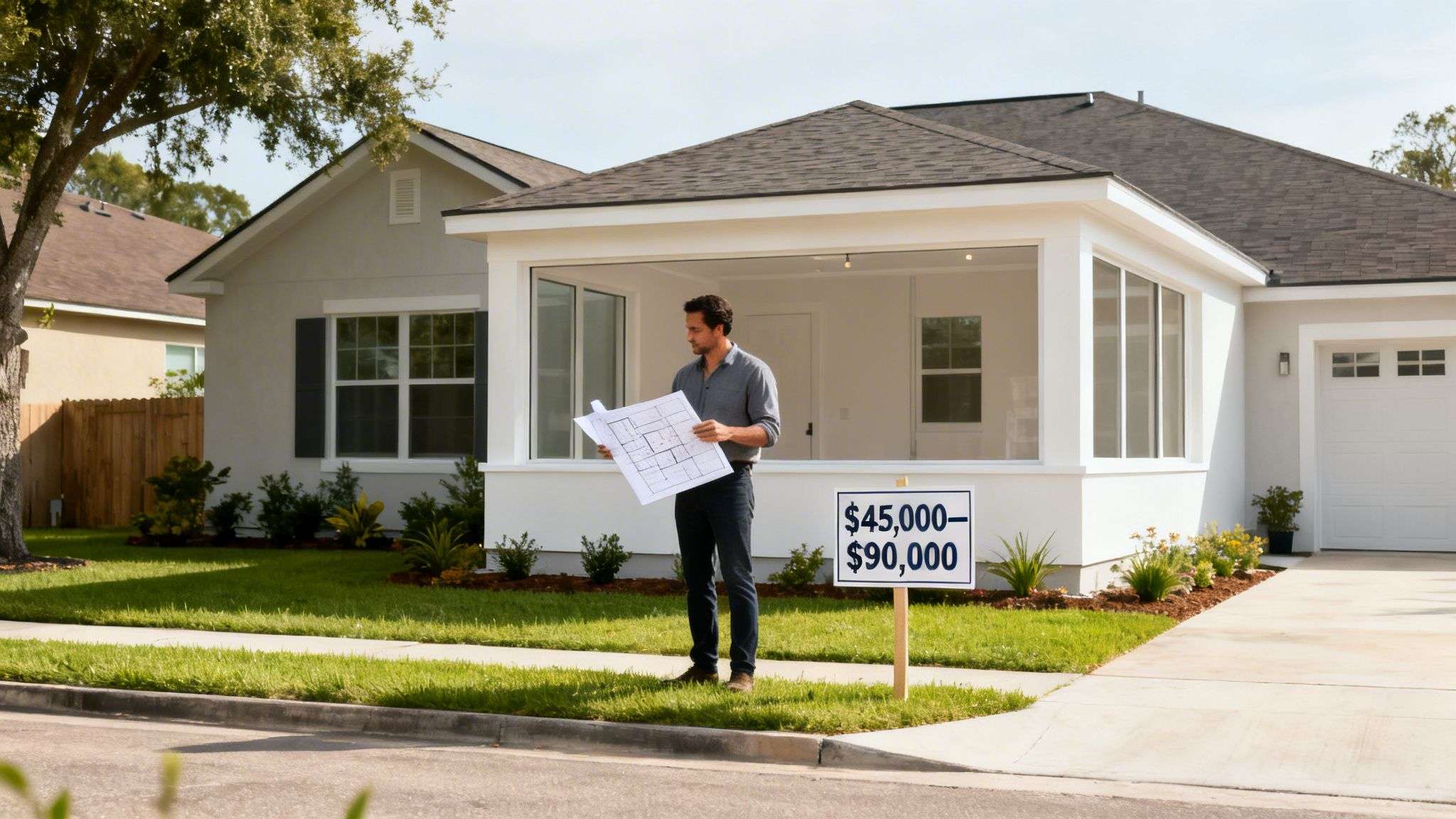
When you ask about the cost of a room addition, what you're really asking is what it costs to make your current home fit the life you want to live. An addition is a major investment, whether it’s for a growing family, a much-needed home office, or a master suite that feels like a private retreat. This guide is here to give you a realistic, no-fluff budget range to start with.
The final price is always a moving target, heavily influenced by the size, purpose, and quality of materials you choose. A simple bedroom is a world away from a new kitchen addition, which demands extensive plumbing, dedicated electrical circuits, and high-end appliances.
Putting a Price on Square Feet
To give you a clearer picture, let's talk real numbers. A modest 10×12-foot bump-out for a home office might land between $9,600 and $24,000. A more substantial 20×20-foot family room or master suite could run from $32,000 to $80,000. These figures are right in line with what we see across Greater Houston, from historic neighborhoods like The Heights to sprawling suburbs like Katy where families are always looking for more space.
Nationally, you’ll see a wide per-square-foot cost range from $80 to $480. While it’s a big investment, it’s one that pays dividends, with most additions boosting a home's value by 50-70% of the project's cost.
A straightforward bedroom addition often averages around $50,000, accounting for essentials like windows, a closet, and proper insulation. But if you want to turn that into a primary suite by adding a bathroom, the plumbing alone can tack on another $1,500 to $4,000 to the total.
To give you a quick reference, here are some typical cost ranges for common additions we build for Houston families.
Estimated Room Addition Costs in Houston (2026)
| Type of Room Addition | Average Size (Sq. Ft.) | Estimated Cost Range |
|---|---|---|
| Basic Bedroom | 120-200 | $15,000 – $40,000 |
| Sunroom (3-Season) | 150-250 | $20,000 – $55,000 |
| Bathroom | 60-100 | $25,000 – $75,000 |
| Primary Suite | 300-500 | $60,000 – $150,000+ |
These numbers are a great starting point for your budget. The final cost will always depend on the specifics of your home and the finishes you select.
How Room Type Drives the Budget
The purpose of your new room is the single biggest factor shaping its cost. Here’s a quick rundown of what to expect for different projects we see all the time in the Houston area:
- Bedroom Addition: This is one of the more straightforward projects. It mainly involves framing, drywall, electrical for outlets and lighting, and flooring.
- Bathroom Addition: Expect a higher cost per square foot here. Bathrooms are complex, requiring intricate plumbing, moisture-proof ventilation, detailed tile work, and expensive fixtures. A bathroom remodel is one of our primary specialties.
- Sunroom: This is a fantastic way to add bright, casual living space. The cost varies quite a bit depending on whether it’s a simple three-season room or a fully climate-controlled four-season space integrated with your home's HVAC.
- Primary Suite: Combining a bedroom and a full bathroom, this is a high-value project that dramatically improves your daily life and boosts your home’s resale appeal.
Understanding these initial ranges is the first step in setting realistic expectations. We’re deeply committed to serving our local community, which you can see in our approach to remodeling in https://h-towneremodelers.com/houston-tx/. Now, let’s dig into the specific line items that make up these numbers.
Deconstructing the Cost Per Square Foot
"Price per square foot" is one of the first numbers you’ll hear thrown around for a room addition, but it can also be one of the most misleading. Why does that number bounce around so much? It’s a lot like your grocery bill—the price per pound for potatoes is worlds away from the price per pound for filet mignon. The "ingredients" that go into your room addition are what really drive the cost.
The biggest factor, by far, is what you plan to do in the new space. A simple family room addition in Cypress might pencil out around $150 per square foot. But a high-end master bathroom in Memorial, with custom tilework and premium fixtures, could easily sail past $400 per square foot. Knowing this helps you ask smarter questions and look beyond a single, generic estimate.
Key Insight: A higher cost per square foot isn’t a sign of a bad deal; it’s a sign of a more complex, feature-packed space. A kitchen or bathroom will always cost more per square foot than a bedroom because of the intense plumbing, electrical, and specialized finishes required.
Why Room Type Changes Everything
The purpose of your addition dictates every single line item, from the foundation up. A basic bedroom needs framing, insulation, drywall, and some standard electrical outlets. A kitchen, on the other hand, is a completely different animal. It’s an intricate system that demands:
- Extensive Plumbing: You need multiple water lines for the sink, dishwasher, and ice maker, plus the drain lines to match.
- Dedicated Electrical Circuits: Ovens, cooktops, and microwaves are power-hungry appliances that require their own heavy-duty wiring.
- Specialized Ventilation: A proper range hood is crucial for handling the heat, grease, and smells of a working kitchen.
- High-Cost Finishes: Cabinets, countertops, backsplashes, and appliances are where a huge chunk of the budget goes.
Because of all these moving parts, a kitchen or bathroom addition can easily cost two to three times more per square foot than a simple living room. You're not just adding empty space; you're filling it with complex systems and high-value materials. At H-Towne & Around Remodelers, we specialize in getting these complex projects right, focusing on kitchen and bathroom remodeling to ensure every detail from cabinetry to plumbing is executed perfectly.
Houston Costs Versus Other Major Cities
Where you build matters. While Houston gives us a fantastic quality of life, how do our construction costs stack up against other big U.S. cities? Data from 2026 shows that building in places like New York or San Francisco can run you anywhere from $200 to $600+ per square foot. Here in Houston and along the Gulf Coast, our costs trend much closer to the national average, giving us a great mix of affordability and high-quality work. For a closer look at these national trends, you can explore cost data from Block Renovation.
This means your money simply goes further here. Building out a bathroom in Houston might run $250–$500 per square foot, but that exact same project would be painfully more expensive in other coastal markets. This is a huge advantage for local homeowners looking to expand, whether you're tackling a kitchen remodel or a complete whole home remodel. Your investment pays off, especially as home values here continue to climb.
Unpacking the Hidden Costs in Your Addition Budget
When you get that first quote for your room addition, it's natural to fixate on the big number at the bottom. But a quote isn't just one price; it's a collection of many different costs, and understanding what’s inside that number is the key to a smooth project. It’s what separates a clear, productive conversation with your contractor from a project full of expensive surprises.
Think of it like a car's sticker price. You see the total, but that price includes the engine, the tires, the electronics—every part has its own cost. Your room addition works the same way, with two main buckets of expenses: hard costs and soft costs.
This flowchart breaks down how every choice you make—from what the room will be used for to where it’s located on your property—feeds into the final budget.
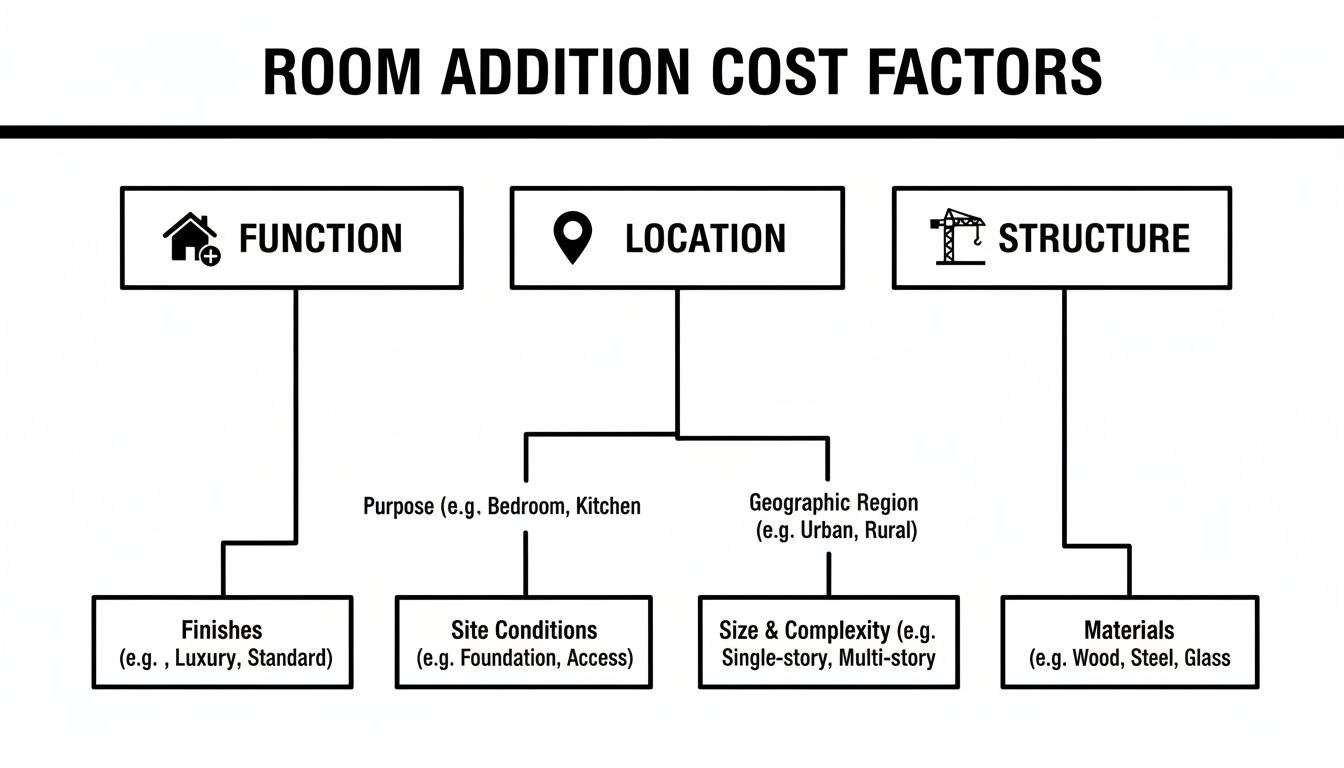
Ultimately, what this shows is that every decision, from the room's purpose to its structural design, has a direct impact on your project's bottom line.
Hard Costs: The Building Blocks of Your Addition
Hard costs are the tangible, physical parts of your project—the lumber, concrete, and labor that bring your new space to life. These are the "nuts and bolts" expenses for the materials themselves and the skilled hands needed to put them all together. For any addition here in the Houston area, these are the line items that form the core of your quote.
Here are the key hard costs you’ll see on any estimate:
- Foundation: This is literally where your project begins. Here in Houston, with our infamous shifting clay soil, a properly engineered foundation isn’t just a line item; it's the non-negotiable insurance policy for your home’s long-term stability.
- Framing: This creates the skeleton of your new room, from the wall studs to the roof trusses.
- Roofing: This isn't just about shingles. It’s the critical work of tying the new roofline into your existing one so it's completely watertight.
- Mechanical Systems (HVAC, Electrical, Plumbing): A simple bedroom needs new electrical circuits. But a bathroom or kitchen remodel requires a whole different level of work, with complex plumbing and HVAC adjustments that can significantly raise the cost.
- Exterior and Interior Finishes: This is the biggest category, covering everything from the siding and windows on the outside to the drywall, paint, flooring, and trim that you'll see every day.
Soft Costs: The Invisible Essentials
While hard costs are easy to see, soft costs are the less visible—but equally critical—expenses that make the project possible in the first place. I've seen more budgets go off the rails from ignoring soft costs than almost any other mistake. These are the services and fees required for a legal, well-managed, and successful build.
Don't overlook the "soft" side of your budget. Architectural plans, city permits, and a healthy contingency fund are the guardrails that keep your project on track and protect your investment.
These are the essential soft costs you need to plan for:
- Architectural and Design Plans: Before a single nail is hammered, you need a professional set of drawings. This is the blueprint for the entire project.
- City of Houston Permits: Nearly every addition requires permits to ensure it meets safety and building codes. The fees and the complexity of the process depend entirely on your project's scope.
- Contingency Fund: This is non-negotiable. Experienced contractors will always tell you to set aside 10-20% of the total project cost for the unexpected. This is the fund that covers things you can't plan for, like finding hidden termite damage in a wall or discovering an old septic tank right where the new foundation needs to go.
Understanding both hard and soft costs changes the way you think about a room addition. It shifts your focus from a single price tag to the actual value you're getting, whether it's for a full kitchen remodel, a simple bedroom expansion, or a complete whole home renovation.
Calculating The Return On Your Investment
Once you’ve wrapped your head around the initial price tag, it’s time to shift your thinking. A room addition isn't just a cost; it's a long-term investment in your property and your quality of life. We need to talk about return on investment (ROI)—a critical step for any Houston homeowner who wants to think like a savvy real estate investor.
An addition is a strategic move that can seriously boost your home's appeal and resale value. Some projects are all about enriching your daily life, while others pack a direct punch to your home’s equity. The real trick is figuring out which project delivers the right kind of value for you and your family.
Balancing Lifestyle Value And Financial Gain
Not all ROI shows up on a spreadsheet. Some projects, like a gorgeous four-season sunroom, deliver immense "lifestyle value." It’s that perfect spot for morning coffee, watching the kids play in the yard, or enjoying a Texas thunderstorm without the humidity. While its direct financial ROI might be a bit lower, its daily impact on your family’s happiness is something you can't put a price on.
On the other hand, projects like a kitchen or bathroom remodel offer a powerful combination of lifestyle improvement and financial gain. These are spaces you use every day, and enhancing them delivers an immediate quality-of-life boost alongside a strong return on investment.
How Different Additions Stack Up In Houston
Additions are definitely not one-size-fits-all, and their costs and returns can vary dramatically right here in Houston. For example, a standard bedroom addition often lands between $35,000 and $70,000 and can bring a solid 50-60% return. In contrast, an in-law suite or accessory dwelling unit (ADU) might run from $75,000 to $175,000, but could net a higher 60-70% ROI, especially in suburbs like The Woodlands where multigenerational living is becoming more common.
Our primary focus is on kitchen remodeling, bathroom remodeling, and whole home remodels, which consistently offer some of the highest ROIs. Big-ticket projects like adding a second story can command $100,000 to $300,000+ but often deliver a strong 50-65% ROI.
Key Takeaway: The additions that pay back the most are almost always the ones that add critical function. Expanding a kitchen or adding a full bathroom nearly always provides a higher ROI because those are the spaces buyers look at first and value the most.
To give you a clearer picture, here’s a look at the estimated ROI for some popular room additions we build for our clients across the Houston area. You can see how these projects come to life by exploring our portfolio of recent projects.
ROI Comparison for Common Houston Room Additions
This table breaks down what you can expect in terms of cost and value for some of the most requested room additions in our market.
| Room Addition Type | Average Cost Range | Estimated ROI |
|---|---|---|
| Kitchen Expansion | $45,000 – $130,000+ | 60% – 80% |
| Bathroom Addition | $25,000 – $75,000+ | 60% – 75% |
| Primary Suite Addition | $60,000 – $150,000+ | 55% – 70% |
| In-Law Suite / ADU | $75,000 – $175,000+ | 60% – 70% |
| Sunroom (4-Season) | $35,000 – $80,000 | 45% – 55% |
The numbers don't lie. Additions that improve the core, functional spaces of a home—kitchens and bathrooms—consistently deliver the strongest financial returns. A well-designed kitchen expansion or a new bathroom not only makes your day-to-day life better but also makes your home a standout in a competitive real estate market, turning your investment into a real, tangible asset.
Financing and Budgeting for Your Home Expansion
Knowing how much a room addition might cost is one thing; figuring out how to pay for it is the real next step. A solid financial plan is the bedrock of a stress-free project. It’s what turns the dream of a new primary suite or expanded kitchen into a reality you can actually afford and enjoy.
First, let's get into the budget. The goal here is to build a detailed financial roadmap, not just a single, ballpark number. This process starts by getting multiple, itemized quotes from reputable local contractors who know the Houston market. A good quote breaks everything down—from the foundation pour to the final coat of paint—so you know exactly where every dollar is going.
One of the most critical parts of any remodel budget is a contingency fund of 10-20% of the total project cost. This isn’t “extra” money for fancy upgrades. It's your safety net for the unknowns, like discovering old, faulty plumbing or finding structural issues once we open up the walls.
Creating a Realistic Project Budget
Once you have a few detailed quotes and have baked in your contingency fund, you’ll have a realistic "all-in" number. Now, you need to square that number with your personal finances. For a project as involved as a kitchen or bathroom remodel, every detail counts.
Here’s how we guide homeowners through building a smart budget:
- Define Your Needs vs. Wants: Make two columns. On one side, list the must-haves (like a functional bathroom for your new master suite). On the other, list the nice-to-haves (like that imported Italian marble you saw online). This helps you prioritize where to invest and where you can potentially save.
- Account for Soft Costs: Don't forget the expenses that aren’t part of the physical build. This includes things like architectural design fees and city permits, which are absolutely essential but often overlooked in early estimates.
- Get Pre-Approved for Financing: Before you sign a single contract, it’s wise to talk to a lender. Understanding how much you can comfortably borrow sets a firm ceiling for your project and keeps you from getting in over your head.
Popular Financing Options for Your Room Addition
With your budget firmly in hand, it’s time to decide how to fund the project. Most Houston homeowners tap into their home's existing equity to pay for major improvements. Here are the most common paths we see people take:
- Home Equity Line of Credit (HELOC): Think of a HELOC as a flexible credit card secured by your home. You get approved for a certain credit limit and can draw funds as you need them during the project, paying interest only on the amount you’ve used. This flexibility is perfect for remodels where costs might change as we go.
- Home Equity Loan: This is a more traditional loan. You get the full amount as a lump sum upfront and pay it back with fixed monthly payments over a set period. It's a fantastic option if you have a very firm project cost and prefer the stability of a predictable payment.
- Cash-Out Refinance: With this strategy, you replace your current mortgage with a new, larger one. You then "cash out" the difference between the two loans to fund your addition. This can be a smart move, especially if you can lock in a lower interest rate than you have on your current mortgage.
Each of these options has its pros and cons. A HELOC gives you flexibility but often comes with a variable interest rate. A home equity loan offers stability but less wiggle room. A cash-out refi might get you a great rate, but it also resets your mortgage clock. The best choice really comes down to your personal financial situation and your comfort level with risk.
Planning Your Houston Remodel with Confidence

Taking on a room addition is a huge step, but it doesn’t have to be a stressful one. We've walked through the numbers, from the cost per square foot to what you can expect in return on your investment. The bottom line is simple: an addition is a big project, but it's completely doable when you have the right team on your side. Success comes down to finding a crew that not only delivers expert craftsmanship but truly gets the Houston-area landscape.
Choosing a contractor who actually lives and breathes Houston makes a world of difference. A local team knows the playbook for building here—from engineering foundations that won't shift in our clay soil to picking materials that can take a beating from the Gulf Coast climate. That kind of on-the-ground expertise is priceless.
The Value of a Local Expert
When you work with a contractor who’s been in the trenches here for years, you’re getting more than just a builder. You’re getting their network of trusted suppliers and their deep understanding of how to work with the city. That knowledge is critical for getting through the City of Houston’s permitting process, a step that can easily stall a project and cause major headaches for out-of-town builders. It just makes everything run smoother.
Whether you’re dreaming of a sprawling kitchen, a spa-like bathroom, or a full home remodel, the right partner does more than just swing a hammer. They should give you a transparent, line-by-line estimate so you know exactly where every dollar is going. No surprises. That’s where trust begins.
A true professional gives you a roadmap, not just a price. They should guide you through the design, tackle the permit paperwork, and stand behind their work with a real warranty. That's how a vision becomes a durable, beautiful reality.
From Vision to Reality
At the end of the day, your home is more than a line item on a balance sheet; it’s the center of your family’s life. Expanding it should be an exciting journey that makes your daily routine better and secures your investment for the long haul. The quality of the work, the durability of the materials, and the dependability of the team you choose—that’s what determines the real value of your project. It’s why we’re so focused on precision in everything we do, including our specialized remodeling services.
Your project deserves a team that’s obsessed with getting it right. From our multi-generation craftsmen to our hands-on project managers, we build every addition to stand the test of time. We’re proud to serve our neighbors across Houston, Katy, and Cypress, creating spaces that truly elevate their lives.
If you’re ready to see what’s possible, let’s talk. Schedule a no-pressure consultation and we’ll walk you through how we can turn your house into the home you’ve always wanted.
Of all the questions we get from Houston homeowners, the ones about cost are always at the top of the list. When you’re making a big investment in your home, you deserve clear, straightforward answers. Let’s tackle a few of the most common ones we hear every day.
Is It Cheaper to Build Up or Build Out in Houston?
This is the big one, and in Houston, the answer is almost always the same: building out is cheaper per square foot than building up. Think of it this way: building out involves a fairly direct process of pouring a new foundation right next to your existing one and framing new walls. It’s work, but it’s straightforward.
Building up, on the other hand, is like performing open-heart surgery on your house. It’s a much more complex job that requires bringing in structural engineers to make sure your first floor can even handle the weight. It means tearing off your roof, reinforcing everything, and often requires your family to move out for a while. All of that adds up, driving the cost significantly higher.
That said, building up is still the perfect solution for homes on smaller lots, which we see all the time in dense neighborhoods like The Heights or West University. If preserving your precious backyard for a pool or patio is the top priority, going up is the only way to go.
How Can I Save Money on My Room Addition?
The single most powerful tool you have for saving money is meticulous upfront planning. I can't stress this enough. Every decision you finalize before a hammer swings is a dollar saved on expensive change orders down the road.
Here are a few other practical ways we help clients manage their budgets:
- Stick to standard-sized windows and doors. Custom sizes look great, but they can easily double or triple your material and labor costs.
- Choose high-quality, mid-range finishes. You can get a stunning, durable look with materials that don't carry a premium "luxury" price tag. The difference in quality between builder-grade and mid-range is huge, but the jump to high-end luxury is often just about brand names.
- Handle some of the final touches yourself. If you're handy, taking on tasks like interior painting after we've finished the heavy lifting is a great way to trim the final invoice.
- Work with a design-build firm. For projects with lots of moving parts, like a kitchen or bathroom remodel, a design-build approach helps lock in your costs early. When plumbing and electrical choices can swing a budget by thousands, this integration is key.
A detailed plan is your best defense against budget creep. By working with an experienced team to finalize selections from fixtures to flooring before work starts, you can eliminate costly surprises and ensure a smoother process.
What Is a Realistic Timeline for a Room Addition?
The timeline really depends on what you’re building. For a more straightforward addition, like a single bedroom or home office, you can expect the actual construction phase to last about 10 to 14 weeks.
If you're planning something more involved, like a kitchen remodel or a primary suite with a full bathroom, the timeline naturally gets longer. For these larger projects, you should plan for 16 to 24 weeks of construction, sometimes more.
And remember, that clock doesn't start until we have approved plans and permits in hand. The initial design, engineering, and permitting phase can easily add several weeks to the very beginning of your schedule. Any contractor worth their salt will give you a detailed project schedule so you know exactly what’s happening and when, from day one.
At H-Towne & Around Remodelers, Inc., we believe in transparent planning and quality craftsmanship. We specialize in turning your vision for a kitchen remodel, bathroom expansion, or whole home renovation into a beautiful, functional reality built to last.
Ready to take the next step? Get your free, no-obligation estimate today!