
You're probably standing in your kitchen looking at cabinets that still work, but don't feel right anymore. Maybe the doors are dated, the finish is worn around the sink, the drawers don't help the way your family cooks, or the whole room feels darker than it should. Most Houston homeowners in that spot ask the same question first. Can I update these cabinets, or am I about to waste money trying to save something that should be replaced?
That's the right question.
A full kitchen remodel isn't always necessary. In plenty of homes, the smartest move is focused cabinet work. Sometimes that means painting. Sometimes it means refacing. Sometimes the cabinet boxes are too far gone, and replacement is the only choice that holds up. The challenge is that good cabinets and bad cabinets can look surprisingly similar from the front, especially in Houston homes that have dealt with humidity, slow plumbing leaks, storm exposure, or years of heavy use.
Located in Houston the primary projects that H-Town would like to undertake are; kitchen remodeling, bathroom remodeling, & whole home remodeling.
The cabinet decision matters because it carries real weight in the budget. Kitchen cabinets account for roughly 28% of total kitchen renovation costs, and in major remodels homeowners spend about $55,000 on average, with cabinet replacement typically landing between $15,400 and $17,500 according to the 2026 Houzz kitchen renovation cost data summarized here. That's why learning how to update kitchen cabinets starts with diagnosis, not paint color.
Table of Contents
- Your Kitchen's Next Chapter Starts Here
- First Things First Assess Your Current Cabinets
- The Three Paths to Cabinet Transformation
- Budgeting and Timelines for Your Houston Project
- DIY Project or Hire a Houston Pro
- Taking the Next Step in Your Kitchen Remodel
- Frequently Asked Questions About Cabinet Updates
Your Kitchen's Next Chapter Starts Here
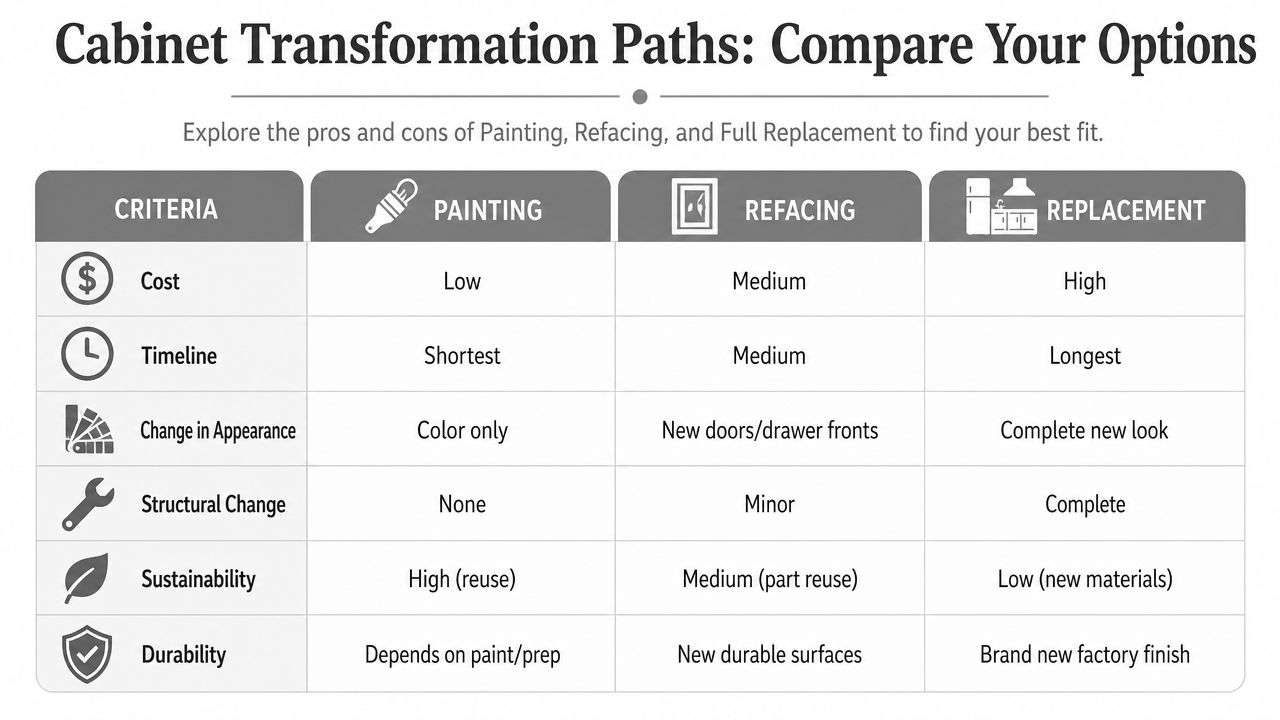
Most cabinet updates fall into three lanes. Painting keeps your existing doors and boxes and changes the finish. Refacing keeps the cabinet boxes but replaces visible fronts, doors, drawer faces, and often hardware. Full replacement removes the old cabinets and starts over with a new layout, new boxes, and new storage options.
The right lane depends on two things. First, whether the cabinet structure is still solid. Second, whether the current kitchen layout still fits how you live. If the boxes are sound and the footprint works, you may not need to tear out the room just to get a cleaner, more current kitchen.
A planning sketch helps before you spend a dollar. If you want to test door styles, aisle spacing, and how new finishes will sit with your counters and flooring, a simple kitchen planner can help you sort the look from the logistics before work starts.
The three update paths in plain terms
| Path | Best for | What changes | What stays |
|---|---|---|---|
| Painting | Solid cabinets with dated finish | Color and hardware | Doors, drawer fronts, boxes |
| Refacing | Solid boxes but outdated door style | Doors, drawer fronts, visible surfaces | Cabinet boxes, most layout |
| Replacement | Damaged boxes or poor layout | Everything | Very little |
Houston homeowners often start by asking what looks cheapest. That's understandable, but it's not the best starting point. Ask what gives you a finish that lasts through humidity, cooking grease, and daily traffic. If you paint swollen particleboard or reface boxes that have softened around the sink base, you haven't saved money. You've delayed a replacement.
Practical rule: Update the surface only after you know the structure deserves to stay.
First Things First Assess Your Current Cabinets
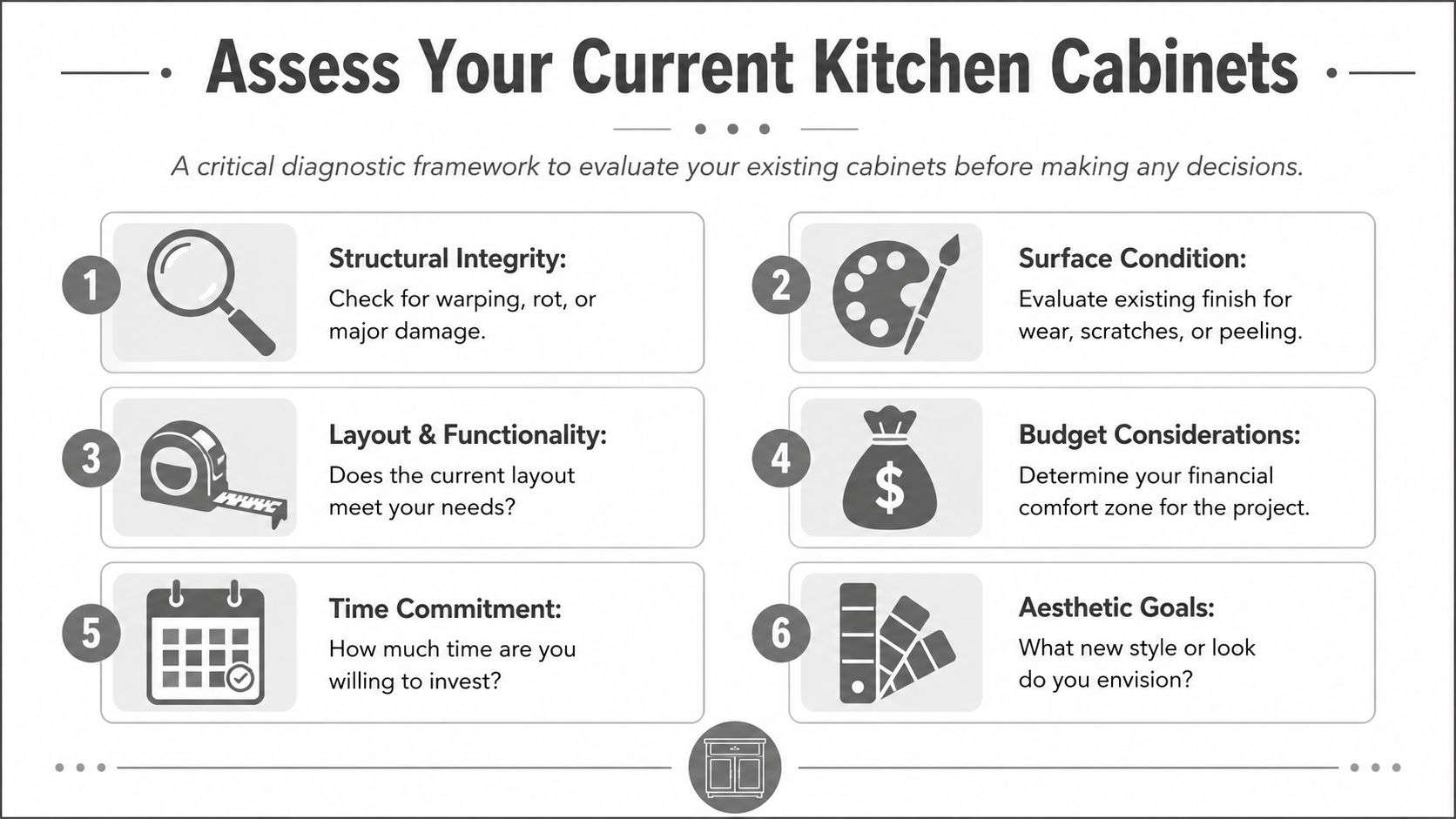
A lot of cabinet guides skip the hardest part. They go straight to paint samples, veneer choices, and hardware finishes. In Houston, that's backwards. Before you decide how to update kitchen cabinets, you need to decide whether these cabinets should be updated at all.
Start with the cabinet boxes
Open every door. Pull every drawer. Don't judge the kitchen from ten feet away. Get your hands on the boxes, face frames, shelves, and bottom panels.
Use this quick inspection list:
- Check for swelling near the sink base, dishwasher, refrigerator water line, and any cabinet touching an exterior wall. Swelling usually shows up first along lower edges, toe kicks, and shelf corners.
- Push on side panels and bottoms. If the material flexes too easily, feels soft, or sounds hollow in a bad way, the substrate may be failing.
- Look for delamination. If laminate or thermofoil is peeling, that may be cosmetic. If the wood composite under it is puffed up or crumbling, that's structural.
- Test hinge screws. If screws won't tighten because the surrounding material is stripped out, you may be beyond a simple door adjustment.
- Inspect shelf sag. A shelf that bows under ordinary dish weight tells you something about the cabinet quality and how much moisture it has absorbed over time.
- Look at door alignment. A crooked door doesn't always mean a bad cabinet. But if several openings are out of square, the box may have shifted.
Houston homes expose cabinets to a rough mix of moisture and temperature swings. Older homes often have sink cabinets that look decent from the front but are weak underneath from years of slow leaks. Homes that have been through storms or minor flooding can hide damage inside the toe kick, behind finished end panels, or under shelf liners.
Check the danger zones Houston homes have
Humidity doesn't ruin every kitchen cabinet, but it does punish weak materials and ignored leaks. Particleboard and low-grade composites are especially vulnerable once water gets into an exposed edge or failed seam. Plywood handles moisture better, but even plywood can separate, warp, or support mold if the cabinet sat wet long enough.
Focus on these trouble spots:
Sink base cabinets
This is the most common failure point. Use a flashlight and look at the floor of the cabinet, not just the plumbing. Staining around supply lines, dark rings under traps, swollen corners, and a spongy bottom panel are warning signs.
Dishwasher adjacent cabinets
Steam and small leaks can beat up the cabinet side next to the dishwasher opening. Run your hand along the inside edge. If it feels rough, bubbled, or expanded, don't assume paint will solve it.
Cabinets on exterior walls
Houston heat, humidity, and occasional water intrusion can create subtle damage where cabinets sit against outside walls. Musty smell matters here. If a cabinet smells damp even when the surfaces look dry, keep investigating.
Floor-level pantry and base cabinets
After a storm event or an unnoticed floor leak, lower boxes can absorb moisture from the bottom up. Remove the lowest shelf if possible and inspect the back corners.
If the box is failing, the finish doesn't matter. A beautiful new door on a weak cabinet is still a weak cabinet.
One overlooked point is the financial risk of skipping this inspection. A 2025 National Association of Home Builders study found that 34% of homeowners who attempted DIY refacing without structural assessment ended up in costly full replacements because of unforeseen box degradation, a risk that's even more relevant in humid coastal regions like the Texas Gulf Coast, as discussed in this cabinet update analysis.
Decide what you are actually saving
Once you've inspected the cabinets, sort them into one of three buckets.
Good candidate for painting or refacing
The boxes are square. Fasteners hold. Bottom panels are firm. There's no active moisture issue. The layout still works.
Borderline candidate
Minor cosmetic damage exists, but the structure seems mostly sound. Maybe one sink base needs repair, or a few doors need replacement while the rest of the run can stay.
Poor candidate
There's warping, rot, repeated water exposure, widespread swelling, or the current layout is so inefficient that preserving it doesn't help.
A cabinet update should improve function, not just appearance. If you already know the kitchen lacks organization, this is also the point to think about inserts, divider systems, and access improvements. Homeowners sorting through corner storage or deep-base cabinet problems can pick up practical ideas from this guide on expert advice for kitchen storage, especially when deciding whether better internal organization can save an existing layout.
The Three Paths to Cabinet Transformation
Once the boxes pass inspection, the work becomes a real comparison. Painting, refacing, and replacement can all work. They just solve different problems.
Painting when the structure is good and the layout still works
Painting is the cleanest answer when you like your cabinet doors, the boxes are solid, and the room mainly needs a visual reset. It works especially well on kitchens with decent bones but dated stain, worn lacquer, or mismatched touch-up history from earlier repairs.
The process matters more than the color.
For cabinet painting to last, prep is the whole job. Surfaces need to be degreased, lightly sanded, primed, and finished with two coats of quality cabinet paint, with cure time before reinstalling and regular use. A common failure point is skipping the cleaning stage. More than 60% of DIY paint failures in kitchens come from poor bond strength tied to skipped degreasing, based on the cabinet painting guidance summarized in this cabinet upgrade resource.
What the real workflow looks like
- Remove doors, drawer fronts, hinges, pulls, and adjustable shelves.
- Label every piece so reinstallation doesn't become guesswork.
- Clean all surfaces with a degreaser. Around cooktops, this step usually takes longer than homeowners expect.
- Sand lightly to dull the old finish and help primer grip.
- Repair minor dents, old hardware holes if needed, and small finish chips.
- Prime. This matters even more when going from dark to light.
- Apply two finish coats.
- Let the finish cure before reinstalling doors and hardware.
The same source notes that cabinets need 24 to 48 hours of cure time before reinstallation and normal use, and that using a hardware jig helps keep new pull placement consistent during updates.
What painting does well
- Keeps costs lower than replacement when the structure is worth saving.
- Changes the room fast without changing the full kitchen footprint.
- Works well with hardware updates and minor trim additions.
- Preserves usable boxes instead of sending them to disposal.
Where painting disappoints
- It won't hide a dated door profile.
- It won't fix bad drawer function.
- It won't make cheap cabinet construction behave like better cabinetry.
- It exposes surface flaws if prep is rushed.
Houston-specific note: painted finishes can hold up well here, but only when the room is dry, vented properly, and free of active moisture problems. If the kitchen has chronic humidity buildup from weak ventilation, address that before you put money into finish work.
Refacing when you need a bigger visual change
Refacing sits in the middle. You keep the cabinet boxes but replace doors, drawer fronts, and the finished skin on visible cabinet faces. For homeowners who dislike the existing door style more than the box layout, refacing can create a much stronger transformation than paint.
This path makes sense when the cabinet boxes are square and stable, but the visible parts feel stuck in another decade. Raised arches, worn slab doors, mismatched repairs, or poor prior paint jobs are common reasons to choose refacing over repainting.
The basic refacing sequence
- Existing doors and drawer fronts come off.
- Exposed cabinet faces get prepared and skinned with matching material.
- New doors and drawer fronts are installed.
- Hinges, drawer hardware, and pulls are updated.
- End panels, moldings, fillers, and toe-kick skins are adjusted to match.
Refacing can also be the moment to improve selected features without a full tear-out. A bank of bad drawers may be rebuilt. A false front can become a functioning drawer. Panels at an island or peninsula can be upgraded so the room feels more custom.
Pros of refacing
| Advantage | Why it matters |
|---|---|
| Stronger visual change | New doors shift the whole style of the kitchen |
| Less demolition | The kitchen shell stays in place |
| Better for good layouts | You keep what already functions |
| Cleaner than replacement | Fewer moving parts in the room |
Limits of refacing
| Limitation | Why it matters |
|---|---|
| Layout stays mostly the same | You're not reworking workflow much |
| Bad boxes stay bad | Structural issues still kill the project |
| Interior storage remains limited | Unless you add inserts or drawer upgrades |
| Finish matching matters | Cheap materials show fast |
Refacing isn't a shortcut around structural judgment. If the cabinet boxes have moisture damage, loose joints, or failing bottoms, refacing is just dressing up a problem.
Replacement when function and structure both need help
Replacement is the right move when the cabinets are damaged, the layout is inefficient, or you want meaningful storage and workflow improvements. It costs more, takes longer, and creates more disruption, but it's the only path that lets you fix every weakness at once.
Homeowners can rethink the kitchen instead of just refreshing it. Drawer stacks can replace hard-to-reach base shelves. Trash can storage can move off the floor and into a concealed pullout. Narrow filler spaces can become tray dividers. Blind corners can be handled more intentionally instead of just disappearing into dead space.
Cabinet design has also changed. Wood-toned cabinetry overtook white for the first time in 2026, with wood tones at 29% and white at 28% among renovating homeowners surveyed, according to the 2026 Houzz trend summary published here. If your kitchen still has a heavy builder-grade look, replacement gives you the chance to move toward warmer, more natural finishes or balanced two-tone combinations that feel current without chasing a fad.
Functional upgrades matter just as much as color. In the same body of renovation data, 94% of updated cabinets in 2026 renovations included specialty storage features, including pullout waste bins, tray and cookie sheet drawers, spice organization, and cutlery storage, as noted in the earlier remodeling cost source. Those are the upgrades that change how a kitchen works every morning, not just how it photographs.
If cabinet replacement is part of a broader remodel, countertop decisions need to happen at the same time because overhangs, splash details, sink placement, and edge profiles all affect the cabinet plan. This guide on how to choose kitchen countertops is a useful companion when you're coordinating the full package.
A replacement project pays off when it solves both appearance and daily frustration. If all you change is the color, you missed the best opportunity.
Budgeting and Timelines for Your Houston Project
Houston cabinet pricing varies more than homeowners expect because local jobs range from simple repaint work to full custom rebuilds after moisture damage. The cabinet line item also swings hard based on how much labor is tied to prep, repair, installation, and trim work.
Where Houston cabinet budgets usually split
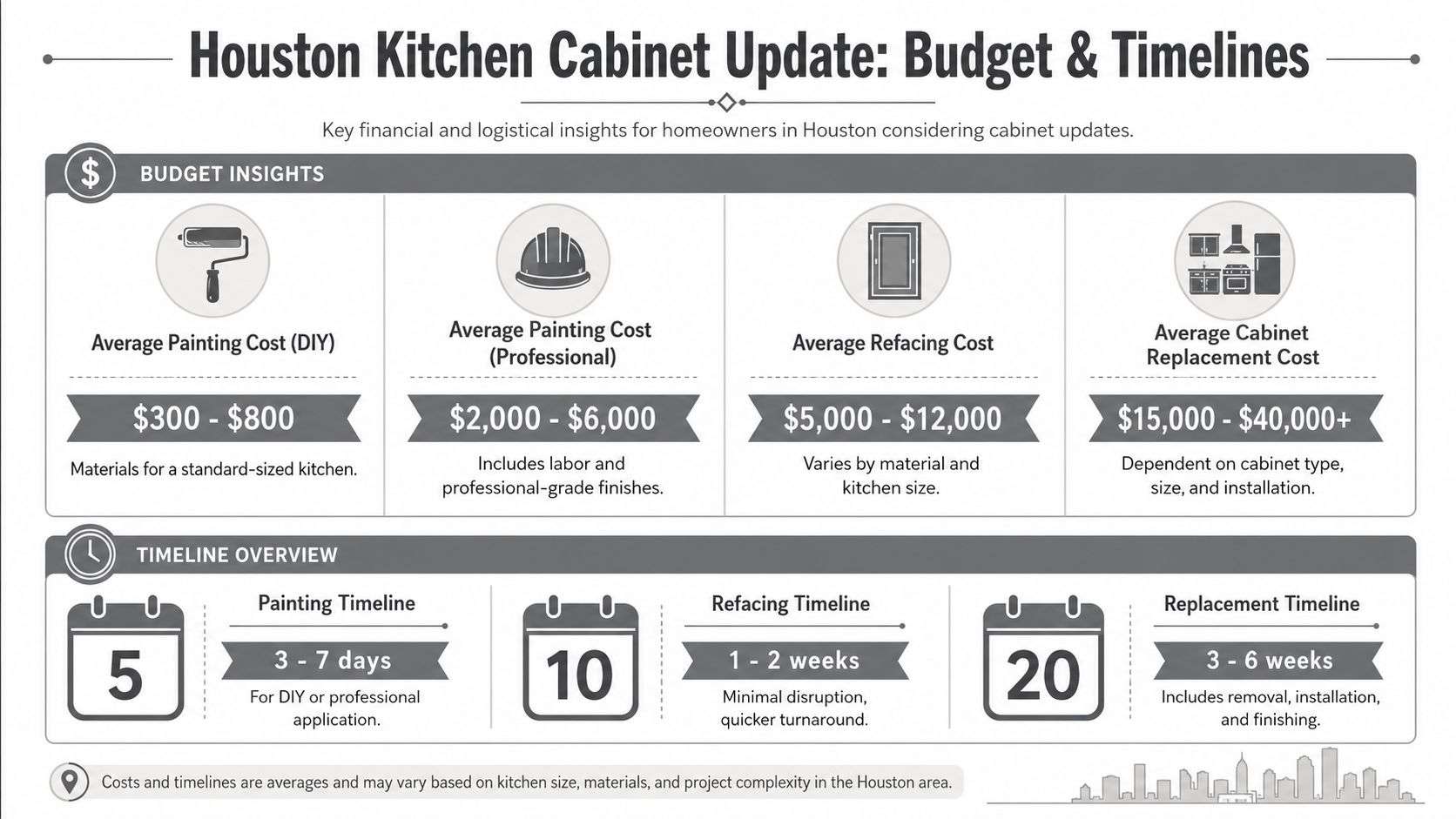
For local planning, this is the cost range that gives homeowners a realistic starting point. In Houston, updating kitchen cabinets costs $1,000 to $3,000 if repainting or refacing, while custom replacement can range from $15,000 to $25,000, based on this Houston kitchen remodel cost guide.
That spread tells you something important. “Updating cabinets” isn't one job. It's several very different jobs under one label.
A whole kitchen budget adds more context. The national average kitchen remodel cost runs about $149 to $215 per square foot, according to research cited in this kitchen remodeling cost breakdown for Houston. Local pricing shifts with kitchen size, material quality, and how much of the room you're changing at once.
Labor is another major factor. In Houston, labor accounts for about 25% to 35% of total kitchen remodeling cost, meaning a $30,000 project may include roughly $7,500 to $10,500 in labor alone, according to this Houston renovation labor cost overview.
What changes the final number
The quoted range isn't the final bill. These are the variables that move the number up or down:
- Cabinet count and kitchen size. More doors, drawers, end panels, and trim pieces mean more labor.
- Material condition. If boxes need repair before painting or refacing, the update gets more expensive fast.
- Door style and finish level. Simple slab fronts cost differently than more detailed profiles.
- Hardware replacement. New pulls, soft-close hinges, drawer slides, and hole drilling add labor and parts.
- Extent of modification. Keeping everything in place costs less than changing cabinet depths, widths, or appliance clearances.
For homeowners looking at painted cabinets specifically, it helps to see how a repaint process is priced and staged in practice. This overview of Newline Painting for cabinet repaints gives a useful example of the prep-heavy nature of cabinet refinishing, even though every local scope differs.
How to think about timing
Timelines depend on access, material lead times, and how much work is bundled into the kitchen. A cabinet-only repaint is usually the shortest path. Refacing sits in the middle because it depends on fabrication and installation coordination. Full replacement takes longest because demolition, layout verification, install, punch work, and adjacent finish trades all come into play.
A practical way to budget is to build from the cabinet decision outward. Start with the update path, then add likely companion work such as countertops, backsplash patching, lighting adjustments, flooring transitions, and trim repairs. If you're trying to map the whole renovation before signing contracts, this guide on how to estimate home renovation costs helps organize the budget in the right order.
Budget check: The cheapest cabinet bid often becomes the expensive job when surface work starts before hidden damage is addressed.
DIY Project or Hire a Houston Pro
Some cabinet projects are reasonable for a skilled homeowner. Some are not. The hard part is that almost everyone thinks they're in the first group until doors go back on crooked, the finish flashes differently under light, or the sink cabinet opens up and reveals damage nobody planned for.
A straight reality check
Ask yourself these questions before you decide:
- Do you have the time to remove, label, clean, sand, prime, paint, cure, and reinstall without rushing the finish?
- Can you spot structural damage instead of assuming every problem is cosmetic?
- Do you have a controlled work area where doors can dry flat and stay clean?
- Are you comfortable drilling for new hardware with repeatable accuracy on every door and drawer front?
- Can you live with your kitchen being partially down while the project runs longer than expected?
If several of those answers are no, DIY gets expensive.
When DIY makes sense
DIY can work when the cabinets are structurally sound, the finish change is simple, the homeowner has patience, and the standards are realistic. A smaller kitchen with straightforward doors and minimal repairs is the best candidate. Hardware swaps, hinge adjustments, shelf organization, and light cosmetic updates are also manageable for many homeowners.
Good DIY cabinet work usually comes from homeowners who treat prep like the project, not the obstacle. They label every part, keep dust under control, let coatings cure, and don't try to compress a multi-stage finish into a weekend.
When a pro is the cheaper decision
Hire a pro when any of these conditions show up:
- Moisture damage is possible around sinks, appliances, or floor-level cabinetry.
- The layout needs modification to improve storage or appliance fit.
- Door replacement or refacing is involved and finish matching matters.
- You want a factory-like result instead of a good-enough room refresh.
- The kitchen is part of a larger remodel involving counters, tile, electrical, plumbing, or permits.
Houston homes also add complications that people underestimate. Humidity changes dry times. Older houses can be out of level. Previous repairs are often hidden behind toe kicks or under laminate skins. Storm and leak history changes the risk profile of what looked like a simple cabinet update.
A licensed, insured remodeler brings a few protections DIY doesn't. They know how to evaluate boxes before recommending a surface update. They sequence cabinet work around countertops and other finish trades. They can rebuild damaged sections instead of trying to paint over them. And if the kitchen is part of a broader project, they can manage the moving parts without each trade blaming the last one.
For homeowners weighing a larger kitchen overhaul in Northwest Houston, this page on a kitchen remodel contractor in Cypress TX gives a sense of what full-service project coordination looks like when the work goes beyond cabinet cosmetics.
Good cabinet work looks easy when it's done right. That's usually a sign that a lot of hard steps were handled before the finish coat ever went on.
Taking the Next Step in Your Kitchen Remodel
The smartest cabinet update starts with honesty. Not optimism. Not inspiration photos. Not a paint chip.
If the boxes are solid and the layout still serves the household, painting or refacing can make real sense. If the boxes are weak, swollen, or out of square, surface updates won't hold up. If the kitchen functions poorly every day, replacement may cost more up front but save you from living with the same frustrations under a better finish.
That's the framework for how to update kitchen cabinets in Houston. Check structure first. Match the method to the cabinet condition. Then build the budget around the scope that solves the problem.

For many homeowners, the next best step is a room-by-room walkthrough with someone who can tell the difference between a cabinet worth saving and one that needs to go. That's especially true after leak history, storm exposure, or years of humidity have put hidden wear into the kitchen.
If you're in Houston, Cypress, Katy, or nearby Gulf Coast communities, get a clear assessment before you commit to the wrong path.
Frequently Asked Questions About Cabinet Updates
Can I paint any kitchen cabinet?
No. Some cabinets can be painted successfully, and some shouldn't be. The deciding factors are the condition of the substrate, the existing finish, and whether moisture has already compromised the box or door. Paint can refresh a sound cabinet. It won't rescue a failing one.
Does Houston humidity ruin painted cabinets?
Humidity by itself doesn't automatically ruin the finish. Ongoing moisture problems do. Poor ventilation, active leaks, and wet cabinet materials cause most failures. If the room stays damp or the box has already swollen, the coating won't be the weak link. The cabinet will.
Is replacing hardware enough to update the look?
Sometimes, yes. New pulls or knobs can sharpen the look of a tired kitchen, especially when the cabinet style is still workable. Hardware alone won't fix bad layout, weak drawers, or a damaged finish, but it can be a strong supporting upgrade.
Do I need permits to update kitchen cabinets in Houston?
Simple cabinet painting or hardware replacement usually doesn't trigger permit issues. Full replacement can be different if the work includes electrical, plumbing, wall changes, or broader remodeling scope. It's smart to verify requirements before demolition starts.
Should I choose painted cabinets or wood tones?
That depends on the door style, the rest of the house, and how long you plan to live there. Painted cabinets still work well in many kitchens. Wood tones have come back strongly because they bring warmth and hide day-to-day wear differently. The better choice is the one that fits the house and the cabinet path you're taking.
If you want a clear, no-pressure opinion on whether your cabinets should be painted, refaced, or replaced, contact H-Towne & Around Remodelers, Inc.. They serve Houston, Cypress, Katy, and surrounding areas with complimentary, no-obligation estimates for kitchen remodeling, bathroom remodeling, and whole home remodeling.