
The rain stops and the house gets quiet. That's usually when Houston homeowners notice the ceiling stain spreading, the wet drywall by the window, the branch on the roof, or the smell that tells you water got in somewhere it shouldn't have.
That first walk-through after a storm can feel bigger than the damage itself. You're trying to figure out what's urgent, what's cosmetic, what insurance will cover, and who you can trust to show up and do the work right. In Houston, where wind-driven rain and fast-rising moisture can turn a small breach into a major interior problem, the first decisions matter.
Storm damage restoration contractors Houston homeowners hire should do more than patch visible damage. They should help stabilize the house, document the loss properly, dry the structure thoroughly, and hand the project off cleanly into repairs or remodeling. That's how you protect both your health and your budget.
After the Storm Your First Look at the Damage
A lot of storm calls start the same way. A homeowner walks into the living room and sees water on the floor, but its source is two rooms away. Wind pushed rain under a lifted roof edge, water traveled through the attic, then dropped through a light fixture or ceiling seam hours later. What looks like one leak can involve roofing, insulation, drywall, flooring, trim, and electrical concerns at the same time.
The first pass through the house should be calm and deliberate. Start with what affects safety. Look for sagging ceilings, standing water near outlets, broken glass, damaged doors, and any area where the structure seems soft or unstable. If something feels unsafe, treat it that way.
What you're usually dealing with in Houston
Houston homes take a different kind of storm beating than homes in drier climates. Water doesn't just hit and leave. It lingers in wall cavities, attic insulation, subfloors, cabinets, and framing. That creates two problems at once: visible repair work and hidden moisture.
Common trouble spots include:
- Roof penetrations and edges: Vents, flashing transitions, valleys, and lifted shingles often let water in before the leak shows indoors.
- Window and door openings: Wind-driven rain can get past failed seals and saturate drywall or framing around openings.
- Attics and insulation: Wet insulation holds moisture and can hide the extent of intrusion until stains appear below.
- Flooring transitions: Water moves downhill and sideways, so adjacent rooms often need inspection even when they look dry.
Don't trust what the eye sees on day one. Storm water has a habit of showing up far from the point of entry.
The good news is that there is a sequence that works. Secure the house. Document everything. Stop ongoing water entry. Dry the structure correctly. Then rebuild with a clear scope. That's the path from emergency response to a stable home again.
The First 24 Hours Critical Emergency Actions
The first day is about safety, documentation, and stopping secondary damage. Not cleanup for appearance. Not deciding finishes. Not arguing with the carrier. Just protecting people and preserving the claim.
Start with safety
Before you move furniture or pull up wet rugs, check for immediate hazards.
- Shut off power to affected areas if water is near fixtures, outlets, appliances, or panel components.
- Stay off the roof. A storm-damaged roof is slick, unstable, and easy to misjudge from the ground.
- Leave the house if needed when ceilings are sagging, water is entering around electrical components, or structural movement is visible.
If you can stay safely, begin recording the condition of the property exactly as it sits.
Document before you touch anything
Insurance disputes often start because the homeowner cleaned up too soon or threw damaged materials away before anyone documented them. Take wide shots first, then close-ups. Get exterior and interior images. Record ceilings, floors, walls, windows, contents, insulation, and debris.
Include:
- Every affected room: Even minor staining matters if damage spreads later.
- The exterior envelope: Missing shingles, bent flashing, gutter damage, broken siding, fence damage, and fallen limbs.
- Personal property: Furniture, rugs, electronics, and stored items that got wet.
- Temporary conditions: Buckets, active drips, pooled water, and visible openings.
Stop the water from getting farther in
Fast action saves real money. Houston contractors often use reinforced temporary roof coverings because an exposed opening can keep feeding damage long after the storm is over.
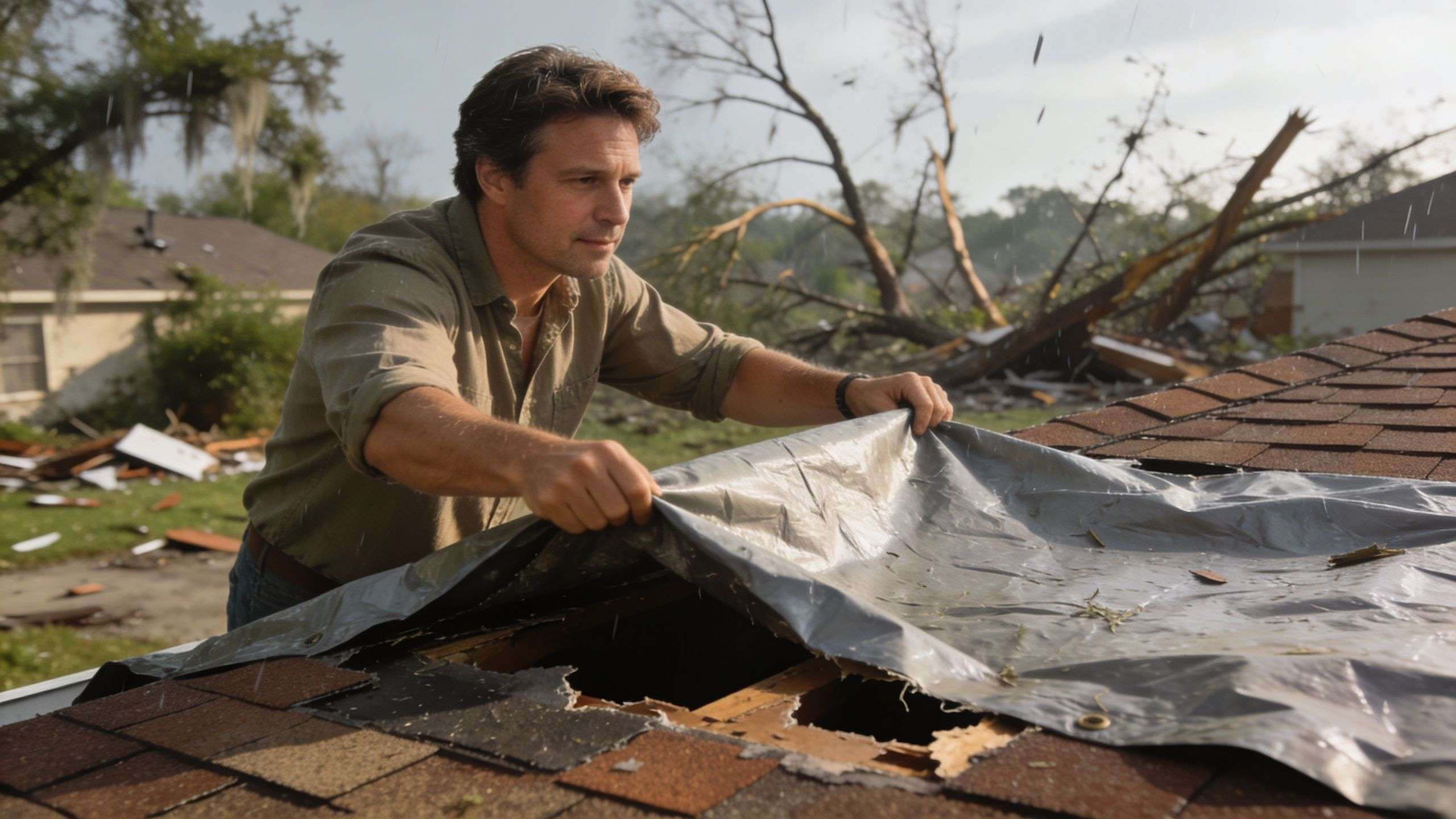
Houston storm restoration experts use advanced roof tarping in the 10-12 mil range, fastened to resist 90 mph winds, and delayed tarping can raise repair costs by 300-500% because water keeps entering through the same breach, according to storm damage repair guidance from Beyond Roofing.
A proper temporary stabilization plan may include:
- Professional tarping: Not a loose sheet with a few nails. It needs secure fastening and edge treatment.
- Board-up work: Broken windows and doors need to be closed in quickly.
- Controlled water removal: Wet contents can be moved, but don't disturb damaged building materials until they're documented.
- A service call from a restoration team: If you need immediate help with stabilization and interior protection, home restoration services when you need it should include emergency response, dry-out planning, and repair coordination.
Practical rule: If water can still get in, your claim and your house both get worse by the hour.
The Professional Restoration Process Step by Step
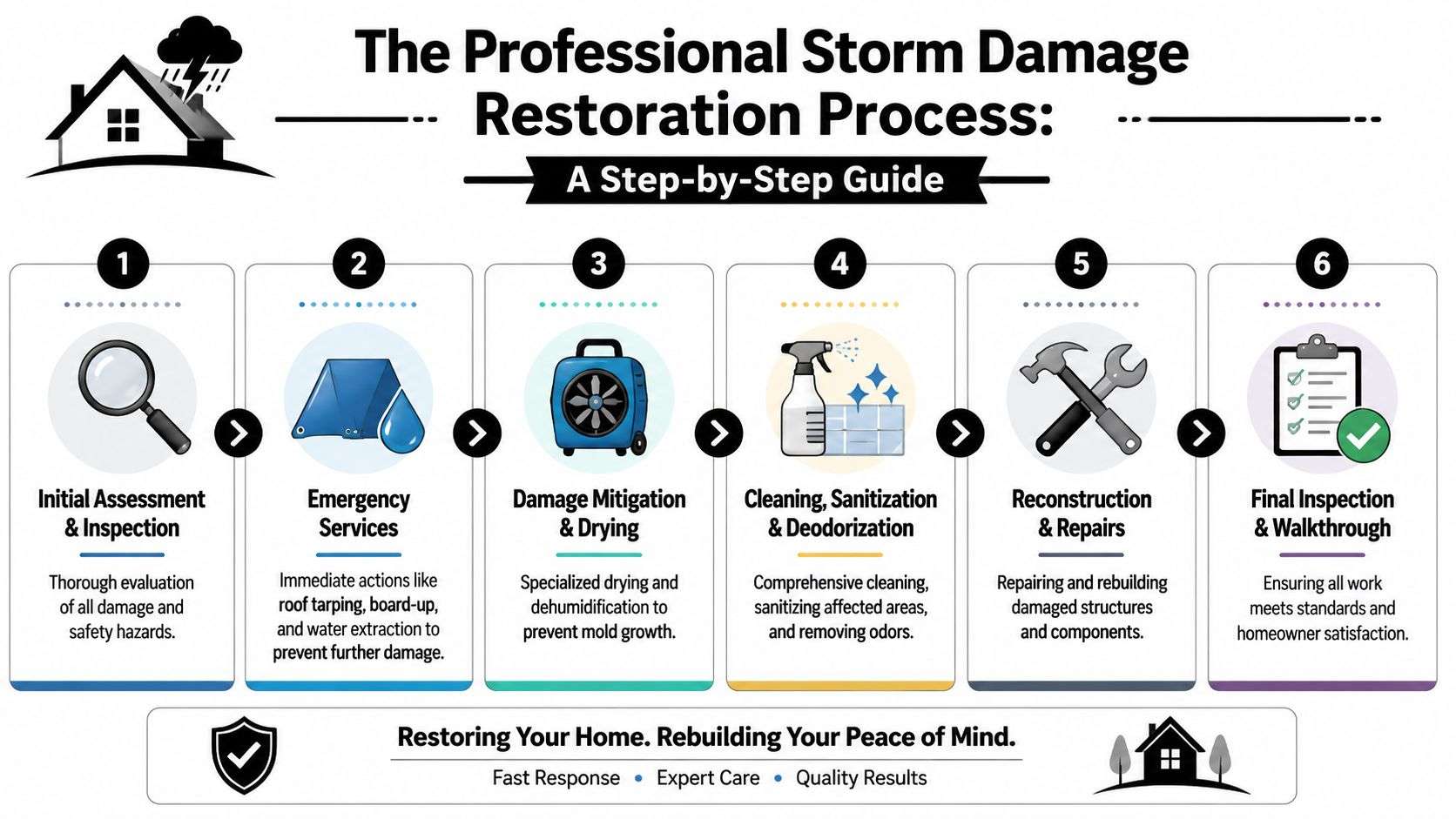
Once the property is safe and stabilized, the work shifts from emergency response to controlled restoration. Good contractors distinguish themselves from patch crews in this phase. Drying a house properly isn't the same thing as making it feel dry.
Assessment goes beyond visible damage
The first serious step is a full inspection of the building envelope and affected interiors. That means roof damage, wall cavities, flooring assemblies, insulation, trim, cabinetry, and attic conditions all get checked. A ceiling stain alone doesn't tell you how far moisture traveled.
In Houston's humid climate, contractors use thermal imaging and moisture meters to build moisture maps that show hidden wet areas. According to Jenkins Restorations in Houston, secondary mold growth can begin in 24-48 hours, and the target is to dry materials to a verified moisture content below 15%.
Water extraction and controlled dry-out
After assessment, crews remove standing water and isolate affected zones. Then they place air movers and dehumidifiers based on the structure, not just wherever there's floor space. Good drying plans are deliberate. They account for airflow, temperature, material type, and how trapped moisture moves through the assembly.
That process usually includes:
- Extraction first: Bulk water comes out before drying equipment goes in.
- Selective demolition: Wet drywall, base, insulation, or cabinetry may need removal so trapped moisture can escape.
- Equipment placement: Air movers and dehumidifiers are positioned to dry framing, sheathing, and subfloor systems evenly.
- Daily or scheduled monitoring: Moisture readings guide adjustments. Equipment shouldn't run on guesswork.
Jenkins notes that this kind of documented drying can restore properties 40% faster and reduce insurance claim size by 25% when compared with conventional methods, based on their Houston restoration guidance in the source above.
If a contractor can't explain where the moisture is, how they're measuring it, and what drying goal they're working toward, they aren't really managing the job.
Cleaning, removal, and rebuild prep
Once the structure reaches dry standards, crews clean affected areas, remove debris, and prepare for reconstruction. This is the stage where homeowners often realize storm damage wasn't just a roofing problem. Flooring transitions, cabinet toe kicks, door casings, insulation, and paint systems all start coming into view.
A clean handoff matters here. If you're comparing options for storm and flood damage restoration, ask whether the same company can carry the job from dry-out into reconstruction, or whether you'll need separate trades for framing, drywall, flooring, cabinetry, and finish work. The smoother that transition is, the fewer delays and finger-pointing you'll deal with later.
| Stage | What a good contractor does | What goes wrong when it's rushed |
|---|---|---|
| Inspection | Maps hidden moisture and checks structural components | Wet areas get missed behind walls or under floors |
| Dry-out | Uses readings to guide equipment and removal | The house feels dry but still holds moisture |
| Cleanup | Removes compromised materials in a controlled way | Odors, staining, and contamination linger |
| Rebuild prep | Creates a clear repair scope for the next trade | Repairs start before the structure is ready |
Navigating Houston Insurance Claims and Permits
The repair work is stressful. The paperwork can be worse. A claim can stall even when the damage is obvious, and that's one reason homeowners need a contractor who documents the house as carefully as they repair it.

In 2025, storm-related claims in Harris County had a 28% denial or underpayment rate, often tied to improper documentation or disputes over policy language, according to storm claim guidance cited on SERVPRO's Town & Country page. That's high enough that homeowners can't afford a casual approach.
What helps a claim hold up
The strongest claims are organized from the start. That doesn't mean inflating the damage. It means proving it.
Use this approach:
- Create a single claim file: Keep photos, videos, receipts, temporary repair invoices, adjuster notes, and contractor estimates together.
- Document the sequence: Show what happened first, what emergency steps were taken, and what damage appeared afterward.
- Get a detailed scope: Broad language like "repair storm damage" is weak. Itemized scopes are harder to dismiss.
- Be careful with cleanup: Don't discard damaged materials until your carrier or contractor has documented them properly.
For homeowners trying to sort out policy language before talking numbers, this guide to understanding storm damage deductibles in Texas is useful because deductible confusion is one of the easiest ways a settlement goes sideways.
What not to say and what not to sign too fast
Insurance conversations are easier when you stick to facts. Describe what you observed, when you observed it, and what emergency mitigation was necessary. Don't guess at causes you can't verify. Don't downplay damage because you're trying to sound reasonable. And don't authorize a vague repair contract before you've seen a written scope.
A few habits protect homeowners:
- Don't speculate: If you're not sure when a leak started, say so.
- Don't rely on phone summaries: Follow important claim conversations with written notes.
- Don't accept a bare-bones estimate as final: If hidden moisture or additional damage appears, supplements may be necessary.
- Don't ignore permit requirements: Unpermitted structural or system work can create trouble later when you sell, refinance, or file another claim.
The adjuster is evaluating a file. Your contractor should be documenting a building. Those are different jobs, and you need both done well.
Permits matter more than people think
Not every temporary emergency measure needs a permit, but permanent repair work often does, especially when the scope reaches structural framing, electrical components, plumbing, major roofing assemblies, or significant interior reconstruction. A qualified contractor should tell you plainly what requires approval and who is responsible for pulling it.
That's not bureaucracy for its own sake. Permits create a record, tie the work to code requirements, and reduce the chance that hidden storm repairs become a problem later. In Houston, that matters because restoration often turns into partial rebuilding.
Understanding Restoration Costs and Project Timelines
Homeowners usually ask two questions once the immediate panic settles down. What is this going to cost, and how long am I going to live with it?
For water damage restoration in Houston, the average cost is $3,074, with most projects falling between $1,067 and $5,169, according to Houston water damage pricing from Angi. That same source lists $2.50 to $6.00 per square foot as a common pricing range, and specialized labor can run up to $160 per hour.
Why one storm job costs far more than another
The visible stain doesn't set the budget. Scope does. A small roof leak caught early may stay in the lower end of the range. A larger event that affects insulation, drywall, flooring, cabinets, trim, and multiple trades climbs quickly.
A realistic estimate usually reflects:
- How much of the structure got wet: One room and an attic chase is different from several connected spaces.
- Material type: Hardwood, built-ins, tile assemblies, and custom finishes take more labor to remove and restore.
- Access and complexity: High ceilings, second-story damage, and tight attic spaces increase labor.
- What has to happen after dry-out: Restoration cost and reconstruction cost are related, but they aren't identical.
Drying is fast compared with rebuilding
Structural drying usually moves faster than finish restoration. The dry-out phase may take several days, while reconstruction can stretch much longer depending on the scope, insurance approvals, material availability, and whether permits are required.
Homeowners often get frustrated at this stage. The fans come out, the moisture readings improve, and it feels like the house should be back to normal right away. But drying only gets you to stable. It doesn't replace insulation, hang drywall, reinstall cabinets, patch flooring, repaint walls, or restore a damaged bath or kitchen.
A simple comparison helps:
| Phase | What happens | What affects duration |
|---|---|---|
| Emergency mitigation | Tarping, board-up, extraction, stabilization | Access, weather, safety issues |
| Dry-out | Equipment setup, monitoring, moisture verification | Material saturation and hidden moisture |
| Scope and approvals | Estimate review, claim coordination, permit handling | Carrier response and paperwork |
| Reconstruction | Repairs, finish work, inspections | Trade scheduling and material lead times |
The smart way to read a bid is to ask which parts are emergency work, which parts are drying, and which parts are rebuild. When those are blended together with no separation, homeowners have a hard time comparing proposals.
Your Checklist for Choosing the Right Houston Contractor
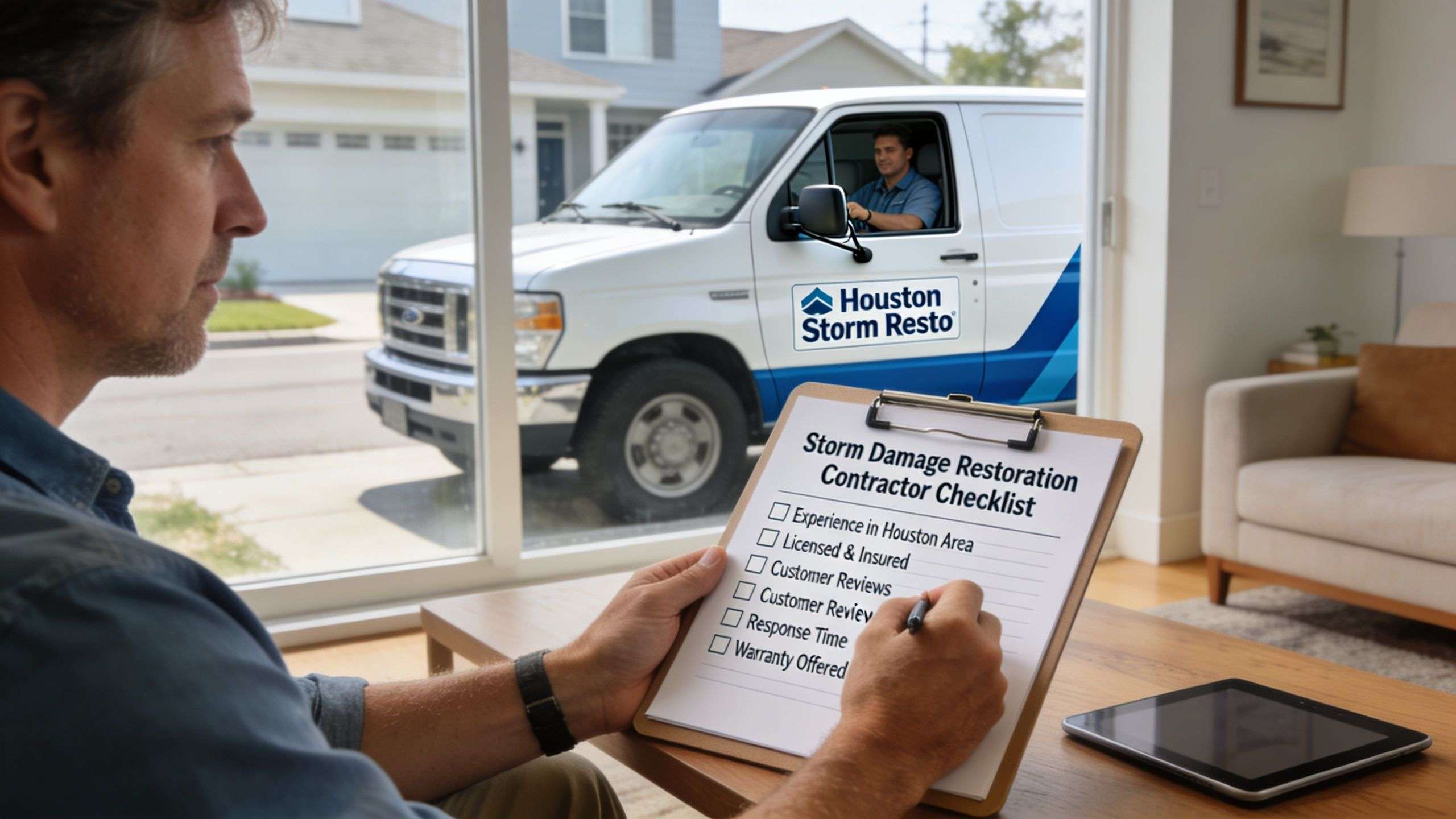
Houston doesn't have a shortage of restoration companies. The BBB Houston restoration category lists over 100 businesses, and some firms have been operating locally for nearly 30 years. That's good in one sense because homeowners have options. It's also why vetting matters so much.
Non-negotiables before you hire
Start with proof, not promises.
- Local track record: Houston storm work has its own pace, permit realities, and weather patterns. You want a contractor who works here regularly.
- Insurance and licensing status: Ask for documentation, not verbal assurance.
- Clear emergency process: They should explain how they stabilize the house before discussing cosmetic repairs.
- Written scope of work: You need itemized work, not a one-line number on a business card.
- Responsiveness: In this market, reputable firms stand out by rapid response, strong BBB history, and modern inspection and drying methods, as reflected in the BBB listing source above.
Questions worth asking on the first call
The answers tell you a lot about how the job will go.
- How do you document storm damage for insurance?
- What do you do first if the roof is compromised and the interior is wet?
- How do you verify that walls, floors, and framing are dry?
- Do you handle reconstruction after mitigation, or do I need to hire additional trades?
- Who handles permit coordination if the scope expands beyond emergency repairs?
Red flags homeowners should take seriously
Some warning signs show up before a crew ever unloads a ladder.
- Large upfront payment demands: Emergency work may require authorization, but pressure for major payment before scope clarity is a bad sign.
- Vague language: If every answer is "we'll take care of it," keep asking.
- No local references or physical presence: Storm-chasing operators come and go.
- Pressure to skip paperwork: That often means skipped permits, poor documentation, or both.
Good contractors lower your stress by making the job more transparent. Bad contractors ask you to trust them more as they explain less.
One practical note for homeowners comparing service models: some companies only dry and demo, while others can move directly into full residential repair. That distinction matters if your storm loss affects kitchens, bathrooms, flooring, cabinetry, or larger renovation work.
From Restoration to Remodel Rebuilding a Better Home
Storm recovery doesn't have to end with putting things back exactly as they were. Once the house is dry, cleaned out, and opened up for repair, many homeowners realize they have a rare window to improve the space at the same time.
A damaged kitchen wall may expose an awkward layout you've wanted to fix for years. A water-damaged bathroom may be the moment to replace worn finishes, upgrade storage, or improve ventilation. If several rooms are affected, the project can shift from isolated repair into a more thoughtful whole-house plan.
That doesn't mean every storm claim should become a major renovation. It means you should look at the opportunity realistically. If cabinetry already has to come out, if flooring already has to be replaced, or if walls are already open, coordinated upgrades can be more practical now than later.
For homeowners thinking beyond basic repair, house renovation options can help connect restoration work to kitchen remodeling, bathroom remodeling, and broader home updates without treating them as completely separate projects.
This is also the one place where a full-service residential contractor can make life easier. H-Towne & Around Remodelers, Inc. handles storm and flood restoration work along with kitchens, baths, and whole-home renovation, which is useful when an insurance-driven repair naturally overlaps with planned improvements. The value isn't hype. It's continuity. Fewer handoffs, fewer scope gaps, and a cleaner transition from emergency work to finished living space.
When your home has taken storm damage, you need more than a patch crew. You need a calm, licensed, insured team that can stabilize the property, document the loss, coordinate repairs, and rebuild the parts of your home that matter most. H-Towne & Around Remodelers, Inc. serves Houston-area homeowners with storm, flood, and fire restoration, along with kitchen remodeling, bathroom remodeling, room additions, and whole-home renovation. If you need a practical next step after a storm, reach out for an estimate and a clear plan.