
If you're planning a kitchen remodel, updating a primary bath, or reworking your whole home in Houston, hardwood is probably on your shortlist. Then the doubt sets in. You know this city is hard on materials. Humidity hangs in the air, slab foundations are common, and one bad leak or storm event can turn a good flooring choice into an expensive problem.
That hesitation is reasonable. But it shouldn't push you into the wrong material by default.
Hardwood can work very well in Houston. The key is choosing the right type of wood, installing it for Gulf Coast conditions, and being honest about where hardwood belongs and where another surface may perform better. That's where most generic flooring advice falls apart. Houston homes need a climate-specific approach, not a showroom pitch.
Why Hardwood Floors Are a Top Choice in Houston
A lot of homeowners start in the same place. They want the warmth and continuity of real wood through the main living areas, especially when they're already investing in a larger remodel. They also see plenty of look-alike products on the market and wonder whether hardwood is still worth it.
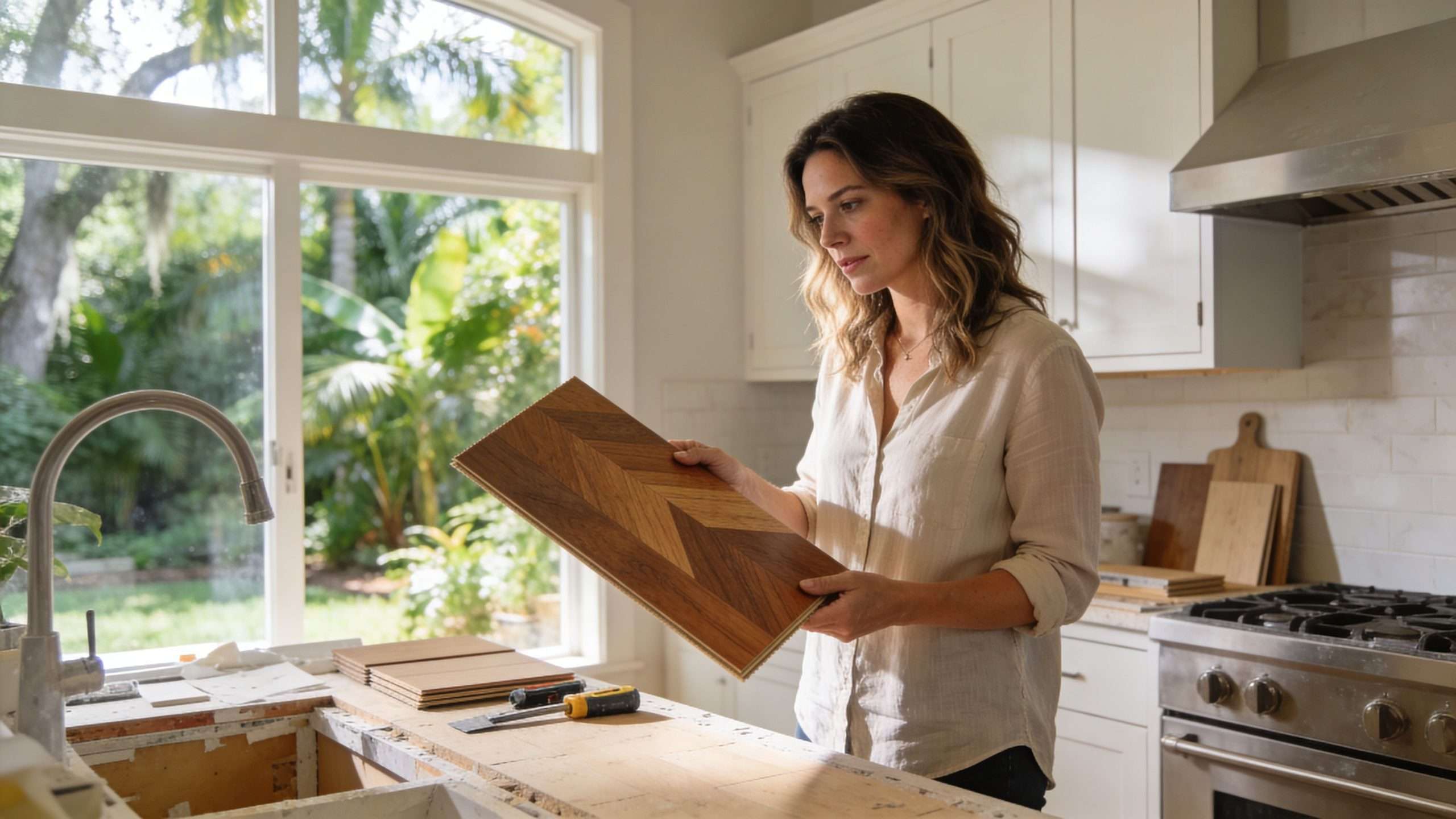
It is, if you want a premium finish and you're willing to install it correctly. Real hardwood gives a house a feel that printed surfaces still struggle to match. In open kitchens, family rooms, hallways, and full-home renovations, wood creates visual continuity that helps the entire remodel read as more intentional.
Hardwood still holds premium appeal
The broader market has shifted. Wood-look floors have taken share because they're cheaper, easier to install, and less sensitive to moisture. Even so, hardwood hasn't disappeared from serious remodeling work.
According to Floor Covering News reporting on hardwood market conditions, the U.S. hardwood flooring industry fell to $1.845 billion in 2024, the lowest level since 2009, and hardwood's share dropped to 12.6% of hard surfaces. At the same time, over 60% of National Wood Flooring Association members expected sales growth in 2025, which points to continued strength in the premium end of the market.
That tracks with what Houston homeowners often want in a major remodel. Not the cheapest floor. The right floor.
Why Houston homeowners keep choosing it
Hardwood remains attractive for a few practical reasons:
- Real material value: Buyers and homeowners usually recognize genuine wood immediately.
- Design flexibility: It works with traditional homes, newer interiors, and mixed-style renovations.
- Long-term fit: In a kitchen or whole-home project, wood often ties the remodeled spaces together better than room-by-room patchwork flooring.
Bottom line: Hardwood isn't the default choice for every room in Houston, but it is still one of the strongest finish materials for the right spaces and the right project scope.
For homeowners planning larger renovations, the best results usually come when flooring is considered as part of the full remodeling plan instead of an afterthought. That's especially true in Houston homes with mixed subfloors, older transitions, or moisture history. Local project context matters, and that's where experience with Houston remodeling work makes a difference.
Understanding Your Options Solid vs Engineered Hardwood
Most hardwood floor houston decisions come down to one question first. Solid or engineered?
The easiest way to think about it is this. Solid hardwood is like a full block of aged cheese. It's one material all the way through. Engineered hardwood is more like that same real cheese layered over a sturdy cracker base. The top is still real wood, but the structure underneath is built for more stability.
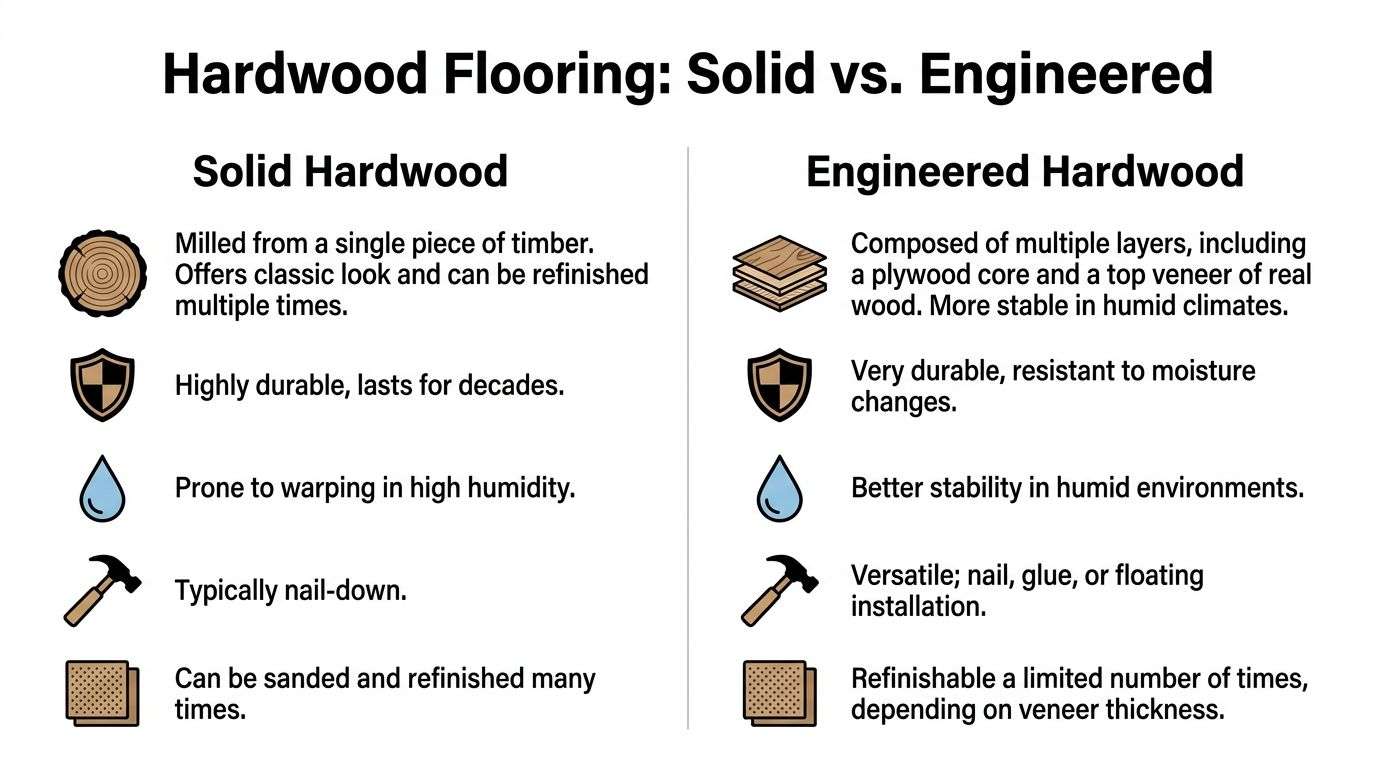
That structural difference matters a lot in Houston.
What solid hardwood does well
Solid hardwood is milled from a single piece of timber. That's the classic product many homeowners picture first.
It has real strengths:
- Refinishing potential: Solid wood can usually be sanded and refinished multiple times over its life.
- Traditional feel: It has the full-depth wood profile that many homeowners prefer.
- Long service life: In the right environment, it can last for decades.
But solid wood asks for discipline. It reacts more sharply to shifts in indoor conditions, and that makes it less forgiving in homes with inconsistent climate control, slab moisture issues, or spaces that see repeated wetness.
Where engineered hardwood makes more sense
Engineered hardwood uses a real wood wear layer over a layered core. That layered construction is why it performs better in many Houston homes.
For practical remodeling work, engineered wood often wins in these situations:
- Concrete slabs: Common in Houston, and usually a better match for engineered products.
- Open-plan remodels: Better dimensional stability helps when flooring runs through long connected spaces.
- Humidity-prone interiors: It generally handles seasonal moisture swings better than solid planks.
The trade-off is refinishing depth. Some engineered products can be refinished, but not as many times as a thick solid floor. How much refinishing you get depends on the wear layer.
A lot of Houston homes don't fail because the homeowner picked "bad hardwood." They fail because the product type didn't match the subfloor, the interior conditions, or the room's exposure to moisture.
A quick side-by-side view
| Feature | Solid hardwood | Engineered hardwood |
|---|---|---|
| Core construction | Single piece of wood | Layered core with real wood top |
| Humidity tolerance | More sensitive | More stable |
| Best common use in Houston | Carefully controlled interiors | Slab homes and wider project applications |
| Refinishing | Usually multiple times | Limited by veneer thickness |
| Installation flexibility | More limited | More flexible |
Sustainability matters more now
Some homeowners want hardwood, but they also want to know where it came from and whether the product supports a more responsible build.
That concern isn't niche anymore. According to this Houston flooring and green remodeling overview, 40% of new Houston builds seek FSC-certified wood. The same source notes that Texas HB 1892 offers a 15% tax credit for certified green remodeling materials, and that policy has been linked to an 18% adoption spike in the Greater Houston area.
For a remodel, that means you can ask better questions than just species and stain color:
- Certification: Is the wood FSC-certified?
- Material composition: Is the engineered core low-emission and appropriate for indoor use?
- Project fit: Does the greener option also make sense for Houston conditions?
The practical choice
If a homeowner wants the most forgiving real-wood floor for Houston living areas, engineered hardwood is often the safer recommendation. Solid hardwood still has a place, especially in tightly controlled interiors and homes where refinishing over many years is a priority.
The right answer depends on the house. Not the showroom label.
Navigating Houston’s Climate Moisture Humidity and Floods
Houston doesn't treat flooring gently. The air is damp for much of the year, slab foundations can pass moisture upward, and storm season changes the risk calculation for every finish material on the first floor.
That's why hardwood floor houston advice has to start with climate, not color.
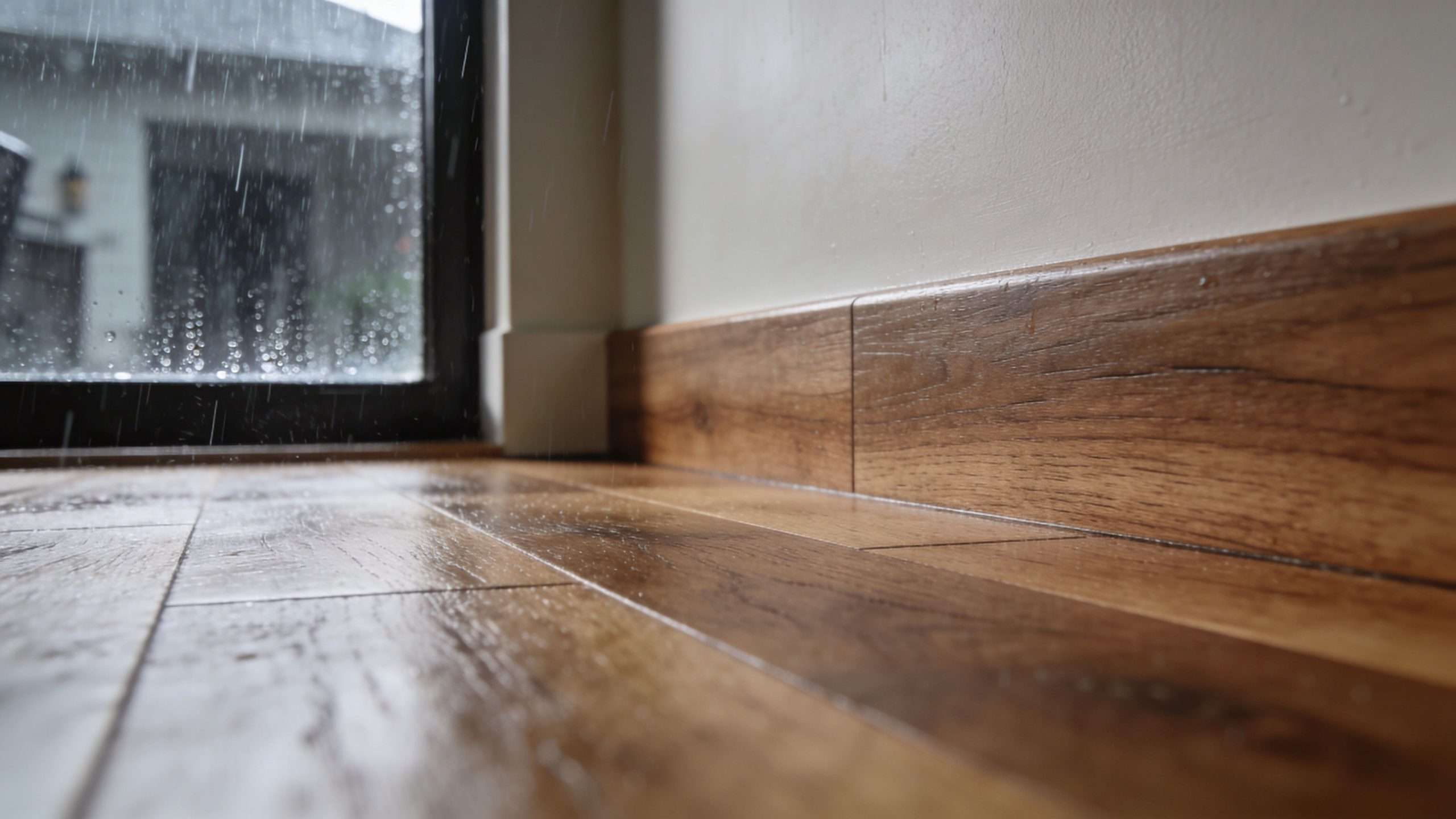
Humidity is a daily issue
Wood is hygroscopic. It takes on and releases moisture from the surrounding air. In a dry climate, that movement can be manageable with standard installation practice. In Houston, the risk is greater because indoor conditions are constantly pushing against the floor.
According to this Houston-specific hardwood climate article, relative humidity often exceeds 70% in Houston. The same source cites ASTM findings showing that engineered hardwood can have 60% to 70% less moisture absorption than solid wood in high-humidity environments.
That's a major reason engineered products often outperform solid planks here. Less moisture absorption usually means less swelling pressure and less visible movement.
What moisture problems look like
Homeowners usually don't notice the problem at the moment the floor starts absorbing moisture. They notice it later, when the boards change shape.
Common failure patterns include:
- Cupping: The board edges rise higher than the center.
- Gapping: Seasonal shrinkage leaves visible spaces between planks.
- Buckling: Boards lift off the subfloor after more severe moisture exposure.
- Finish stress: Coatings can separate or wear unevenly when the wood moves too much.
These aren't random defects. In Houston, they're often signs that the floor, the subfloor, and the indoor environment weren't managed as one system.
Flooding is a different category of risk
Humidity is one problem. Flooding is another.
A storm event, plumbing leak, appliance failure, or exterior water intrusion can push hardwood past the point where normal seasonal movement is the issue. Once standing water gets involved, decisions have to be made quickly. Drying, containment, material triage, and subfloor assessment matter more than cosmetic appearance in the first phase.
The same Houston source notes a 25% rise in inquiries for waterproof and resilient flooring options following recent storms. That makes sense. After homeowners see what water can do to a first-floor finish, they start asking harder questions about resilience.
If a house has flood history or a realistic flood exposure concern, the flooring conversation should change. You may still use hardwood in some areas, but the specification needs to be more conservative.
Not every Houston home should get the same hardwood recommendation. A raised house in a controlled interior and a slab-on-grade house with prior water intrusion are two different jobs.
For homes with prior storm or water damage, flooring decisions should be coordinated with broader drying and rebuilding work, not handled in isolation. That's where teams experienced in storm and flood damage restoration usually catch problems that a flooring-only installer can miss.
What works better in this climate
The homes that do best with hardwood in Houston usually follow a few consistent rules:
- They control indoor humidity year-round.
- They choose the product around the subfloor and risk profile.
- They don't install hardwood in wet-prone spaces just because the sample looks good.
- They treat water events as structural problems first and flooring problems second.
The takeaway for material selection
If moisture control is uncertain, solid hardwood becomes a much riskier bet. Engineered wood gives you a wider margin for error, but it isn't waterproof and it isn't flood-proof. That's an important distinction.
Practical rule: In Houston, "real wood" and "carefree" do not belong in the same sentence. The floor can perform beautifully, but only if the house supports it.
The Hardwood Installation Process for Houston Homes
Good hardwood installation in Houston starts before the first board comes out of the box. Most failures begin lower down, with the subfloor, the moisture conditions, or the decision to rush.
The visible surface gets the attention. The prep work decides whether the floor lasts.
Start with jobsite conditions
For a successful Houston installation, NWFA-aligned guidance in these installation requirements calls for maintaining 35% to 55% relative humidity and keeping the wood's moisture content within 4% of the subfloor's. The same guidance requires subfloor flatness within 3/16 inch over 10 feet and a 1/2-inch expansion gap around the perimeter.
Those aren't optional details. They're basic survival rules for wood flooring in this climate.
Before installation, the interior should already be operating like a lived-in house. HVAC should be on. Wet trades should be complete. Interior conditions should be stable enough that the wood can acclimate to the environment it will live in.
Concrete slab homes need extra scrutiny
A large share of Houston homes sit on concrete slabs, and that changes the installation strategy.
Concrete can look dry and still carry enough moisture to damage wood flooring over time. That means the slab has to be checked, not guessed at. Flatness matters too. If the floor rolls, dips, or crowns beyond tolerance, the hardwood above it will telegraph those defects.
On slab projects, contractors should pay close attention to:
- Moisture control: Use the right vapor-management approach for the chosen product and system.
- Surface prep: High spots need grinding, and low areas may need approved leveling materials.
- Adhesive compatibility: Glue-down systems must match the flooring product and the slab condition.
Pier-and-beam homes have their own risks
Older Houston houses often have wood subfloors over crawl space or pier-and-beam construction. These can be excellent candidates for hardwood, but only if the framing and subfloor are stable.
Look for squeaks, bounce, prior patching, and any signs that moisture has entered from below. If the subfloor moves, the finish floor moves with it. Installing beautiful planks over a weak base just hides the problem temporarily.
Installation method matters
Different products and house conditions call for different methods. There isn't one "best" method for every Houston home.
Nail-down
Nail-down is common with traditional wood installations over suitable wood subfloors. It provides a solid feel underfoot and works well when the framing and subfloor are in good shape.
It's less useful where concrete is involved unless a sleeper or plywood system is built, which adds complexity.
Glue-down
Glue-down is common for engineered hardwood over slabs. Done correctly, it can provide a firm, quiet floor with good stability.
The catch is prep. Glue-down exposes every surface defect, so slab flatness and adhesive selection have to be right.
Floating
Floating systems can work well with some engineered products, especially where minor substrate variation exists or the design calls for a specific underlayment approach.
They aren't a shortcut. Perimeter expansion space, transitions, and substrate prep still matter.
The method should fit the product and the house. If the installation plan sounds identical for every project, it probably isn't designed enough for Houston conditions.
Small details prevent big failures
The little items are where rushed jobs often come apart:
- Expansion space: That 1/2-inch perimeter gap gives the floor room to move seasonally.
- Transitions: Doorways, material changes, and long runs need clean planning.
- Layout direction: Board direction affects both appearance and performance.
- Cabinet sequencing: In kitchen remodels, flooring and cabinetry need to be coordinated carefully.
A kitchen project is a good example. If the floor height changes, that affects appliances, island clearances, and trim details. Hardwood can't be treated as an isolated trade.
What homeowners should ask before work starts
A qualified installer should be able to answer these clearly:
- What type of subfloor do I have, and what prep does it need?
- How will indoor humidity be managed before and during installation?
- Which installation method fits this product and this house?
- Where will expansion space be left?
- How will transitions, baseboards, and adjacent rooms be handled?
If those answers are vague, the risk is high.
Budgeting for Hardwood Floors in Houston
Hardwood pricing in Houston isn't one number. It moves with the wood species, product quality, layout complexity, neighborhood expectations, subfloor condition, and how much prep the house needs before installation can even start.
The most useful budget is the one that separates the visible material from the hidden work.
What Houston homeowners can expect
According to this Houston hardwood flooring cost breakdown, installed hardwood flooring in Houston averages $12 to $50 per square foot. That same source notes that pricing in Houston Heights (77018) can reach $65 per square foot, while East Houston (77044) ranges from $7 to $40 per square foot.
The same source also reports that hardwood flooring typically recoups 70% to 80% of its installation cost at resale, and homes with hardwood often sell faster.
That resale angle matters most when the flooring is part of a coherent remodel. A well-executed wood floor in the main living areas usually supports the overall perception of quality.
Where the money goes
A hardwood proposal usually includes several layers of cost:
- Material selection: Species, grade, plank width, and finish level all shift the price.
- Labor: Straightforward rooms cost less to install than cut-up layouts with many transitions.
- Demolition and removal: Existing flooring may need to be removed and hauled away.
- Subfloor correction: Moisture issues, leveling, and repairs can add significantly.
- Trim work: Baseboards, shoe molding, thresholds, and reducers affect the final total.
One reason estimates vary so much is that some contractors price only the floor itself, while others price the floor plus everything required to make the job look finished.
Sample Hardwood Flooring Budget for a 500 sq. ft. Houston Project
| Cost Item | Average Low End | Average High End | Notes |
|---|---|---|---|
| Installed hardwood flooring | $6,000 | $25,000 | Based on $12 to $50 per sq. ft. installed |
| Higher-end neighborhood range | N/A | $32,500 | At $65 per sq. ft. in areas such as Houston Heights |
| Lower local range example | $3,500 | $20,000 | At $7 to $40 per sq. ft. in areas such as East Houston |
| Subfloor and finish complexity | Varies | Varies | Usually depends on site conditions, layout, and trim scope |
| Resale recoup potential | Qualitative | Qualitative | Source notes 70% to 80% cost recoup at resale |
Budgeting without surprises
The cleanest way to budget is to ask for a scope that spells out what's included and what isn't.
Look for clarity on these points:
- Prep work included or excluded
- Material allowance or exact product
- Baseboard and transition treatment
- Furniture moving responsibility
- Disposal of old flooring
- What happens if hidden moisture or subfloor damage is found
A cheap hardwood number often becomes an expensive hardwood job once the necessary prep work shows up.
For kitchen, bath-adjacent, and whole-home projects, flooring cost should be reviewed alongside cabinets, trim, paint, and door clearances. That's where budget accuracy gets much better.
How to Choose a Licensed Houston Flooring Contractor
Hardwood in Houston is not a product-only decision. It's a contractor decision.
A great board installed badly will still fail. An average board installed with disciplined prep and local judgment will often outperform expectations. That's why contractor selection matters as much as wood selection.
Look for Houston-specific experience
Any contractor can say they install hardwood. The better question is whether they understand what Houston homes do to hardwood.
That means they should be able to speak comfortably about:
- Slab versus pier-and-beam conditions
- Indoor humidity control
- Moisture testing and acclimation
- Transitions across remodel zones
- Storm or leak history and how it changes recommendations
A contractor who mainly sells flooring may miss issues tied to the larger house. In real remodeling work, flooring intersects with cabinets, appliances, trim, doors, and sometimes structural repair.
Ask for a project process, not just a price
Good contractors can explain how the work will happen.
Ask for:
- A site evaluation of the existing floor and subfloor.
- A written scope of prep, installation method, and finish details.
- A plan for protecting adjacent areas during the work.
- Clear communication about what could change the price.
- Warranty language that defines what is covered.
If you get only a square-foot number with no method behind it, that's not enough for Houston hardwood.
The best flooring contractors don't just tell you what product to buy. They tell you what can go wrong in your specific house and how they'll prevent it.
Verify the business fundamentals
Before signing anything, confirm the basics:
- Licensing and insurance: You want current documentation, not verbal assurance.
- Local portfolio: Look for work in Houston-area homes, not generic stock photos.
- Detailed contract: Material, prep, payment schedule, and exclusions should be written down.
- References or testimonials: Focus on communication, cleanliness, and follow-through, not just appearance on day one.
Whole-home remodelers often manage flooring better
In many Houston projects, the hardwood isn't a stand-alone job. It's part of a kitchen remodel, a bathroom renovation nearby, or a larger whole-home update.
That's where a remodeler with broad trade coordination often has an advantage. They can align flooring with cabinetry, millwork, paint schedules, appliance installation, and permit-related project sequencing. If you're evaluating that kind of partner, it's worth reviewing the scope of Houston remodeling services they handle beyond the floor itself.
Red flags to take seriously
A few warning signs show up repeatedly:
- No discussion of moisture or humidity
- No mention of acclimation
- One installation method recommended for every house
- No written treatment for subfloor correction
- Pressure to commit before the house is properly assessed
Those are not minor issues. In Houston, they usually mean the contractor is pricing speed, not durability.
Conclusion Creating Lasting Value with Your New Floors
Hardwood remains one of the best finish choices for the right Houston home. It brings warmth, permanence, and a level of material quality that still stands apart from look-alike products.
But success here depends on realism. Houston's humidity, slab foundations, and flood exposure change the rules. The best outcomes usually come from choosing a product that fits those conditions, often engineered hardwood, and installing it with strict attention to moisture, subfloor prep, and expansion planning.
That's why hardwood should be treated as part of the remodel strategy, not just a decorative upgrade. In kitchens, bath-adjacent spaces, and whole-home renovations, the floor has to work with the house as it performs.
If you approach hardwood that way, it can be a strong long-term investment and a daily-use surface that still looks right years from now. If you skip the climate-specific details, even expensive materials can disappoint.
Frequently Asked Questions About Houston Hardwood Flooring
Can hardwood be used in Houston kitchens
Yes, in many kitchens it can. The safer approach is to use a product and finish system that fits the home's moisture profile and daily use. Kitchens see spills, appliance connections, and repeated cleaning, so fast cleanup and proper installation details matter.
Engineered hardwood is often the more practical choice when the kitchen sits on a slab or opens into large connected living areas.
Is hardwood a good idea in bathrooms
Usually, full hardwood isn't the first recommendation for a bathroom. Bathrooms create repeated moisture exposure from showers, tubs, sink splash, and humidity spikes.
In a powder room, homeowners may have more flexibility. In full baths, many remodelers prefer other materials that handle wet conditions with less risk.
How long does a hardwood project take
The timeline depends on the condition of the house, the type of product, and whether the flooring is part of a larger remodel. Demolition, subfloor correction, acclimation, and trim work all affect scheduling.
A good contractor should give you a sequence, not just a finish date.
What's the best way to maintain hardwood in Houston
Keep indoor conditions steady. Use climate control consistently, clean spills quickly, and avoid letting moisture sit at the edges of planks.
Routine care usually works better than aggressive cleaning. Harsh wet mopping and over-saturation are common mistakes.
Does engineered hardwood look less real than solid hardwood
No. The top layer is still real wood, so the visible surface can look excellent. The difference is in the construction underneath, not in the fact that the wear layer is genuine wood.
What most homeowners notice more than product type is board quality, finish quality, and installation quality.
When should I avoid hardwood entirely
Be cautious in rooms with repeated wet exposure, in homes with unresolved moisture problems, or on first floors with significant flood risk history. In those cases, a different finish may be the smarter long-term move.
Choosing against hardwood in one zone doesn't mean giving up the look and value of wood in the rest of the house.
If you're planning a kitchen remodel, bathroom update, whole-home renovation, or rebuilding after water damage, H-Towne & Around Remodelers, Inc. can help you make the right flooring decision for Houston conditions. Their licensed, insured team handles design assistance, remodeling, and restoration work across Greater Houston, with practical guidance on where hardwood makes sense, how it should be installed, and how it fits into the larger project. Reach out for a complimentary estimate and design consultation.